

💬 This article is for educational purposes and isn’t a substitute for medical diagnosis. If you’re currently unwell, please see the “When to See a Doctor” section below or speak with a healthcare provider directly.
Parasite From Mexico Symptoms
Quick answer: Parasite from Mexico symptoms usually include watery diarrhea, stomach cramps, bloating, nausea, fatigue, and sometimes weight loss, depending on the parasite involved. In more severe cases, this shows up as frequent, sudden, explosive diarrhea. Symptoms often begin days to weeks after exposure and may need specialized stool testing to properly diagnose.
Quick Facts: Parasites Linked to Mexico Travel
| Parasite | Time to Symptoms | Contagious Person-to-Person? | Typically Treatable? |
|---|---|---|---|
| Giardia | 1–3 weeks | Yes | Yes, with antiparasitic medication |
| Cyclospora | 2 days–2 weeks | No (needs contaminated food/water) | Yes, though it can relapse |
| Cryptosporidium | 2–10 days | Yes | Often self-limiting; medication available if needed |
| Entamoeba histolytica | Days to weeks | Yes | Yes, with antiparasitic medication |
| Chagas disease | 1–2 weeks (acute phase) | No (insect-borne, not person-to-person) | Yes, especially if treated early |
You got home from Mexico. The photos are already on your phone, the tan is fading, and everything should be back to normal by now. Except your stomach never got the memo.
Maybe it’s cramping that won’t quit. Maybe it’s a bathroom trip that comes on so fast and hard you barely make it, what a lot of my patients simply call “explosive diarrhea.” Whatever it is, you’re not imagining it, and you’re not the only one asking the same question in my inbox every week: is this a parasite from Mexico?
I run NFH Clinic, and post-travel digestive complaints are one of the things we see the most. So let’s go through this properly, what actually causes these symptoms, what’s just normal travel tummy, and what’s a genuine explosive diarrhea parasite outbreak that needs a doctor’s attention.
In this article:
- First, a Quick Reality Check
- Interesting Twist: The Current Outbreak Isn't Coming From Mexico
- The Parasites Most Often Linked to Travel in Mexico
- Common Parasite From Mexico Symptoms, At a Glance
- Explosive Diarrhea Parasite Outbreak: Why This Symptom Gets So Much Attention
- Traveler's Diarrhea vs. a Real Parasite: How to Tell the Difference
- When to See a Doctor
- What Recovery Actually Looks Like
- Prevention Tips That Actually Hold Up
- Key Takeaways
- Frequently Asked Questions
- Sources
First, a Quick Reality Check
Most stomach trouble after a Mexico trip isn’t a parasite at all. It’s usually what people casually call “Montezuma’s revenge”, bacterial traveler’s diarrhea, not a parasitic infection. According to Mayo Clinic, the majority of traveler’s diarrhea cases come from bacteria, not parasites, and Mexico sits on the list of higher-risk destinations right alongside Central America, South America, and parts of Africa and Asia. In other words, your gut isn’t being dramatic, it’s reacting to a genuine change in the bacteria and water quality it’s used to.
That said, parasites are a real and separate category, and they behave differently than ordinary travel diarrhea. Bacterial “traveler’s diarrhea” tends to hit fast and, left untreated, typically clears up in about 3 to 7 days on its own. Parasites are patient. They can sit quietly for one, two, even several weeks before you notice anything, and once they do show up, they tend to overstay their welcome, sometimes for weeks or months if they go untreated.
That distinction matters, because it changes what you should do next. It also matters afterward: some people who go through a bacterial or parasitic gut infection develop lingering digestive sensitivity for months once the infection itself is gone, a pattern doctors call post-infectious IBS. It’s not permanent for most people, but it’s one more reason not to brush off a “recovered” gut that still doesn’t feel right.
Interesting Twist: The Current Outbreak Isn’t Coming From Mexico
Here’s something worth knowing, and it’s actually the opposite of what most headlines assume. In July 2026, Mexico’s own Ministry of Health issued a travel advisory, not about Mexico, but warning its citizens about a growing outbreak in the United States.
As of late July 2026, the CDC has confirmed nearly 2,000 lab-verified cases tied to a specific multistate outbreak across 9 states, with the heaviest concentration in Michigan, Ohio, Kentucky, and West Virginia. A broader nationwide uptick in cyclosporiasis cases, not all connected to this single outbreak, has also been reported across 34 states this season.
Investigators traced the outbreak to iceberg lettuce from Taylor Farms de Mexico, sourced from a farm in central Mexico, which was recalled in mid-July. These figures are still moving,case counts for active outbreaks typically climb for weeks after an initial recall, so check the CDC’s outbreak page for the latest tally.
So if you’ve seen “explosive diarrhea parasite outbreak” trending in the news lately, this is likely what people are talking about, a Cyclospora cayetanensis outbreak tied to contaminated produce, not something you’d catch by lying on a beach in Cancún. It’s a good reminder that parasite exposure isn’t only a “foreign travel” problem. Contaminated greens can travel just as easily as people do.
Still, if you’ve recently been to Mexico, the traditional list of travel-related parasites is still worth knowing well.
The Parasites Most Often Linked to Travel in Mexico
1. Giardia (Giardiasis)
Giardia is one of the most common parasites picked up worldwide through unsafe water, and Mexico is no exception. It spreads through contaminated water, food rinsed in that water, or close contact with someone who’s infected.
Typical symptoms, according to Mayo Clinic, include:
- Watery, often foul-smelling loose stools (sometimes greasy)
- Bloating and excess gas
- Stomach cramps
- Fatigue
- Unexplained weight loss
Symptoms usually start one to three weeks after exposure and can drag on for two to six weeks if untreated. One quirk worth knowing: giardia often does not raise your eosinophil count (a type of white blood cell doctors check for parasitic infection), so a “normal” blood test doesn’t automatically rule it out. Stool testing is what actually confirms it.
2. Cyclospora (Cyclosporiasis)
This is the parasite behind the “explosive diarrhea” headlines. Per the CDC, Cyclospora infects the small intestine and typically causes watery diarrhea with frequent, and yes, sometimes explosive bowel movements. It can also bring nausea, bloating, fatigue, loss of appetite, and low-grade fever.
Symptoms tend to show up around a week after exposure, though it can range from two days to two weeks or longer. Left untreated, cyclosporiasis can drag on for a month or relapse just when you think it’s cleared. Standard stool tests often miss it too, since it needs specific lab testing that isn’t part of a routine panel, so if you suspect it, tell your doctor directly and ask for Cyclospora-specific testing.
3. Entamoeba histolytica (Amebiasis)
Amebiasis is common in regions with limited sanitation infrastructure, and Mexico is listed among higher-risk countries by Cleveland Clinic, alongside India, Pakistan, Bangladesh, and parts of Africa and South America.
Most infected people have no symptoms at all, which is part of what makes this parasite sneaky. When symptoms do appear, they include:
- Belly pain or cramping
- Diarrhea, sometimes with blood
- Fever
- Nausea and vomiting
Left unchecked, it can occasionally spread beyond the gut to the liver, so it’s not one to shrug off if symptoms persist.
4. Cryptosporidium (“Crypto”)
Crypto is a waterborne parasite you’ll find worldwide, including in Mexico’s water supply and pools, and it’s a genuine traveler’s-diarrhea culprit that often gets overlooked next to giardia and cyclospora.
Per the CDC, symptoms typically start 2 to 10 days after exposure (about a week on average) and include:
- Prolonged, watery diarrhea
- Stomach cramps or pain
- Nausea and vomiting
- Low-grade fever
- Dehydration
Symptoms usually clear up within one to three weeks in people with healthy immune systems, though they can wax and wane for up to 30 days. One frustrating trait it shares with the others on this list: Crypto is resistant to chlorine, so it can survive in pools and water parks even where the water looks and smells “clean.”
5. Chagas Disease (Trypanosoma cruzi)
Chagas is less common in short-term travelers, but it’s worth knowing about since Mexico is one of the countries where it occurs, transmitted by the “kissing bug,” which bites near the mouth and leaves the parasite in its droppings near the bite site.
Mayo Clinic notes that most acute infections are mild or symptom-free, but when symptoms appear they can include swelling near the bite, fever, fatigue, body aches, and swollen glands. Symptoms usually surface within one to two weeks of exposure. The bigger concern is the chronic phase, which can surface 10 to 20 years later as serious heart problems.
The reassuring part: tourists staying in hotels are rarely exposed, since the bug prefers mud, adobe, or thatch housing rather than resorts. Chagas also isn’t spread through contaminated food or water the way Giardia or Cyclospora are, which is exactly why it’s a much less common cause of diarrhea in returning travelers, even though it’s worth knowing about if you’re staying somewhere rural.
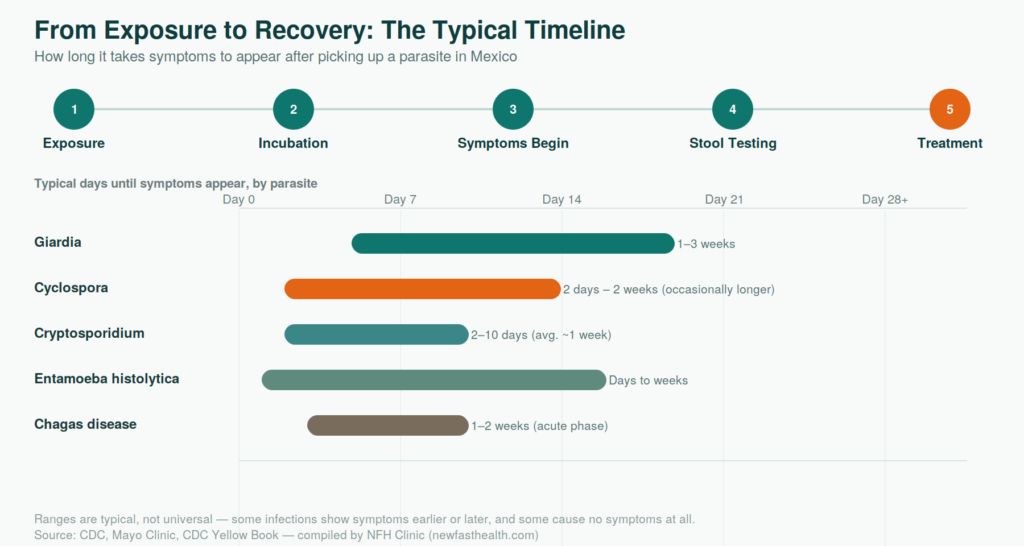
Parasite Incubation Periods at a Glance
| Parasite | Typical Time to Symptoms |
|---|---|
| Giardia | 1–3 weeks |
| Cyclospora | 2 days–2 weeks (occasionally longer) |
| Cryptosporidium | 2–10 days (average ~1 week) |
| Entamoeba histolytica | Days to weeks |
| Chagas disease | 1–2 weeks (acute phase) |
Common Parasite From Mexico Symptoms, At a Glance
Across giardia, cyclospora, amebiasis, and crypto, these are the symptoms that show up again and again:
- Watery diarrhea, sometimes explosive and frequent
- Greasy, floating, or foul-smelling stools (classic for giardia)
- Sulfur-smelling burps or breath
- Bloating and excess gas
- Stomach cramps and urgency
- Nausea, occasional vomiting
- Fatigue
- Unexplained weight loss
- Low-grade fever
- Dehydration signs: dry mouth, dizziness, dark urine, reduced urination
Not every parasite causes every symptom, and mild or symptom-free infections are common. But if several of these are stacking up together, especially two or more weeks after a trip, it’s worth getting tested rather than waiting them out.
Explosive Diarrhea Parasite Outbreak: Why This Symptom Gets So Much Attention
Let’s talk plainly about the phrase everyone’s searching for right now.
“Explosive diarrhea” isn’t just a dramatic way of describing a bad day. It’s actually the term the CDC itself uses to describe classic Cyclospora symptoms — frequent, sudden, and forceful watery stools. When people online talk about an “explosive diarrhea parasite outbreak,” this is generally the parasite behind it.
Here’s why it matters clinically, not just uncomfortably:
- It signals rapid fluid loss. Explosive, frequent diarrhea drains your body of water and electrolytes fast, which raises your risk of dehydration, especially in children, older adults, and anyone with an existing health condition.
- It often means the infection is active and progressing, not settling down, which is different from the tail end of ordinary traveler’s diarrhea.
- It’s a signal to get tested, not just to wait it out. Regular stool panels can miss parasites like Cyclospora and Giardia, so if your symptoms fit this pattern, ask specifically for parasite-focused testing.
Traveler’s Diarrhea vs. a Real Parasite: How to Tell the Difference
I get asked this constantly, so here’s the simplest way to think about it.
Here’s the same comparison in table form:
| Symptom Pattern | Likely Traveler’s Diarrhea | Possibly a Parasite |
|---|---|---|
| Onset | Sudden, during or right after the trip | Can appear 1–3 weeks (or longer) after returning |
| Duration | Typically 3–7 days untreated, then resolves | Lingers for weeks or months if untreated, may relapse |
| Stool | Loose, watery | Watery, greasy, foul-smelling, sometimes bloody |
| Response to rest | Usually resolves on its own | Rarely resolves without treatment |
| Extra clues | Mild cramping, nausea | Bloating, fatigue, weight loss, gas |
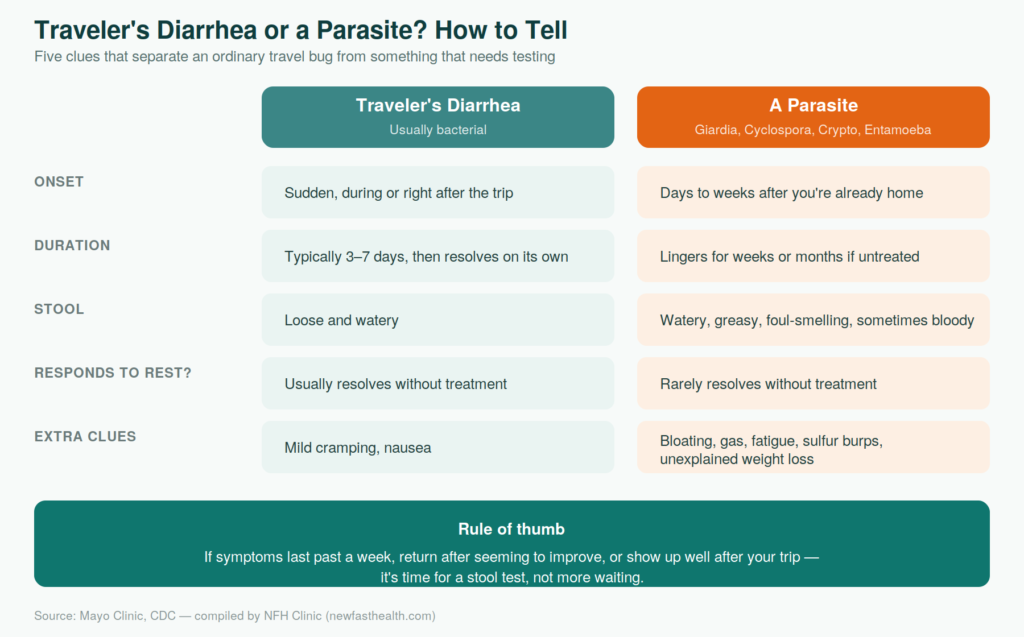
If your symptoms match the right-hand column, or you’re still dealing with digestive chaos two or more weeks after landing, it’s time to stop guessing and get a stool test.
When to See a Doctor
Please don’t wait it out if you notice any of the following:
- Diarrhea lasting more than a few days, or returning after seeming to improve
- Blood in your stool
- Fever above 102°F (39°C)
- Signs of dehydration — dry mouth, dizziness, very little urination
- Ongoing fatigue, bloating, or weight loss weeks after your trip
A simple stool test, sometimes repeated over a few days for accuracy, is usually all it takes to identify what’s actually going on. Many clinics now use multiplex GI PCR panels, which can screen a single stool sample for several bacteria, viruses, and parasites at once. That said, some parasites, including Cyclospora, may still need separate, specifically requested testing depending on the lab your doctor uses. Once identified, most of these parasitic infections respond well to the right medication.
Higher-Risk Groups
Anyone can get one of these infections, but a few groups are more likely to end up with a severe or prolonged case: young children, older adults, pregnant individuals, and anyone with a weakened immune system, whether from an underlying condition or immune-suppressing medication. If you fall into one of these groups and develop diarrhea after a Mexico trip, it’s worth seeing a doctor sooner rather than waiting to see if it passes.
What Recovery Actually Looks Like
Once you’ve got a diagnosis and started treatment, recovery is usually straightforward:
- Stay hydrated. Water alone isn’t enough if you’ve been losing fluids fast, oral rehydration solutions or electrolyte drinks replace what plain water can’t.
- Ease back into eating. Bland, low-fat foods (rice, toast, bananas, broth) are gentler on a recovering gut than anything greasy or heavily spiced.
- Reintroduce fiber gradually. Jumping straight back to raw vegetables or whole grains can aggravate a gut that’s still settling.
- Finish the full course of medication, even once you feel better. Stopping early is one of the more common reasons symptoms relapse.
- Go back if symptoms don’t fully clear. Some people need a second round of treatment or a different medication if the first one doesn’t fully resolve things, that’s a normal part of the process, not a failure.
Prevention Tips That Actually Hold Up
None of this is about avoiding Mexico, it’s one of the most visited countries in the world for good reason. It’s about traveling smart:
- Stick to bottled or properly boiled water, and skip ice unless you know it was made from purified water.
- Peel fruit yourself rather than eating pre-cut produce.
- Avoid raw vegetables and salads unless you trust how they were washed.
- Wash your hands often, particularly before eating.
- Keep your mouth closed in the shower, and avoid swallowing pool or lake water.
- If you’re staying somewhere rural with mud, adobe, or thatch walls, use bed netting and insect repellent at night.
Simple habits like these cut your risk dramatically, without turning your trip into a stress test.
Key Takeaways
- Most post-Mexico stomach trouble is bacterial traveler’s diarrhea, not a parasite, and usually clears in 3–7 days on its own.
- Parasites behave differently: they can take one to several weeks to show symptoms and tend to linger without treatment.
- “Explosive diarrhea” is specifically associated with Cyclospora, though other parasites can cause severe symptoms too.
- Standard stool tests can miss some parasites, ask for specific or repeat testing if symptoms persist.
- Most parasitic infections are very treatable once properly diagnosed.
Frequently Asked Questions
How soon do parasite from Mexico symptoms start after I get home?
It varies by parasite. Giardia usually takes one to three weeks. Cyclospora can take anywhere from two days to two weeks or more. That’s exactly why so many people are shocked when symptoms appear well after they’ve unpacked their suitcase.
Is explosive diarrhea always a sign of a parasite?
Not always, but it’s a strong clue, especially when paired with a recent trip, bloating, fatigue, or symptoms lasting more than a few days. It’s worth getting checked rather than assuming it will pass.
Can a stool test miss a parasite?
Yes, this happens more often than people expect. Parasites like Cyclospora and Giardia sometimes need specialized testing or multiple stool samples on different days to be detected. If your doctor’s first test comes back clear but symptoms persist, ask about repeat or specific parasite testing.
Do I need antibiotics if I think I have a parasite?
Not necessarily; treatment depends on which parasite is confirmed. Some are treated with antiparasitic medication, others with specific antibiotics. This is exactly why testing before treatment matters instead of guessing.
Are resorts and hotels safer than rural areas in Mexico?
Generally, yes, for exposure to things like Chagas disease, since the “kissing bug” prefers mud, adobe, or thatch buildings rather than modern hotels. However, waterborne and foodborne parasites like Giardia, Cyclospora, and Entamoeba can still occur anywhere food or water handling isn’t consistent, resorts included.
Can I spread a parasite to my family once I’m home?
Some, yes. Giardia and Entamoeba histolytica in particular can spread person-to-person through the fecal-oral route, meaning contaminated hands, shared bathrooms, or food prep are the usual paths, not casual contact. Careful handwashing, especially after using the bathroom and before cooking, is your best protection for the rest of the household while you’re being treated.
Can a parasite infection go away without treatment?
Sometimes, but it’s not something to count on. Mild giardia or crypto infections occasionally resolve on their own over several weeks as your immune system clears them. Cyclospora and amebiasis are far less predictable and can relapse or, in the case of amebiasis, spread beyond the gut if left alone. If you already suspect a parasite, getting a proper diagnosis is a safer bet than waiting to see what your body does with it.
Should I stay home from work or school while symptomatic?
Yes, at least until diarrhea has settled, particularly if you work in food handling, healthcare, or childcare. Since several of these parasites spread through the fecal-oral route, that’s also the window when you’re most likely to pass it on to others.
Do probiotics help with a parasite infection?
There isn’t strong evidence that probiotics can treat or clear a diagnosed parasitic infection on their own, so they shouldn’t replace proper antiparasitic treatment. Some people use them alongside recovery to support general gut health once treatment is underway, but if you suspect a parasite, testing and the right medication should come first.
Sources
- Giardia infection — Mayo Clinic
- Traveler’s diarrhea — Mayo Clinic
- About Cyclosporiasis — CDC
- Post-Travel Evaluation of Parasitic Disease — CDC Yellow Book
- Investigation Update: Cyclospora Outbreak, July 2026 — CDC
Related Articles: