I get asked about the benefits of putting your legs up on the wall more than almost anything else in my practice. A patient will mention it almost sheepishly, as if lying on the floor with your legs propped against a wall is too simple to actually work. And every time, I tell them the same thing: sometimes the simplest habits carry the biggest payoff.
I’m McLee Tembo, founder of NFH Clinic, and over the years I’ve recommended legs-up-the-wall to tired nurses, new mothers, desk-bound professionals, and anxious clients who couldn’t switch their brains off at night. Below, I’ll walk you through exactly what this pose does for your body, who should be cautious, and how to get the most out of it, no yoga background required.
Quick Facts
| Also known as | Viparita Karani |
| Type of pose | Passive, restorative inversion |
| Best for | Swollen legs, tired legs, stress, trouble sleeping |
| Typical duration | 2–15 minutes |
| How often | Once or twice daily |
| Equipment needed | A wall (or a bed/pillows as an alternative) |
| Best time of day | Evening, though morning works too |
| Who should avoid it | Glaucoma, congestive heart failure, uncontrolled high blood pressure, severe fluid retention, kidney/liver failure, serious neck or spine conditions |
| Not proven to help with | Weight loss, fertility/conception |
Key takeaways
- This restorative yoga pose supports venous return, easing swollen ankles and tired legs after a long day.
- It’s one of the simplest relaxation techniques for calming a racing mind before bed.
- It won’t help you lose weight or conceive faster — but it’s still worth doing for the benefits it does deliver.
- Most healthy adults can practice it daily; a few conditions (glaucoma, heart failure, uncontrolled high blood pressure) call for caution.
Benefits of Putting Your Legs Up On the Wall, at a Glance
- Supports venous return and reduces swollen feet and ankles
- Promotes relaxation and eases perceived stress
- Supports better, faster-onset sleep
- Relieves tired legs and gently stretches the lower body
- May ease stress-related bloating
- Doubles as a low-effort recovery pose after exercise or travel
In this article:
- What Is Legs-Up-the-Wall Pose (Viparita Karani)?
- Benefits of Putting Legs Up on Wall
- Who Benefits Most From Putting Their Legs Up on the Wall?
- Benefits of Putting Legs Up on Wall for Female Health
- Can Legs Up the Wall Help You Get Pregnant?
- Legs Up the Wall Weight Loss: Myth or Reality?
- Benefits of Putting Legs Up on Wall Before Bed
- Legs Up the Wall in Bed
- Spiritual Benefits of Putting Legs Up on Wall
- 4 Things That Happened When I Tried Legs Up the Wall Every Night for a Week
- How to Put Your Legs Up on the Wall Safely (Step-by-Step)
- How Long and How Often Should You Do Legs Up the Wall?
- Best Time to Put Your Legs Up on the Wall: Morning vs. Evening
- Common Mistakes to Avoid With Legs Up the Wall
- Who Should Avoid Putting Their Legs Up on the Wall
- Frequently Asked Questions
- Final Thoughts
- Resources
What Is Legs-Up-the-Wall Pose (Viparita Karani)?
In Sanskrit, viparita means “inverted” and karani means “in action.” Put together, it describes a gentle inversion — a position where your legs sit higher than your heart while the rest of your body stays relaxed on the floor.
Unlike a headstand or shoulder stand, there’s no weight on your neck, no balance required, and no risk of straining your spine. That’s exactly why I recommend it to people who’ve never rolled out a yoga mat in their life. You just need a clear patch of wall, a few free minutes, and a willingness to do absolutely nothing for a while.
Benefits of Putting Legs Up on Wall
1. Better Circulation and Less Leg Swelling
This is the benefit my patients notice fastest. When you’re on your feet all day, or glued to a desk chair, gravity pulls blood and fluid down into your calves and ankles. Over time, that shows up as puffiness, heaviness, or the first signs of varicose veins.
Flip that around by raising your legs above heart level, and gravity now works in your favor. This leg elevation temporarily improves venous return — blood drains back toward your heart more easily, which takes pressure off tired veins and eases that end-of-day swelling for a while. It’s not a permanent fix for circulation issues, but as a daily recovery pose, it adds up.
This is especially worth trying if you’re:
- On your feet for long shifts (nurses, teachers, retail and hospitality workers)
- A frequent flyer dealing with post-flight ankle swelling
- Managing early signs of venous insufficiency
2. Supports Lymphatic Drainage
This point often gets left out of articles on this topic, and it shouldn’t. Your lymphatic system doesn’t have a pump like your heart — it relies on muscle movement and gravity to move fluid through the body. Elevating your legs may temporarily assist lymphatic fluid return through gravity, which is one reason massage therapists often suggest this pose as a follow-up to lymphatic drainage massage or after a hard workout. It’s a gentle assist, not a deep-tissue treatment substitute.
3. Calms Your Nervous System
Legs-up-the-wall nudges your body toward the parasympathetic nervous system — out of “fight or flight” and into “rest and digest.” Your heart rate slows and your muscles let go of gripped tension. Evidence on cortisol specifically is mixed, but the pose reliably promotes relaxation and helps reduce perceived stress, which is what most people are actually chasing.
You don’t need a clinical study to notice this one. Most people feel it within the first two or three minutes: a kind of quiet settling, as though someone turned the volume of the day down a few notches.
4. Better Sleep Quality
Because it relaxes both body and mind, this pose works well as a wind-down ritual. It’s particularly useful if your thoughts tend to race the moment your head hits the pillow.
5. Eases Muscle Tension and Fatigue
Tight hamstrings, sore calves, cranky hips, an achy lower back — this pose gently stretches all of them without forcing anything. Because the wall does the work, there’s no strain, which makes it safe even on days your body already feels beaten up.
6. May Ease Bloating and Digestive Discomfort
This pose won’t cure a digestive condition, but stress and digestion are closely linked. When you calm the nervous system, you often take some pressure off a tense gut too. Think of it as setting the right internal conditions, not a fix in itself.
7. Takes the Edge Off Minor Aches
Some people find relief from tension headaches, mild lower back pain, and general soreness. The evidence here leans anecdotal rather than clinical, but plenty of my patients keep this pose in their toolkit for exactly this reason.
A quick note on evidence: research is strongest for relaxation and temporary relief of leg swelling. The rest of these benefits are backed by smaller studies, clinical experience, or a mix of both — worth knowing so you set realistic expectations.
Who Benefits Most From Putting Their Legs Up on the Wall?
In my clinic, four groups get the most out of this habit:
- Office workers and anyone desk-bound — counters hours of sitting with a quick reset for the legs and lower back.
- Nurses, teachers, and retail staff — relieves the heaviness that builds up after shifts spent standing.
- Frequent travelers — eases swollen ankles after long flights or drives.
- Athletes and active people — works well as a recovery pose after training, alongside stretching and hydration.
Pregnant women can benefit too, with the modifications covered below.
Benefits of Putting Legs Up on Wall for Female Health
This is one of the questions I get asked most in consultations, so it deserves its own section.
During PMS and your period: Restorative poses like this one, done consistently as part of a broader routine, have been linked in small studies to fewer sleep disturbances during PMS. It also gently reduces the bloating and pelvic heaviness that often shows up around your cycle, and it takes pressure off a lower back that’s already cramping.
Hormonal fluid retention: Many women notice more swelling in the feet and ankles in the days before their period. Since this pose directly targets fluid pooling in the legs, it’s a natural fit here.
Pregnancy: This is where I ask patients to slow down. In the first and second trimester, many women can do a modified version safely — feet up a wall with hips well away from it, never lying flat on the back for long stretches. In the third trimester, lying flat on your back can compress a major vein and isn’t recommended. If you’re pregnant, check with your OB or midwife before trying any inversion, and stop immediately if you feel dizzy or short of breath.
Menopause: Hot flashes, disrupted sleep, and tired legs are common complaints I hear from patients in this stage of life. This pose isn’t a treatment for menopausal symptoms, but many women find it genuinely relaxing and helpful for tired legs after a long day — a small, low-effort addition to a broader routine.
Can Legs Up the Wall Help You Get Pregnant?
I want to be straight with you here, because this question comes up a lot and deserves an honest answer rather than a hopeful one. There’s no scientific evidence that elevating your legs after intercourse improves your chances of conceiving. The idea sounds logical — “let gravity help things along” — but sperm movement isn’t governed by gravity in that way, and fertility specialists don’t recommend it as a technique.
What this pose can genuinely do is lower stress, and chronic stress is known to disrupt hormonal cycles. So while propping your legs up won’t act as a fertility hack, using it as part of a broader stress-reduction routine isn’t a bad idea. If you’re actively trying to conceive, your time is better spent with a reproductive endocrinologist than with a stopwatch and a wall.
How long should you keep your legs up to get pregnant? Some people stay in the position for 10–20 minutes after intercourse, based on anecdotal advice passed around online. But to be clear, there’s no evidence this timing — or the position itself — increases the odds of conception, so fertility specialists don’t recommend relying on it as a conception strategy.
Legs Up the Wall Weight Loss: Myth or Reality?
Short answer: no, this pose will not burn meaningful calories or melt fat. I’ve seen this claim spread on social media, usually paired with a “get skinny fast” hook, and I want to clear it up plainly because it’s misleading.
What it can do is support the conditions around weight management — better sleep, lower stress-driven cravings, and reduced bloating that can make you feel lighter the next morning. There’s also a quieter benefit worth mentioning: better recovery between workouts can indirectly support exercise consistency, and consistency is what actually drives results over time. That’s a real benefit, just not the one going viral. If weight loss is your goal, this pose is a nice recovery habit to pair with proper nutrition and movement, not a shortcut around them.
Benefits of Putting Legs Up on Wall Before Bed
I recommend this as a bedtime habit more than almost any other wellness tip I give. Ten to twenty minutes before you turn off the lights, it helps in a few specific ways:
- Slows a racing mind so you’re not lying awake replaying the day
- Releases physical tension built up from sitting or standing all day
- Signals to your body, through slow breathing and stillness, that it’s time to shift into sleep mode
- Reduces the leg heaviness that can make it hard to get comfortable
- Takes the edge off bedtime anxiety by activating the parasympathetic nervous system, the same system responsible for that “rest and digest” feeling
Pair it with slow nasal breathing or a short body scan, and it becomes one of the easiest sleep rituals you’ll ever build. What makes it especially effective isn’t any single night, it’s doing it consistently enough that your body starts to recognize it as the cue that bedtime is coming.
Legs Up the Wall in Bed
Don’t have a clear wall next to your mat, or simply prefer to stay under the covers? You can absolutely do this in bed. Lie on your back and rest your legs up against your headboard, or simply stack two or three firm pillows under your calves and ankles to lift them above heart level. If you have an adjustable bed, raising the foot section works just as well and takes even less setup.
One honest note: propped up on pillows or a headboard, this isn’t technically Viparita Karani anymore — the angle and support are different from the traditional wall version. But it still elevates your legs above heart level, which is what drives most of the circulation and relaxation benefits, and it’s the easiest version to fall asleep straight after.
Spiritual Benefits of Putting Legs Up on Wall
Beyond the physical, many long-time practitioners describe this pose as a small daily practice in surrender — a chance to stop doing and simply be held by the floor and the wall for a few minutes. In yogic tradition, inversions like this are said to turn attention inward, quiet mental chatter, and create a sense of groundedness.
I’ll be honest with you: there’s no clinical way to measure a “spiritual benefit,” and I won’t pretend otherwise. But plenty of people use this pose as a moment of stillness or informal meditation, and that quiet pause has value on its own, whatever you want to call it.
4 Things That Happened When I Tried Legs Up the Wall Every Night for a Week
I put this pose to the test myself for seven straight nights, mostly out of curiosity about whether my own patients were exaggerating. Here’s what actually happened:
- My ankles stopped feeling puffy by day three. After long clinic days on my feet, my ankles used to feel tight by evening. That eased up noticeably within the first few nights.
- I fell asleep faster. Not dramatically, but consistently — somewhere around ten minutes quicker most nights, which added up over the week.
- My lower back felt looser in the morning. I hadn’t connected my mild morning stiffness to how I sit during the day until this made it obvious.
- The first two nights felt boring, and that was the point. I kept reaching for my phone out of habit. By night four, ten minutes of doing nothing had become the most restful part of my day.
None of this is a clinical trial of one person, and I won’t pretend it is. But it matched almost exactly what I hear from patients week after week.
How to Put Your Legs Up on the Wall Safely (Step-by-Step)
1. Set up your space. Lay a mat or blanket on the floor next to a clear wall. A folded towel or thin pillow under your hips is optional but comfortable. If you have them, a yoga bolster or a firm folded blanket under the hips, and a yoga block under the lower back, can make the pose easier to hold for longer.
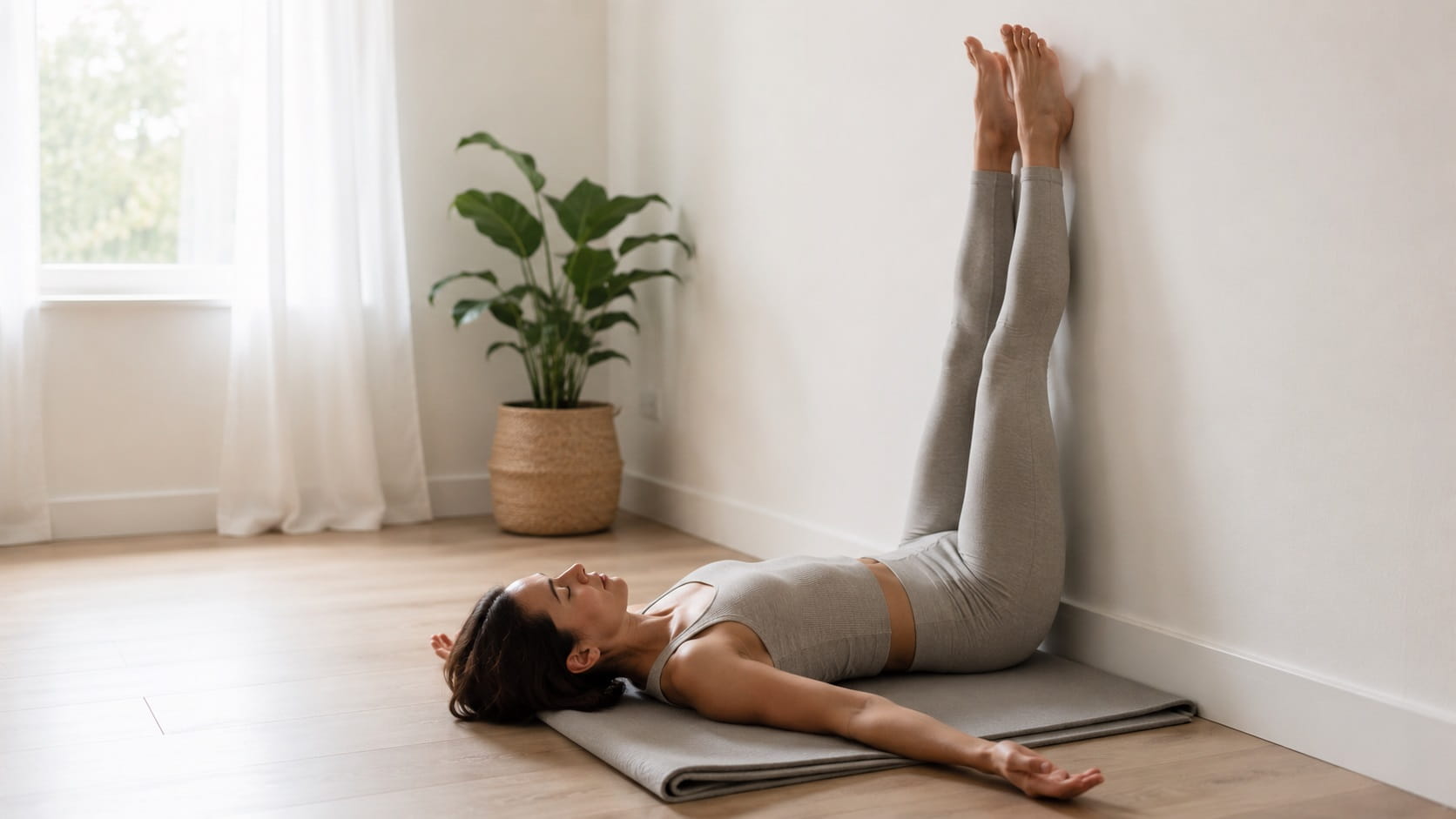
2. Get into position. Sit sideways with one hip touching the wall, then swing your legs up as you lower your back to the floor. Your hips can rest right against the wall or a few inches away, whichever feels better.
3. Settle in. Let your back and head relax fully on the floor. Arms rest by your sides, palms facing up. Keep your knees soft rather than locked straight.
4. Breathe. Close your eyes and slow your breathing down. Let the wall and the floor do all the work — you don’t need to hold or engage anything.
5. Hold for the right amount of time. Beginners can start with 2–3 minutes. For deeper relaxation, work up to 5–15 minutes.
6. Come out slowly. Bend your knees, roll gently onto one side, and sit up for 30 seconds before you stand. Standing up too fast after this pose can leave you lightheaded.
How Long and How Often Should You Do Legs Up the Wall?
This pose is gentle enough for once or twice a day. Use it at the end of a yoga session, whenever your legs feel tired or your mind feels wound up, or as a wind-down ritual before bed. Consistency matters far more than how long you hold it.
Best Time to Put Your Legs Up on the Wall: Morning vs. Evening
Both work, and it really depends on what you need.
Morning: A few minutes after waking can help drain overnight fluid buildup and gently wake up your circulation before you start the day. It’s a nice option if you tend to feel stiff getting out of bed.
Evening: This is when most of my patients get the most value from it — after a day of sitting or standing, your legs need the reset more, and it doubles as a wind-down ritual before sleep.
If you can only fit it in once, evening is the better default for most people.
Common Mistakes to Avoid With Legs Up the Wall
A few small adjustments make a real difference:
- Locking your knees. Keep them soft. Locked knees create unnecessary tension in a pose that’s meant to be passive.
- Scooting your hips too close to the wall. If your lower back feels strained or your hamstrings feel overstretched, move your hips a few inches away from the wall.
- Holding your breath. It’s easy to do without noticing. Keep your breathing slow and steady throughout.
- Staying too long, too soon. Build up gradually. Fifteen minutes on your first try can leave your legs feeling numb or tingly.
- Standing up too quickly. Skipping the roll-to-your-side step is the most common reason people feel lightheaded afterward.
Who Should Avoid Putting Their Legs Up on the Wall
Skip it, or check with your doctor first, if you have:
- Glaucoma or other eye pressure conditions (inversions can raise intraocular pressure)
- Congestive heart failure
- Kidney or liver failure
- Severe fluid retention
- Uncontrolled high blood pressure
- A serious neck or spinal condition
If anything feels off while you’re in the pose — dizziness, pressure in your eyes, shortness of breath — come out of it right away.
Frequently Asked Questions
Is putting your legs up on the wall good for you?
Yes, for most healthy people. It supports circulation, eases leg swelling, calms the nervous system, and helps with physical and mental fatigue when done correctly.
How long should you keep your legs up the wall?
Start with 2–3 minutes as a beginner and build up to 5–15 minutes as you get comfortable. Comfort should always guide the duration — stop if you feel strain or dizziness.
Is it safe to put your legs up the wall every day?
For most healthy adults, yes. Once or twice daily is a reasonable routine, whether as part of a yoga practice or on its own.
Does legs up the wall help with sleep?
Yes. It’s one of the simplest, most reliable pre-bed rituals I recommend, especially for people whose minds race at night.
Can legs up the wall reduce leg swelling?
Yes. Elevating your legs above heart level helps gravity move pooled blood and fluid back toward your heart.
Does legs up the wall help digestion?
Indirectly. It doesn’t treat a digestive condition, but the relaxation it triggers can ease stress-related bloating and discomfort.
Can legs up the wall lower blood pressure?
There isn’t strong evidence for this. If you have uncontrolled high blood pressure, check with your doctor before trying it.
Is legs up the wall better than just lying flat?
For circulation and fluid drainage, yes — lying flat doesn’t give gravity the same assist that elevating your legs does.
Can pregnant women do legs up the wall?
In early and mid-pregnancy, a modified version is usually fine. In the third trimester, avoid lying flat on your back for extended periods, and check with your healthcare provider first.
Does legs up the wall help you get pregnant?
No credible evidence supports this. It may reduce stress, which is generally good for hormonal balance, but it isn’t a fertility technique.
Does legs up the wall help varicose veins?
It can ease the heaviness and swelling that come with mild venous insufficiency by temporarily improving venous return, but it doesn’t treat or reverse varicose veins themselves. If you have diagnosed varicose veins, it’s worth using alongside your doctor’s recommended treatment, not instead of it.
Can you do legs up the wall every night?
Yes, for most healthy adults this is a safe nightly habit. It’s actually one of the easiest ways to make it stick, since pairing it with your existing bedtime routine builds consistency without adding much time to your evening.
What’s the best time of day to put your legs up the wall?
Evening tends to deliver the most noticeable benefit, since that’s when leg swelling and mental wind-up have built up the most. A morning session works well too if you wake up feeling stiff. See “Best Time to Put Your Legs Up on the Wall” above for a fuller breakdown.
Final Thoughts
There’s a reason this pose has stuck around for centuries and keeps resurfacing on every wellness feed: it works, and it asks almost nothing of you in return. No equipment, no flexibility, no experience — just a wall and a willingness to lie still for a few minutes.
At NFH Clinic, I recommend it as one of the easiest habits my patients can add to a busy week, whether the goal is calmer evenings, lighter legs, or simply five minutes where nothing is expected of you. Give it a real week’s try before you decide whether it’s for you, most people I’ve worked with are surprised by how much a few quiet minutes can shift the rest of their day.
Resources
- Cleveland Clinic: Varicose Vein Remedies — covers leg elevation, including the legs-up-the-wall pose, as a self-care option for vein health.
- Stanford Health Care: Elevation of the Legs for Varicose Veins — clinical guidance on how leg elevation supports circulation.
- NCCIH: Yoga — Effectiveness and Safety — a federal overview of what current research does and doesn’t support for yoga practice.
- ACOG: Exercise During Pregnancy FAQs — official guidance on safe physical activity, including positioning, during pregnancy.
Related Articles: