If you’ve spent any time in an Indian kitchen, you already know ghee. It’s the golden fat that goes into everything from morning parathas to festival sweets. Over the last few years, it’s also moved from a cultural staple to a wellness trend, which raises a fair question: is ghee actually good for you, or is this just another food fad?
As a health consultant, I get asked about the health benefits of ghee more than almost any other cooking fat, and the honest answer is rarely as simple as “superfood” or “avoid it.” Below, I’ll walk through what the research actually supports, where the popular claims get ahead of the evidence, and how much ghee makes sense in a normal day.
Quick Facts: Ghee
| What it is | Clarified butter, made by simmering butter until the water and milk solids separate out |
| Main advantage | A good source of vitamin A, with a high smoke point that makes it practical for cooking |
| Main drawback | Calorie-dense and high in saturated fat |
| Weight loss | Not a weight-loss food on its own; useful mainly as a replacement for other fats, not an addition to them |
| Heart health | Less favorable than unsaturated fats like olive oil for everyday use |
| Daily amount | No universal requirement; a small serving fits into most diets, but portion size matters |
In this article:
- Is Ghee Good for Health?
- What Is Ghee?
- How Is Ghee Made?
- Ghee Nutrition: What's Actually in It
- Top Health Benefits of Ghee
- Ghee vs. Butter: What's the Real Difference?
- Ghee vs. Olive Oil
- Advantages and Disadvantages of Ghee
- Who Should Limit or Avoid Ghee?
- How Much Ghee Should You Eat Daily?
- How to Use Ghee
- Ghee Benefits: Ayurveda and Modern Science Compared
- What Ghee Does Not Do
- Key Takeaways
- Frequently Asked Questions
- Bottom Line
- Sources
Is Ghee Good for Health?
Yes, ghee can be part of a healthy diet, but it isn’t necessarily healthier than other fats. It provides vitamin A and holds up well under high heat, which makes it a genuinely useful cooking fat. At the same time, it’s dense in calories and saturated fat, so whether it’s a good choice for you depends largely on how much you eat and what it’s replacing in your diet. The sections below go through the specifics.
What Is Ghee?
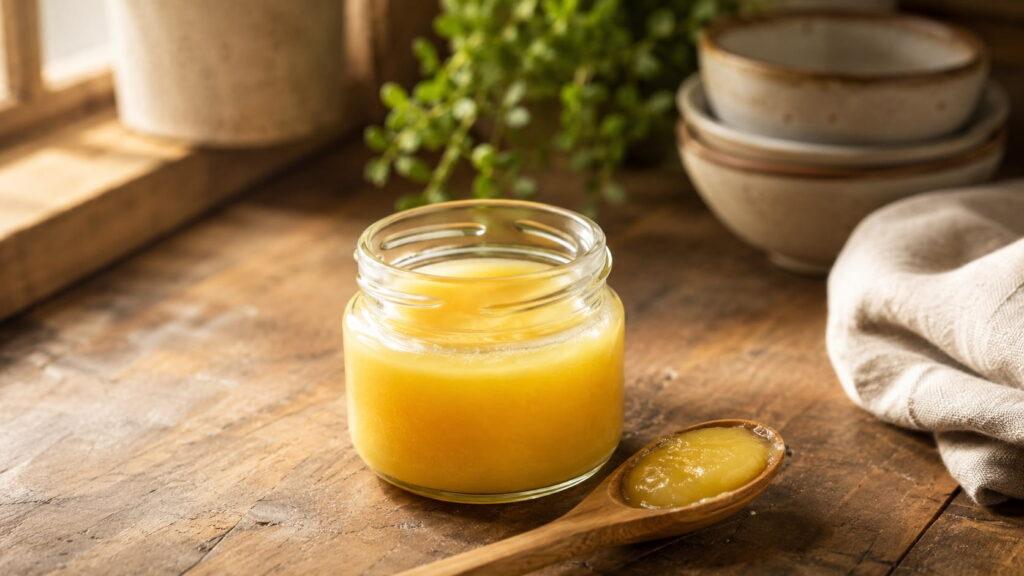
Ghee is clarified butter. You make it by simmering butter until the water evaporates and the milk solids separate out, leaving behind a pure, golden fat. Because those milk solids are removed, ghee has almost no lactose or casein left in it, which is why many people who react to regular dairy can tolerate ghee without trouble.
Traditional ghee, often called desi ghee, is made from cow or buffalo milk using slow, low-heat methods rooted in Ayurveda. “Desi” simply refers to this traditional, locally made style. It doesn’t automatically mean the ghee is more nutritious than any other dairy ghee, so treat labels like “desi,” “A2,” “grass-fed,” or “bilona” as descriptions of how it was made, not proof of superior health benefits.
This is different from “vegetable ghee,” which is a manufactured blend of vegetable oils made to mimic the taste and texture of real ghee. It isn’t the same product nutritionally. Some vegetable ghee is made with hydrogenated or partially hydrogenated oils and may contain industrial trans fats, though formulations vary by brand. If you’re buying ghee for health reasons, check the ingredient label rather than assuming, and stick to dairy-based ghee when you can.
How Is Ghee Made?
You can make ghee at home with nothing but unsalted butter, and it’s worth doing at least once if you cook with it regularly:
- Cut unsalted butter into cubes and melt it in a saucepan over low heat.
- Let it simmer gently. It will foam up as the water evaporates, and milk solids will rise to the surface.
- Skim off the foam as it forms, or leave it to sink, depending on your method. Either way, keep the heat low so the milk solids don’t burn.
- Once the milk solids turn golden brown and settle at the bottom, and the liquid turns a clear, deep gold, remove it from the heat.
- Strain through a cheesecloth or fine mesh strainer into a clean, dry jar.
Homemade ghee keeps at room temperature for about 3 to 4 months, and up to a year if refrigerated. Store it in an airtight container, away from light and moisture, since both speed up spoilage. If you’re using ghee for frying, using a fresh batch each time rather than reusing the same portion repeatedly helps limit cholesterol oxidation, which we cover in more detail in the heart health section below.
Ghee Nutrition: What’s Actually in It
Here’s what a teaspoon and a tablespoon of ghee typically provide:
| Serving | Calories | Total fat | Saturated fat |
|---|---|---|---|
| 1 teaspoon | ~40 to 45 | ~4.5 to 5 g | ~3 g |
| 1 tablespoon | ~120 to 130 | 14 g | 9 g |
And per tablespoon, its vitamin and dairy-residue content looks like this:
| Nutrient | Amount per tablespoon |
|---|---|
| Vitamin A | 11 to 13% of Daily Value |
| Vitamin E | 2 to 3% of Daily Value |
| Vitamin K | 1% of Daily Value |
| Cholesterol | ~35 mg |
| Lactose and casein | Trace amounts only |
Ghee is almost entirely fat, so it’s calorie-dense. It also carries small amounts of butyrate, a short-chain fatty acid, and conjugated linoleic acid (CLA), which is where most of its talked-about benefits come from. Keep these numbers in mind because they matter later, when we talk about how much ghee is actually reasonable to eat in a day. (Nutrient values are drawn from USDA FoodData Central, the standard reference database also used by most major health sites.)
Top Health Benefits of Ghee
1. Supports Digestive Health
In Ayurvedic tradition, ghee has long been used to support gut health, and there’s a real mechanism behind that idea.
Ghee contains butyrate, a short-chain fatty acid that helps nourish the cells lining your intestines and has been linked to easing inflammation in the gut. That said, ghee is only around 1% butyrate by volume, and most of the butyrate your colon actually uses comes from gut bacteria fermenting fiber, not from what’s on your plate.
So there isn’t strong evidence that eating ghee itself meaningfully improves digestion. If gut health is the goal, a fiber-rich diet is doing the heavy lifting, and ghee is, at best, a small supporting piece of that picture.
2. Provides Vitamin A
Ghee is a genuine, measurable source of vitamin A, a nutrient with a well-established role in immune function, skin repair, and vision. Because vitamin A needs fat to be absorbed properly, cooking vegetables in a bit of ghee can actually help your body take in more of it from the food itself.
That said, eating ghee doesn’t “boost” your immune system beyond what it does for anyone meeting their normal vitamin A needs. The benefit here is nutritional, not a special immune effect unique to ghee.
3. Ghee and Heart Health: Good or Bad?
This is probably the most searched question about ghee, and the honest answer is: it depends on how much you eat. Ghee contains monounsaturated fats and small amounts of omega-3s, and some studies link moderate ghee consumption to a modest improvement in HDL (good) cholesterol. CLA, the compound found in grass-fed ghee, has also been studied for its potential to support a healthier lipid profile.
But ghee is also about 62% saturated fat, and the American Heart Association’s current guidance is to replace saturated fats with unsaturated fats where possible, rather than treating saturated-fat-rich foods as heart-healthy. High-heat processing can also create cholesterol oxidation products, and research on ghee specifically has linked these to cardiovascular risk in animal studies, with intermittent heating and reused ghee producing more of them than a single round of cooking.
Practically, that means it’s worth avoiding the habit of reheating or reusing the same batch of ghee for frying multiple times. Clinical trials on ghee and cholesterol in humans are limited and mixed: some show no significant change over several weeks, others show a rise in total cholesterol when ghee makes up a large share of daily calories.
So the fair answer to “is ghee good or bad for the heart” is this: ghee isn’t a heart-health food in the same way unsaturated-fat-rich oils like olive oil are. A randomized crossover trial comparing the two directly found that a ghee-based diet raised apoB and non-HDL cholesterol compared with an olive oil-based diet over the same period, which lines up with what the broader research on saturated fat suggests.
Using ghee occasionally or in small amounts can still fit into an otherwise balanced diet, but if you’re trying to lower cardiovascular risk or LDL cholesterol, replacing some of your ghee with unsaturated fats is the better move, not just adding more ghee and hoping the CLA balances it out.
4. Ghee Benefits for Skin
Ghee is rich in fatty acids and antioxidants, which is why it shows up in skincare routines as much as in cooking. Applied topically, it can act as an occlusive moisturizer, helping reduce water loss and soothe dry skin.
You’ll also see claims online about ghee healing wounds or boosting collagen, but the evidence behind those specific claims is limited compared to established dermatological treatments, so I wouldn’t rely on ghee for anything beyond basic moisturizing. If you’re trying it on your skin for the first time, patch test it first, since it is a dairy-derived product.
5. Is Ghee Good for Weight Loss?
Ghee contains CLA, a compound that has been studied for its potential to reduce body fat and support weight management. Some small studies suggest CLA may help preserve lean muscle while reducing fat mass. But context matters here: ghee has about 120 calories per tablespoon, all from fat.
Adding it on top of your regular diet without adjusting anything else is more likely to add weight than remove it. If you want to use ghee as part of a weight-conscious diet, the smarter approach is to use it in place of other cooking oils or butter, in modest amounts, rather than adding it as an extra.
6. Ghee and Brain Health: What the Evidence Shows
Ghee has long been considered a “brain tonic” in Ayurvedic medicine, and the underlying biology is reasonable to start with: the brain is largely made of fat, and dietary fats are used by the body for energy and cell membrane health.
But that’s a general fact about fat, not a specific finding about ghee. There isn’t enough human research on ghee itself to say it improves memory, focus, or cognitive performance. Treat this as a traditional belief with a plausible mechanism behind it, not a proven effect.
7. Ghee Benefits for Women: What We Actually Know
A lot of women look into ghee specifically for hormonal support, so it’s worth being precise here. Hormones like estrogen and progesterone are built from fat, which is why adequate dietary fat matters for hormone production in general.
Ghee provides calories and fat-soluble nutrients like vitamin A and E, so it can be part of a balanced diet, including during times when fat intake has been too low. What it isn’t is a treatment for hormonal conditions. There’s no good clinical evidence that ghee specifically improves PCOS, fertility, thyroid function, or menopause symptoms, and it shouldn’t be presented or used as one.
If you’re dealing with a hormonal health concern, that’s a conversation for your doctor, not a dietary fix.
8. Ghee and Eye Health
Vitamin A is essential for normal vision, and ghee is a genuine source of it. But the evidence here really points to vitamin A’s role in eye health generally, not to any special eye benefit from ghee specifically. Its contribution is best understood as one part of meeting your overall vitamin A intake.
A traditional Ayurvedic practice involves using ghee as an eye drop, but this isn’t something we’d recommend without direct guidance from a healthcare provider, since unsterilized fats near the eyes carry infection risk.
Ghee vs. Butter: What’s the Real Difference?
Nutritionally, ghee and butter are close cousins, and ghee isn’t automatically the healthier of the two.
| Ghee (1 tbsp) | Butter (1 tbsp) | |
|---|---|---|
| Calories | ~123 | ~100 |
| Total fat | 14 g | 11 g |
| Saturated fat | 9 g | 7 g |
| Vitamin A | ~13% DV | ~11% DV |
| Lactose/casein | Trace | Small amounts present |
| Smoke point | ~485°F | ~350°F |
Ghee actually has slightly more calories and saturated fat per tablespoon than butter, since removing the water concentrates the fat. Its real advantages are practical rather than nutritional:
- Lactose and casein: Ghee has next to none, making it a better option if you’re sensitive to dairy.
- Smoke point: Ghee holds up much better under high-heat cooking like searing or frying.
- Shelf life: Ghee doesn’t need refrigeration and can last for months at room temperature, while butter needs to be chilled.
- Flavor: Butter has a creamier, sweeter taste that works better in baking, while ghee brings a deeper, nuttier flavor suited to savory, high-heat cooking.
If you’re managing lactose sensitivity or cooking at high heat, ghee has the edge. If you’re baking or watching saturated fat closely, butter isn’t actually the worse choice.
Ghee vs. Olive Oil
This comparison is less about which fat is universally “healthier” and more about what you’re using it for. Extra virgin olive oil is rich in monounsaturated fat and plant compounds, and it has a much stronger evidence base for cardiovascular health, backed by the same trial data referenced in the heart health section above.
Ghee, on the other hand, has a notably higher smoke point and a rich, buttery flavor that makes it more practical for certain high-heat cooking. For everyday, heart-conscious eating, olive oil is generally the better default. Ghee makes sense when you specifically want its flavor or its cooking stability, used in moderate amounts rather than as your main fat.
Advantages and Disadvantages of Ghee
Advantages:
- Very low in lactose and milk proteins compared with butter, easier on dairy-sensitive digestion
- High smoke point, stable for high-heat cooking
- Rich in fat-soluble vitamins A, E, and K
- Long shelf life without refrigeration
- Contains CLA and butyrate, both linked to gut and metabolic benefits
Disadvantages:
- High in saturated fat and calories, so it’s easy to overconsume
- May raise LDL cholesterol or other atherogenic markers, especially when used heavily
- Can contain some oxidized cholesterol from the heating process, though saturated fat content is the bigger everyday concern
- Not automatically safe for a diagnosed dairy protein (casein) allergy, even though lactose intolerance is usually fine
- Vegetable ghee substitutes can contain industrial trans fats, depending on the brand
So is ghee healthy or not? In moderate amounts, as part of a varied diet, most healthy adults tolerate it well. In excess, or for certain people, it can work against you. Like most fats, the dose really does make the difference.
Who Should Limit or Avoid Ghee?
Ghee is worth being more careful with if you fall into any of these groups:
- You have elevated LDL cholesterol or existing cardiovascular disease
- You’re actively trying to reduce saturated fat intake
- You’re managing type 2 diabetes or insulin resistance, since saturated fat intake is one factor worth watching alongside carbohydrate intake
- You’re managing your weight closely and counting calories
- You have a dairy protein (casein) allergy, not just lactose intolerance
- You notice digestive discomfort, bloating, or reflux after eating it
That last point on allergies is worth spelling out, since lactose intolerance and a casein allergy aren’t the same thing. Ghee has had the lactose largely removed, so many lactose-intolerant people tolerate it fine. Casein is a milk protein, and trace amounts can remain in ghee, so if you have a diagnosed dairy protein allergy, ghee isn’t automatically safe just because it’s “clarified.”
How Much Ghee Should You Eat Daily?
There’s no single medically prescribed amount that applies to everyone. As a general guide, a small serving such as one to two teaspoons a day (roughly 40 to 80 calories) can fit comfortably into many healthy adults’ diets, provided the rest of the day is reasonably light on saturated fat.
Where you land really depends on your total calorie needs, how much saturated fat you’re already getting from other foods, and your health goals. If you have high cholesterol, heart disease, or are managing weight closely, it’s worth checking with your doctor or a dietitian before making ghee a daily habit.
How to Use Ghee
- Cooking and frying: Its high smoke point makes it ideal for sautéing, roasting, and pan-searing.
- Ghee on an empty stomach: In Ayurveda, a small spoonful of warm ghee first thing in the morning is believed to support digestion and lubricate the gut. There’s no strong clinical evidence that taking it on an empty stomach offers any real advantage over having it with a meal, so don’t feel like you have to force this if it doesn’t sit well with you. It’s a traditional practice worth respecting, not a proven medical benefit, and if it causes nausea, reflux, or digestive discomfort, there’s no reason to push through it.
- Ghee coffee: Adding a teaspoon of ghee to coffee, sometimes called “bulletproof coffee,” can make the drink creamier and may make it more filling. Despite the popular claim, there isn’t solid evidence that it slows caffeine absorption or gives you steadier energy. What it reliably does is add calories, roughly 120 per tablespoon, so factor that in if you’re watching your intake.
- As a butter replacement: Swap it into most savory recipes, though it’s not ideal for delicate baking where butter’s water content matters.
- On toast, rice, or lentils: A traditional and simple way to use it, adding richness and helping your body absorb fat-soluble nutrients from the meal.
Ghee Benefits: Ayurveda and Modern Science Compared
Ayurveda has treated ghee as a near-sacred food for thousands of years, using it to support digestion, memory, skin, and what it calls “ojas,” or vital energy. Modern nutrition science doesn’t use that language, but it does back up several of the underlying ideas: the vitamin A and E content is real, the connection between dietary fat and hormone production is well established, and butyrate’s role in gut health is documented in research.
Where the two perspectives diverge is in scale and specificity. Ayurveda tends to describe ghee as broadly healing, while clinical research shows more measured, situational benefits that depend heavily on quantity, quality of the ghee, and a person’s existing health profile. The most balanced view treats ghee as a nutrient-dense traditional fat with several credible benefits, not a cure-all.
What Ghee Does Not Do
Ghee gets promoted online as something close to a cure-all, and it’s worth being clear about where that oversells it. Based on the current evidence, ghee does not:
- Automatically cause weight loss
- “Detox” your body
- Balance female hormones or treat PCOS, infertility, or thyroid conditions
- Prevent heart disease
- Replace fiber as a source of gut-supporting short-chain fatty acids
- Meaningfully improve memory or cognitive performance
- Become healthier just because it’s labeled “desi,” “A2,” or “bilona”
- Make coffee healthier simply by adding fat to it
None of this makes ghee a bad food. It just means the realistic benefits, vitamin A, cooking stability, being easier on lactose-sensitive digestion, are worth appreciating on their own, without stretching them into claims the research doesn’t back up.
Key Takeaways
- Ghee is a genuine, measurable source of vitamin A and works well for high-heat cooking, thanks to its high smoke point.
- It’s calorie-dense and high in saturated fat, about 62% by volume, so portion size matters more than any single “benefit.”
- It isn’t a heart-health food in the way olive oil is; current AHA guidance and direct trial data both favor unsaturated fats for everyday cardiovascular health.
- Ghee has slightly more calories and saturated fat than regular butter, so it isn’t automatically the “healthier” swap.
- Claims that ghee balances hormones, treats PCOS, boosts brain function, or aids weight loss on its own go beyond what current evidence supports.
- A small daily serving, roughly one to two teaspoons, fits comfortably into most healthy diets; people managing cholesterol or heart disease should use it more sparingly and check with a doctor or dietitian.
Frequently Asked Questions
Is ghee a healthy fat?
Yes, in moderation. It offers fat-soluble vitamins and CLA, but it’s also high in saturated fat, so portion size matters.
Is ghee healthier than butter?
Not clearly. Ghee actually has slightly more calories and saturated fat per tablespoon. Its real advantages are practical: less lactose and casein, a higher smoke point, and a longer shelf life.
Is vegetable ghee healthy?
Not necessarily. It’s a manufactured oil blend rather than dairy ghee, and some versions contain hydrogenated oils with industrial trans fats. Check the label instead of assuming.
What are the benefits of eating ghee daily?
In small daily amounts (one to two teaspoons), many people find it an easy source of fat-soluble vitamins and a useful high-heat cooking fat. Larger daily amounts add up quickly in saturated fat and calories, so more isn’t automatically better.
Does ghee help with weight loss?
The CLA in ghee has been studied for fat loss, but the effect is modest at best and easily outweighed by ghee’s calorie density. It’s more useful as a replacement for other fats than as an addition to your diet.
Can ghee be used every day?
Yes, in modest amounts, ghee is fine for daily use for most healthy adults. People managing cholesterol or heart disease should use it more sparingly.
Is ghee good for the heart?
Not especially. It isn’t a heart-healthy food in the way olive oil is, since it’s high in saturated fat. Small, occasional amounts can fit into a balanced diet, but unsaturated fats are the better everyday choice if you’re watching cardiovascular risk.
Which is healthier, ghee or olive oil?
It depends on the use. Olive oil is generally the better choice for everyday heart health and lower-heat cooking. Ghee is more practical for high-heat cooking and offers a different set of fat-soluble vitamins.
Is ghee good on an empty stomach?
No special benefit has been shown over having it with a meal. It’s a traditional practice, not a proven one, so let your own digestion be the guide rather than forcing it.
What are the benefits of ghee for women?
Ghee provides fat and nutrients like vitamin A as part of a balanced diet, but there’s no strong evidence that it specifically balances hormones or treats PCOS, infertility, or menopause symptoms.
Is ghee good for skin?
It can work as a moisturizer, since its fat content helps reduce water loss from dry skin. Evidence for it treating skin conditions, healing wounds, or boosting collagen is limited.
Is ghee coffee healthy?
It’s not harmful, but it’s not a metabolic upgrade either. You’re mainly adding fat and calories to your coffee, roughly 120 per tablespoon, without solid evidence of extra energy or fat-burning benefits.
Bottom Line
Ghee earns its place in the kitchen, just not as the superfood it’s sometimes made out to be. It’s a stable, nutrient-carrying fat with a long history in Ayurvedic tradition, and some of its practical benefits, like vitamin A content and cooking stability, hold up well under modern scrutiny.
Others, like its effects on hormones, weight, or brain function, are supported more by tradition than by strong human evidence right now. The key is moderation: a spoonful used thoughtfully can fit comfortably into a healthy diet, while a diet built heavily around it can work against your heart health goals. Ghee isn’t magic and it isn’t a mistake. It’s simply a fat worth using with the same common sense you’d apply to any other.
Sources
- Ghafouri A, et al. Effects of diets rich in ghee or olive oil on cardiometabolic risk factors in healthy adults: a two-period, crossover, randomised trial. British Journal of Nutrition, PubMed.
- American Heart Association. Saturatesatd Fats.
- USDA Agricultural Research Service. FoodData Central, nutrient data for ghee and butter.
- Kanjilal S, et al. The effect of ghee (clarified butter) on serum lipid levels and microsomal lipid peroxidation. AYU: An International Quarterly Journal of Research in Ayurveda, PubMed.
Related Articles: