
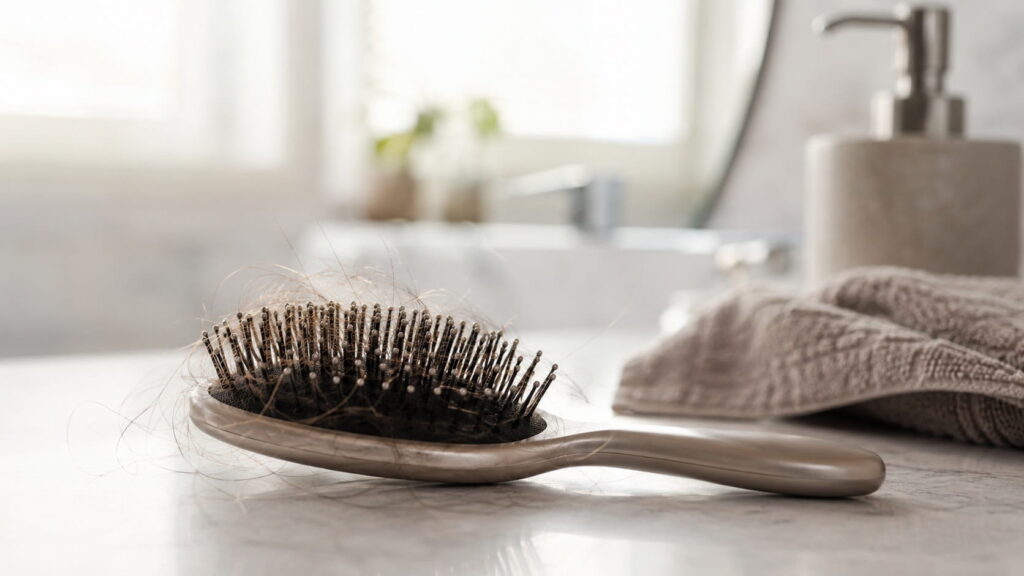
If you’ve started noticing more hair in your brush since starting a GLP-1 medication, you’re not imagining it. You’re also not alone.
I’m McLee Tembo, founder of NFH Clinic and an online health consultant who spends most days fielding this exact worry from patients. Over the last two years, “why is my hair falling out on Ozempic” has gone from a rare question to one of the most common ones in my inbox. And now, science backs up what patients have been telling doctors for a while: weight loss drugs and hair loss are genuinely connected.
Let’s walk through what’s actually happening, what a major new study just confirmed, and, more importantly, what you can do about it.
Key Takeaways:
- Hair loss on these medications is usually temporary, not permanent.
- Rapid weight loss, not the drug itself, is the real trigger.
- Most people see regrowth within 6–12 months once weight stabilizes.
- Getting enough protein and correcting nutrient deficiencies makes the biggest difference.
- You almost never need to stop your medication because of it.
Quick Answer: Weight Loss Drugs Hair Loss
Weight loss drugs like Ozempic, Wegovy, Mounjaro, and Zepbound don’t attack your hair follicles directly. But the rapid weight loss, calorie restriction, and nutrient shifts they cause can trigger a temporary shedding condition called telogen effluvium. It usually starts two to three months after significant weight loss begins, peaks around month four to six, and reverses once your weight and eating habits stabilize. For most people, hair grows back within six to twelve months.
That’s the short version. Here’s the full picture, including the numbers.
Hair Loss and GLP-1 Drugs at a Glance
- BMJ 2026 study: 37% higher alopecia risk vs. SGLT-2 inhibitors; 68% higher vs. DPP-4 inhibitors
- Wegovy trials: hair loss in 3% of adults vs. 1% on placebo
- Wegovy in adolescents: 4% vs. 0% on placebo
- Mounjaro trials: 4.9%–5.7% vs. 0.9% on placebo
- Zepbound trials: 4%–5% overall; 7.1% in women vs. 0.5% in men
- Typical onset: 8–12 weeks after rapid weight loss begins
- Typical regrowth window: 6–12 months once weight stabilizes
In this article:
- Before You Panic
- A Major New Study Just Confirmed the Link
- Why Do Ozempic, Wegovy and Mounjaro Cause Hair Loss?
- Does Ozempic Cause Hair Loss?
- Does Wegovy Cause Hair Loss?
- Does Mounjaro or Zepbound Cause Hair Loss?
- Signs Your Hair Loss May Be Something Else
- Should You Stop Your GLP-1 Medication?
- Is It Reversible? Will Your Hair Grow Back?
- How to Prevent Hair Loss While Taking Ozempic, Wegovy, or Mounjaro
- Best Treatments for Hair Loss After Ozempic or Wegovy
- When to See a Doctor or Dermatologist
- Frequently Asked Questions About Weight Loss Drugs Hair Loss
- Bottom Line
- References
Before You Panic
A little context helps here. Everyone sheds 50 to 150 hairs a day as part of a normal cycle, and that’s not a red flag on its own. What you’re likely reacting to is a noticeable increase over your personal baseline, which feels alarming but usually looks worse than it actually is. Diffuse shedding, even when it feels dramatic, rarely leads to visible baldness, and the overwhelming majority of GLP-1-related cases fully reverse. Keep that in mind as you read the rest of this: the goal here is to manage it intelligently, not to panic about it.
A Major New Study Just Confirmed the Link
For years, this connection lived in patient forums and dermatology waiting rooms rather than in peer-reviewed journals. That changed in July 2026, when a large study published in the BMJ examined alopecia rates in adults with type 2 diabetes taking GLP-1 medications.
Researchers from the University of Pennsylvania used electronic health records to compare over 12,000 adults with type 2 diabetes newly starting a GLP-1 drug against more than 15,000 starting an SGLT-2 inhibitor, and a separate group of nearly 12,000 GLP-1 users against over 11,000 starting a DPP-4 inhibitor. The study design, known as target trial emulation, is a method that mimics a randomized trial using real-world data, which gives the findings more weight than a typical retrospective chart review.
The findings were striking. People on GLP-1 drugs had a 37% higher risk of alopecia compared with those taking SGLT-2 inhibitors, and a 68% higher risk compared with those on DPP-4 inhibitors. Researchers pointed to rapid weight loss, shifting nutritional status, and possible micronutrient shortfalls, particularly biotin, iron, and zinc, as the likely drivers, rather than the drug molecule itself acting on hair follicles.
This is the “weight loss drug linked to loss of hair in major new study” news you may have seen circulating. It doesn’t mean the drugs are unsafe. It means the side effect is real, measurable, and worth planning for rather than dismissing.
One important nuance most headlines leave out: a 37% to 68% higher risk sounds alarming, but it’s a relative risk, not the odds that it will happen to you. The researchers themselves noted that the absolute risk of alopecia in the study remained low overall. In plain terms, most people on these medications will never develop noticeable hair loss at all; the increase is real, but it applies to a small baseline number, not a coin-flip chance.
It’s also worth knowing what the study couldn’t tell us. The authors were upfront about its limits: the health records didn’t capture how severe the hair loss was, how long it lasted, or whether it reversed after people stopped the medication. It also can’t rule out that some unmeasured factor, rather than the drug itself, nudged the numbers. That’s not a reason to dismiss the findings, but it is a reason to treat “37% higher risk” as a signal worth watching rather than a verdict.
Beyond this single cohort study, the current evidence picture also includes clinical trial data submitted for FDA approval, post-marketing pharmacovigilance reports, and a growing number of dermatology case reviews, all pointing in the same direction: this is a real, dose- and speed-related side effect, not a coincidence.
Why Do Ozempic, Wegovy and Mounjaro Cause Hair Loss?
Your hair grows in cycles. Roughly 85 to 90% of your follicles sit in an active growth phase (anagen) at any given time, while the rest rest quietly before shedding naturally. That’s why losing 50 to 150 hairs a day is completely normal.
Rapid weight loss, extreme calorie cuts, or a sudden physical shock can push far more follicles than usual into the resting and shedding phase at once. Dermatologists call this telogen effluvium, and it’s the same mechanism behind hair loss after childbirth, major surgery, a high fever, or crash dieting.
With GLP-1 medications, a few specific factors seem to pile on:
- Fast, significant weight loss, often 15% to 20%+ of body weight within a year, which is a bigger and quicker shift than most diets produce.
- Reduced food intake. GLP-1 drugs suppress appetite so effectively that many people simply eat less overall, which can mean less protein, iron, zinc, and biotin than their hair follicles need.
- Ongoing stress on the body. Unlike a one-off event like surgery, weight loss on these medications continues for months, so the “stressor” doesn’t resolve quickly, and it can keep the shedding cycle going longer than a typical bout of telogen effluvium.
- Lifestyle changes layered on top. Many people starting a GLP-1 also ramp up exercise, cut sleep to fit in workouts, or diet more aggressively than they realize, and each of those adds its own physical stress on top of the weight loss itself.
- Possible metabolic shifts tied to the drugs themselves, which researchers are still studying.
So while it’s technically the weight loss, not the semaglutide or tirzepatide molecule, doing the damage, that’s cold comfort if it’s your hair on the line. The practical impact is the same either way.
Does Ozempic Cause Hair Loss?
Ozempic’s own prescribing information doesn’t list hair loss as an official side effect, and it wasn’t flagged in semaglutide’s original diabetes trials. That said, plenty of people using it off-label for weight loss have reported thinning hair, and dermatologists now see it regularly enough that it’s part of routine consultations. The consensus among endocrinologists and dermatologists is that Ozempic-related shedding follows the same rapid-weight-loss pathway as its sister drugs, even though it wasn’t specifically measured in early trials.
Quick answer: Ozempic doesn’t directly damage hair follicles. Hair loss is usually caused by rapid weight loss, reduced calorie intake, and nutrient deficiencies that trigger telogen effluvium. Most people experience temporary shedding that improves once weight stabilizes.
Does Wegovy Cause Hair Loss?
Wegovy is a bit more transparent about it on paper. In clinical trials, hair loss was reported in about 3% of adults taking Wegovy, compared with 1% on placebo. In adolescents aged 12 and older, that gap was wider, at 4% versus 0% on placebo. It’s still classified as an uncommon side effect (affecting fewer than 1 in 20 people), but it’s clearly more frequent than in the general population.
Does Mounjaro or Zepbound Cause Hair Loss?
Tirzepatide-based drugs show a similar, and in some cases higher, pattern:
- Mounjaro: A 2022 clinical trial found hair loss in 4.9% to 5.7% of people on 5–15 mg doses, versus 0.9% on placebo.
- Zepbound: Hair loss appeared in 4% to 5% of users compared with 1% on placebo, and interestingly, it was far more common in women (7.1%) than men (0.5%). No one in the Zepbound trials stopped treatment because of it.
Across every one of these medications, one pattern holds steady: women report it more often than men, and the people who lose weight fastest tend to shed the most hair. Of the four, Zepbound and Mounjaro show the highest reported rates in trial data, though no head-to-head study has directly compared all four drugs for this specific side effect.
Ozempic vs. Wegovy vs. Mounjaro vs. Zepbound: Hair Loss Compared
| Drug | Active Ingredient | Reported Hair Loss Rate | Notes |
|---|---|---|---|
| Ozempic | Semaglutide | Not formally tracked in trials | Widely reported off-label for weight loss |
| Wegovy | Semaglutide | 3% (vs. 1% placebo) | Officially recorded in trial data |
| Mounjaro | Tirzepatide | 4.9%–5.7% (vs. 0.9% placebo) | Slightly higher than Wegovy |
| Zepbound | Tirzepatide | 4%–5% (vs. 1% placebo) | Highest rate in women: 7.1% |
Signs Your Hair Loss May Be Something Else
Not every strand you find on your pillow is caused by your medication. GLP-1-related shedding has a fairly specific pattern: diffuse, gradual, and scalp-wide. If what you’re seeing looks different, it’s worth getting evaluated rather than assuming it’s the medication. Watch for:
- Distinct bald patches rather than overall thinning, which points toward alopecia areata, not telogen effluvium.
- An itchy or painful scalp, which can signal a fungal infection like tinea capitis or an inflammatory scalp condition.
- Scaling, redness, or flaking on the scalp itself.
- Hairs that look broken rather than shed from the root, a sign of physical or chemical damage rather than a growth-cycle issue.
- A sudden, sharply receding hairline that doesn’t match a gradual, all-over thinning pattern.
- Eyebrow or eyelash loss alongside scalp hair loss, which isn’t typical of GLP-1-related shedding and warrants a broader medical workup (it can point to thyroid dysfunction or an autoimmune condition).
If any of these apply to you, book a dermatology visit rather than waiting it out. GLP-1-related telogen effluvium is diffuse and painless, so anything patchy, itchy, or accompanied by eyebrow/eyelash loss deserves its own diagnosis.
Should You Stop Your GLP-1 Medication?
This is one of the most common questions I get, and the short answer is: usually, no.
Hair loss from these medications is, in almost all cases, temporary and non-scarring, meaning the follicles themselves aren’t permanently damaged. Stopping your medication because of shedding alone means giving up real, often significant, health benefits (better blood sugar control, reduced cardiovascular risk, meaningful weight loss) to address a cosmetic side effect that’s very likely to resolve on its own.
A few things worth knowing before you consider stopping:
- Don’t stop suddenly without talking to your prescriber first. Abruptly discontinuing a GLP-1 can affect blood sugar control (if you have diabetes) and often leads to rapid weight regain, which brings its own health trade-offs.
- Slowing down usually helps more than stopping. If your weight loss has been unusually fast, ask your prescriber about adjusting your dose or extending the interval between dose increases. Slower loss is consistently linked to less dramatic shedding.
- Weigh the full picture. Hair loss is distressing, but it’s worth putting it next to what the medication is doing for your metabolic health. For most patients, the honest answer is that the benefits still outweigh a temporary cosmetic side effect.
- If it’s genuinely affecting your quality of life or mental health, that’s a legitimate reason to have an in-depth conversation with your doctor about alternatives, but that decision should be made with your prescriber, not on your own.
Is It Reversible? Will Your Hair Grow Back?
Yes, for the vast majority of people, this type of hair loss is temporary. Once your weight stabilizes and your nutrient intake catches up, the hair growth cycle typically resets on its own.
Here’s a realistic timeline:
| Stage | What’s Happening |
|---|---|
| Week 0 | Rapid weight loss and calorie reduction begin |
| Weeks 8–12 | Increased shedding starts becoming noticeable |
| Months 4–6 | Shedding typically peaks |
| Months 6–12+ | As weight stabilizes, shedding slows and regrowth begins |
| Months 12–18 | Full density typically returns |
If you’re still actively losing weight, the shedding phase may simply continue rather than resolve, which is one reason some clinicians recommend slowing the pace of weight loss if hair loss becomes significant. And because hair only grows about half an inch a month, patience genuinely matters here: there’s no way to rush the biology, only to support it.
How to Prevent Hair Loss While Taking Ozempic, Wegovy, or Mounjaro
You can’t always avoid this side effect entirely, but you can substantially reduce your risk with a few practical steps.
1. Prioritize protein
Hair is made almost entirely of a protein called keratin. If you’re eating less overall, protein is usually the first thing to slip. Good, easy sources include eggs, Greek yogurt, chicken, salmon, cottage cheese, tofu, beans, and lentils. Spread your protein across meals rather than front-loading it at dinner.
2. Don’t lose weight too fast
Faster isn’t always better. If you’re dropping weight unusually quickly, talk to your prescriber about dose pacing. Slower, steadier loss puts less shock on your system, and your hair follicles.
3. Get your levels checked
Ask for bloodwork on ferritin (iron stores), zinc, vitamin D, and B12 before assuming a supplement is the fix. Deficiencies in any of these are common during aggressive calorie restriction and are strongly linked to shedding.
4. Eat before you’re starving, not after
GLP-1 drugs blunt hunger cues so effectively that some people accidentally under-eat for days at a stretch. Set reminders if you need to, and don’t skip meals just because you’re not hungry.
5. Be gentle with your hair
Reduce heat styling, tight hairstyles, and harsh chemical treatments while you’re shedding, since your follicles are already under stress, and mechanical damage compounds it.
Nutrients That Matter Most for Hair Health
| Nutrient | Why It Matters | Good Food Sources |
|---|---|---|
| Protein | Hair is built from keratin, a protein | Eggs, chicken, salmon, lentils, cottage cheese |
| Iron (ferritin) | Low stores are strongly linked to shedding | Beef, spinach, lentils, pumpkin seeds |
| Zinc | Supports follicle repair and growth | Pumpkin seeds, chickpeas, cashews |
| Vitamin D | Involved in the hair growth cycle | Salmon, fortified milk, sunlight exposure |
| B12 | Supports cell growth and division | Eggs, dairy, fortified cereals |
| Biotin | Only clearly helpful if you’re deficient (see note below) | Eggs, nuts, sweet potatoes |
A quick caveat on biotin: it’s the most heavily marketed hair-loss supplement, but biotin supplements are generally only helpful for people with a confirmed deficiency. If your bloodwork doesn’t show one, your money and attention are better spent on protein and other confirmed deficiencies instead.
Quick Reference: Do’s and Don’ts
✅ Do:
- Eat enough protein at every meal
- Stay well hydrated
- Get bloodwork done if shedding is significant
- Aim for gradual, steady weight loss
- Talk to your prescriber before making any changes
❌ Don’t:
- Crash diet on top of your medication
- Skip meals because you’re not hungry
- Self-prescribe high-dose supplements without testing
- Stop your medication abruptly without medical guidance
- Ignore patchy, itchy, or scalp-pain symptoms
Best Treatments for Hair Loss After Ozempic or Wegovy
If shedding has already started, several approaches have real evidence, and some myths, behind them.
Address the underlying deficiency first
If bloodwork shows low iron, zinc, or vitamin D, correcting that deficiency does more for regrowth than any cosmetic product on the market.
Minoxidil (topical or low-dose oral)
FDA-approved since the 1980s, minoxidil works through anti-inflammatory and blood-flow effects at the follicle. It won’t stop telogen effluvium from happening, but it supports faster, fuller regrowth once the shedding phase passes. It’s available as a topical foam/liquid or as a low-dose oral tablet, which some dermatologists now prefer for convenience and consistency.
Ketoconazole shampoo
This antifungal shampoo has mild anti-androgen properties and can help if you have an underlying tendency toward pattern hair loss layered on top of the temporary shedding.
PRP (platelet-rich plasma) therapy
This involves drawing your own blood, concentrating the platelets, and injecting the plasma into the scalp to stimulate follicles. Evidence is still developing, but recent systematic reviews suggest PRP may be a promising option for speeding up regrowth, particularly for people who feel their shedding is “dragging on.” Larger, well-controlled trials are still needed before it can be considered a proven first-line treatment.
Red or low-level laser light therapy
Delivered via an at-home cap or in-clinic device, this has shown benefit for stimulating follicles and is often combined with other treatments for a stronger effect.
Hair growth supplements
Products like collagen- or marine-protein-based formulas can help if you have a genuine nutrient gap, but they aren’t a substitute for addressing diet quality directly. Treat supplement claims with healthy skepticism, since the evidence base for most over-the-counter formulas is thinner than the marketing suggests.
💬 At NFH Clinic, we typically start by reviewing bloodwork and diet before recommending any product, because throwing supplements at a problem caused by under-eating rarely works long-term. As I tell patients often: the ones who recover fastest are usually those who increase protein intake early and correct nutritional deficiencies before spending money on expensive hair products.
When to See a Doctor or Dermatologist
Most GLP-1-related shedding resolves on its own, but you should get it checked out if:
- You notice distinct bald patches rather than overall thinning.
- Shedding continues well past 12 months without improvement.
- You have scalp itching, redness, or scaling alongside the hair loss.
- There’s a family history of pattern baldness that this may be accelerating.
- The hair loss is affecting your mental health or confidence significantly.
A quick note on terminology: if shedding lasts longer than six months, dermatologists classify it as chronic telogen effluvium rather than the more common acute form. Chronic cases are more likely to have an additional, unaddressed trigger (thyroid imbalance, ongoing iron deficiency, or an underlying pattern hair loss it unmasked), so this is a good marker for when to stop waiting and get bloodwork done.
A dermatologist can run a scalp exam and bloodwork to rule out thyroid issues, iron deficiency, or other causes that mimic, or compound, medication-related shedding.
Frequently Asked Questions About Weight Loss Drugs Hair Loss
Does Ozempic cause hair loss?
Hair loss isn’t listed as an official side effect of Ozempic, but it’s commonly reported by people using it, especially those losing weight quickly. It’s thought to result from the weight loss process itself rather than the drug directly.
Does Wegovy cause hair loss?
Yes, to a measurable degree. Clinical trials found hair loss in about 3% of adults on Wegovy versus 1% on placebo, making it an uncommon but real side effect.
Does Mounjaro cause hair loss?
Yes. Clinical trial data shows hair loss in 4.9% to 5.7% of people using Mounjaro, compared with 0.9% on placebo, a higher reported rate than Wegovy.
Does Zepbound cause hair loss?
Yes. Trials reported hair loss in 4% to 5% of users overall, with a notable gender gap: 7.1% in women versus 0.5% in men.
Which GLP-1 causes the most hair loss?
Based on trial data alone, Zepbound and Mounjaro report the highest rates (around 4–6%), compared to roughly 3% for Wegovy. No study has directly compared all four drugs head-to-head for this specific side effect, so this should be read as a general pattern rather than a precise ranking.
Is a 37% higher risk of hair loss a lot?
Not as much as it sounds. That figure is a relative risk increase compared with other diabetes drugs, and the researchers behind the BMJ study were clear that the overall, absolute risk of alopecia in the study group was low. In practical terms, the large majority of people on GLP-1 medications won’t develop noticeable hair loss at all; the study shows the risk is measurably higher than baseline, not that it’s common or expected.
Is hair loss worse with Wegovy than Ozempic?
It’s difficult to say definitively, since Ozempic’s trials didn’t track hair loss as an official endpoint the way Wegovy’s did. Anecdotally and mechanistically, the risk is driven by the amount and speed of weight loss rather than the specific drug, so someone losing weight quickly on either medication faces similar risk.
How much weight loss triggers hair loss?
There’s no exact cutoff, but rapid loss of roughly 5% or more of body weight within a few months is commonly associated with telogen effluvium. The faster and more significant the loss, the higher the risk appears to be.
Can protein shakes prevent Ozempic hair loss?
They can help close a protein gap if you’re not getting enough through food, but they’re not a guaranteed prevention method on their own. Total daily protein intake matters more than the source.
Should I take biotin with Ozempic?
Only if bloodwork confirms you’re actually deficient. Biotin is heavily marketed for hair health, but there’s little evidence it helps in people who aren’t deficient to begin with.
Can stopping Ozempic stop the hair loss?
Stopping may halt the ongoing trigger, but it also means giving up the medication’s metabolic benefits, and rapid weight regain carries its own risks. Most clinicians recommend addressing nutrition and pacing first, and only considering discontinuation as a last resort in consultation with your prescriber.
Does hair grow back after Ozempic-related shedding?
In most cases, yes. Because this is non-scarring hair loss, the follicles remain intact and typically resume normal growth once weight stabilizes, usually within 6–12 months, with full density returning by 12–18 months.
Is GLP-1 hair loss permanent?
For the vast majority of people, no. It’s classified as non-scarring hair loss, meaning the follicles aren’t permanently damaged. Regrowth typically occurs once weight stabilizes, though it can take up to 12–18 months for full density to return.
Bottom Line
Weight loss drugs and hair loss are connected, and that much is now backed by solid research, not just anecdotes. But the cause isn’t the medication attacking your follicles; it’s the speed and scale of the weight loss itself, often compounded by nutrient gaps that are entirely fixable. Slow your pace if needed, eat enough protein, get your bloodwork checked, and treat any deficiency you find. For most people, this is a temporary detour, not a permanent trade-off.
If you’re on a GLP-1 medication and dealing with unexpected shedding, don’t wait it out in silence: a quick consultation can identify exactly what’s driving it and how to fix it faster.
References
- Tang H, et al. Risk of hair loss associated with glucagon-like peptide-1 receptor agonists in adults with type 2 diabetes: target trial emulation. The BMJ, 2026;394:e100077.
- Wegovy (semaglutide) prescribing information, Novo Nordisk.
- Zepbound (tirzepatide) prescribing information, Eli Lilly and FDA.
- American Academy of Dermatology, Types of hair loss.
Related Articles: