

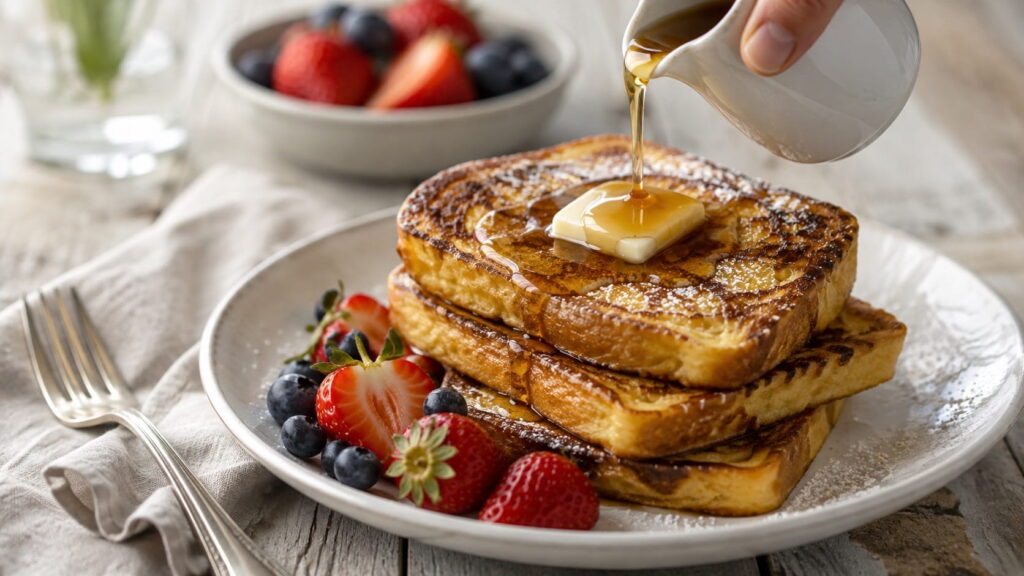
French toast looks simple until you actually try to get it right. Too much soak and you end up with a soggy middle. Too little and you’re left chewing dry bread with a burnt crust. The fix isn’t a fixed timer. It’s matching your soak time to the bread: brief for soft or delicate bread, longer for dense or stale bread, cooked over medium heat until golden and set.
I’m McLee Tembo, founder of NFH Clinic. Most of my work is nutrition consulting. That means I spend a lot of time looking at how everyday meals like this one affect blood sugar, weight, and energy levels, not just how they taste. So alongside the full technique below, you’ll find a short section on making this breakfast work for you, whatever your goals are.
In this guide:
- Overview
- Why Is It Called French Toast?
- Quick Facts
- Key Takeaways
- Quick Answer: How to Make French Toast
- French Toast Ingredients
- How to Make French Toast, Step by Step
- Never Soggy, Never Dry: What Actually Controls the Texture
- How to Make French Toast Even Better Than the Diner
- Classic French Toast Recipe Card
- French Toast Recipe for One
- How to Make French Toast Sticks
- How to Make French Toast in the Oven
- How to Make French Toast in an Air Fryer
- How to Make French Toast Without Milk
- How to Make French Toast Without Eggs
- How to Make French Toast With Regular Bread
- Which Method Should You Use?
- How to Store and Reheat French Toast
- Can You Make French Toast Ahead of Time?
- Toppings and Serving Ideas
- Easy Ways to Make French Toast More Filling and Balanced
- Nutrition Overview (Per Serving, 2 Slices)
- Frequently Asked Questions
- Final Thoughts
Overview
French toast is a custard-dipped, pan-fried bread dish made from eggs, milk, and bread. It’s one of the most searched breakfast recipes for a reason: it’s quick, it uses ingredients most kitchens already have, and it’s surprisingly easy to get slightly wrong. This guide covers the classic technique for making French toast at home, why it turns out soggy or dry, six ways to cook it (skillet, oven, air fryer, sticks, egg-free, dairy-free), and how to make it a more balanced part of your routine.
Why Is It Called French Toast?
Despite the name, the dish isn’t originally French. Cooks across Europe were soaking stale bread in egg and milk long before the term “French toast” existed, largely as a way to use up bread that had gone hard rather than waste it. The French call their version pain perdu, which translates to “lost bread,” a nod to the same idea: rescuing bread that would otherwise go to waste. Other cultures have their own versions under different names, but the method is nearly identical everywhere it shows up, which is part of why it’s stayed a breakfast staple for so long.
Quick Facts
| Prep time | 5 minutes |
| Cook time | 10–15 minutes |
| Serves | 4 (8 slices), scalable for 1 |
| Best bread | Brioche, challah, or thick-cut sandwich bread, a day or two old |
| Core ratio | 1 egg to ¼ cup (60 ml) milk per 2 slices |
| Common mistake | Soaking all bread for the same amount of time |
| Best cooking method | Skillet, for crisp edges and a custardy center |
| Calories (2 slices, plain) | ~260–300 kcal |
| Dietary swaps available | Egg-free, dairy-free, whole-grain, lower-yolk |
Key Takeaways
- Soak time should match the bread. Soft sandwich bread needs a second or two per side; dense bread like sourdough needs five to ten.
- Slightly stale bread holds together better than fresh bread, which absorbs custard too fast and falls apart.
- Medium heat is the sweet spot. Too hot burns the outside before the center sets; too low dries it out before it browns.
- The same recipe adapts easily to sticks, oven-baking, air frying, and egg- or dairy-free versions.
- Small swaps, whole-grain bread, fewer yolks, a protein side, make this a more balanced meal without changing how it tastes.
Quick Answer: How to Make French Toast
Whisk eggs with milk, a little vanilla and cinnamon, then dip slices of bread in the mixture, briefly for soft bread, longer for dense or stale bread. Cook in a buttered pan over medium heat for two to three minutes per side until golden and set in the middle. That’s the whole method. The details below are what separate an average batch from a great one.
French Toast Ingredients
- 4 large eggs
- 1 cup (240 ml) milk (whole milk gives the richest custard, but low-fat or a plant-based option works)
- 1 teaspoon vanilla extract
- ½ teaspoon ground cinnamon
- A pinch of salt (it balances the sweetness and makes the egg flavor pop)
- 8 slices of bread, ideally a day or two old
- Butter or a light coating of oil for the pan
- Toppings of your choice: maple syrup, fresh fruit, yogurt, nuts
This ratio, roughly one egg to a quarter cup of milk per two slices, gives you a custard rich enough to soak in without turning the bread mushy. For a lighter version, swap two of the whole eggs for two egg whites. You’ll cut some fat without losing the structure that holds the toast together.
How to Make French Toast, Step by Step
1. Make the custard. In a shallow bowl or pie dish, whisk the eggs first until they’re fully broken up, then add the milk, vanilla, cinnamon and salt. Whisk until the mixture is smooth and uniform, with no streaks of egg white left. A shallow, wide dish matters here because it lets you dip a full slice of bread flat.
2. Heat the pan. Set a nonstick or cast iron skillet over medium heat and add a small pat of butter. You want it melted and just starting to foam, not browning. If the pan is too hot, the outside will scorch before the inside sets.
(Metric quick reference: 425°F = 220°C, 375°F = 190°C, 350°F = 175°C, 300°F = 150°C, 200°F = 95°C.)
3. Dip the bread, don’t drown it. Soak time depends on the bread: brief for soft or delicate bread, longer for dense or stale bread. Full soak times by bread type are in the table just below. As a general rule, the bread should feel saturated but still hold its shape when you pick it up. If it sags or tears, you’ve soaked it too long.
4. Cook until golden, not just brown. Place the slice in the pan and resist the urge to move it. Cook for two to three minutes on the first side until it’s deep golden, then flip once and cook another two to three minutes. You’re listening for a gentle sizzle the whole time; if the pan goes silent, turn the heat up slightly.
5. Keep batches warm. If you’re making more than a few slices, keep finished ones on a wire rack in a low oven (around 200°F) instead of stacking them on a plate, where trapped steam will soften the crust you just worked for.
6. Serve right away. Top with syrup, fruit, yogurt or whatever you like, and eat while the outside is still a little crisp.
Never Soggy, Never Dry: What Actually Controls the Texture
Five things decide whether French toast comes out right: bread moisture, bread thickness, the custard ratio, soak time, and pan temperature. Once you understand these, “why is my toast soggy” and “why is my toast dry” stop being separate mysteries. They’re usually the same few variables pulling in opposite directions.
Bread moisture and thickness. Fresh, soft bread absorbs custard almost instantly and falls apart before it hits the pan. Bread that’s a day or two old, slightly firm, and cut ¾ to 1 inch thick (2 to 2.5 cm) absorbs more slowly and holds its shape. If all you have is fresh bread, dry it out first: leave slices at room temperature for an hour, or bake at 350°F (175°C) for about three minutes per side until slightly firm but not browned. Skip this step with crusty bread like sourdough, since it’s already dry enough on its own.
Best bread for French toast, ranked:
- Brioche or challah, for a rich, slightly sweet, custardy result
- Thick-cut white sandwich bread, the classic, reliable choice
- Whole-grain or whole-wheat bread, for more fiber and a heartier bite
- Sourdough, for a tangier flavor and firmer texture
- French baguette or rolls, sliced on an angle, good for smaller or bite-sized pieces
- Gluten-free sandwich bread, for anyone avoiding gluten. Choose a firmer, sturdier loaf where you can, since softer gluten-free bread tends to break apart faster in the custard than wheat bread does
Custard ratio. Too much milk relative to egg makes a watery, soggy result. Too much egg makes it dense and rubbery instead of custardy. The 1-egg-to-¼-cup-milk ratio used in this recipe is the balance point that avoids both.
Soak time by bread type:
| Bread type | Soak time per side |
|---|---|
| Soft sandwich bread | 1–2 seconds |
| Thick, slightly stale bread | 3–5 seconds |
| Brioche or challah | ~2 seconds |
| Sourdough or baguette | 5–10 seconds |
Cooking temperature. Medium heat is the sweet spot. Too hot and the outside burns before the center sets. Too low and the toast dries out before it browns.
A quick food safety note. The custard contains raw egg until it’s cooked, so don’t taste it before cooking. Cook each slice until the surface is set and no wet egg mixture remains, not just until it looks golden. If you’re serving young children, older adults, or anyone with a weaker immune system, cook slices a little longer to be sure the center is fully set.
Common French Toast Mistakes
| Problem | Likely cause | Fix |
|---|---|---|
| Soggy center | Too much custard absorbed | Use a shorter soak or thicker, staler bread |
| Burnt outside, raw inside | Heat too high | Drop to medium heat |
| Dry, tough center | Undersoaked or overcooked | Soak a few seconds longer, or reduce cook time |
| Falls apart when dipped | Bread too fresh or too thin | Dry the bread first, or cut thicker slices |
| Tastes too eggy | Custard has too much egg relative to milk | Adjust toward more milk, less egg |
| Pale, won’t brown | Pan not hot enough | Increase heat slightly before adding bread |
| Greasy texture | Too much butter in the pan | Use a thin coating and wipe out excess between batches |
| Uneven browning | Pan overcrowded | Cook in smaller batches with space between slices |
| Clumps of cinnamon on top | Custard wasn’t whisked enough | Whisk vigorously until fully combined |
How to Make French Toast Even Better Than the Diner
A handful of upgrades make a real difference without complicating the recipe:
- Use real butter in the pan, not oil alone. Butter browns and adds flavor the bread can’t get from oil.
- Add a spoonful of sour cream or mascarpone to the custard. It adds richness without much extra liquid, so the bread doesn’t get waterlogged.
- Try a little flour in the custard. A tablespoon whisked in with the eggs thickens the coating slightly and helps build a more substantial, crisper crust once it hits the pan. Treat this as an optional upgrade rather than part of the base recipe, since it changes the texture noticeably.
- Finish with flaky salt. A small pinch on top right before serving sharpens the sweetness of the syrup.
- Warm your syrup in a small pan or the microwave before pouring. It soaks in better and tastes noticeably better warm.
- Don’t crowd the pan. Diners cook in batches on a huge flat top. At home, two or three slices at a time gives each one enough direct heat to crisp properly.
Classic French Toast Recipe Card
Prep time: 5 minutes Cook time: 15 minutes Total time: 20 minutes Serves: 4 (8 slices)
Equipment: mixing bowl or shallow dish, whisk, nonstick or cast iron skillet, spatula, wire rack (optional, for keeping batches crisp)
Ingredients:
- 4 large eggs
- 1 cup (240 ml) milk
- 1 tsp vanilla extract
- ½ tsp ground cinnamon
- Pinch of salt
- 8 slices bread, a day or two old
- Butter, for the pan
Method: Whisk the custard. Heat butter in a skillet over medium heat. Dip each slice for the time that matches your bread (see the table above). Cook 2 to 3 minutes per side until golden and set. Serve warm.
French Toast Recipe for One
Cravings don’t always come in batches of eight. For a single serving:
- 1 egg
- ¼ cup (4 tbsp / 60 ml) milk
- A small pinch of cinnamon and vanilla
- 2 slices of bread
Whisk the egg and milk in a small bowl, dip both slices for the time that matches your bread, and cook in a small pan with a bit of butter for two to three minutes per side. This scales cleanly, since French toast is just a ratio of one egg to a quarter cup of liquid for every two slices, however many servings you need.
How to Make French Toast Sticks
French toast sticks are just the classic recipe cut before cooking, which makes them easier for kids to eat and great for dipping. Because the strips are smaller, they cook faster and dry out faster too, so keep the dip brief and don’t walk away from the pan.
Skillet method: Use slightly thick slices of sandwich bread or brioche and cut each slice into three or four strips. Dip briefly, about one second per side, then cook in a buttered pan over medium heat, turning every minute or so until all sides are golden, roughly 6 to 8 minutes total.
Oven method: Arrange dipped strips on a greased baking sheet with space between them and bake at 425°F (220°C) for about 12 to 15 minutes, flipping halfway, until golden and crisp at the edges.
Air fryer method: Arrange dipped strips in a single layer in the basket and cook at 375°F (190°C) for 6 to 8 minutes, flipping halfway.
For crispier sticks with any method, let the excess custard drip off before cooking and leave space between pieces so steam can escape instead of softening the surface. Serve with syrup, yogurt, or a fruit puree on the side for dipping.
How to Make French Toast in the Oven
Baking is the easiest way to make a large batch without standing at the stove flipping slices one by one.
- Preheat the oven to 425°F (220°C) and line a baking sheet with parchment or lightly grease it.
- Arrange bread slices in a single layer and dip each one fully in the custard, letting excess drip off rather than brushing it on, which tends to leave patches undercoated.
- Bake for about 8 minutes, flip, then bake another 6 to 8 minutes. Timing varies with oven and bread thickness, so start checking at the 6-minute mark on the second side; you’re looking for golden color and a center that’s set, not wet or jiggly.
- For extra crispness, finish under the broiler for 60 to 90 seconds per side, watching closely so it doesn’t burn.
This works well for individual slices. If you’re feeding a large group, a sheet-pan version, where you pour the custard directly over bread arranged on the pan rather than dipping each slice, is faster and needs less hands-on time. For overnight entertaining, a baked French toast casserole (bread cubes soaked overnight, then baked) is a better fit than trying to scale this method up.
How to Make French Toast in an Air Fryer
- Preheat the air fryer to 375°F (190°C).
- Dip bread slices in the custard as usual, letting any excess drip off.
- Lightly spray the air fryer basket and arrange slices in a single layer without overlapping.
- Cook for 5 to 6 minutes, flip, then cook another 4 to 5 minutes.
Air fryers vary a lot between models, so treat these times as a starting point and check early rather than trusting the clock. Thicker slices will need a minute or two longer. You’ll know it’s done when the outside is golden, the edges are crisp, and no wet egg mixture remains on the surface. The air fryer also uses very little added fat, which makes it a solid option if you’re watching saturated fat but still want crisp edges.
How to Make French Toast Without Milk
Not all substitutes work equally well, so it helps to know which to reach for first.
Best substitute: unsweetened almond, oat, or soy milk, swapped in at the exact same ratio as regular milk. This gets you closest to the original texture and flavor.
For extra richness: a splash of coconut milk works well if you don’t mind a faint coconut note.
In a pinch, no milk at all: water will hydrate the custard and the recipe will still technically work, but expect a noticeably less rich result.
As a flavor variation, not a straight swap: orange juice adds a nice citrus note with cinnamon. Treat it as a deliberate choice rather than a default substitute, since the acidity changes the flavor more than a neutral milk alternative would.
Whichever you choose, keep the ratio close to one egg per quarter cup of liquid so the custard still coats the bread properly.
How to Make French Toast Without Eggs
Egg-free substitutes aren’t interchangeable, each one changes the texture and flavor slightly:
| Substitute (per egg) | Result |
|---|---|
| 3 tbsp milk whisked with 1 tbsp cornstarch | Mild flavor, crisp coating, closest to a classic egg custard |
| 1 tbsp ground flaxseed whisked with 3 tbsp water, rested 5 minutes | Neutral, slightly nutty, good binding |
| ¼ cup mashed banana | Adds natural sweetness and banana flavor |
| ¼ cup chickpea flour whisked with milk into a thin batter | More savory and closer to an egg-like structure |
None of these will puff quite the way real eggs do, but they all give you a coated, custardy exterior once cooked. If you’re not sure which to pick, start with the cornstarch version, it’s the most neutral and forgiving for a classic-tasting result.
How to Make French Toast With Regular Bread
You don’t need brioche to get this right. Regular sliced white or whole-wheat sandwich bread is actually more forgiving than rich, buttery bread, since it holds up better to a slightly longer soak. If it’s fresh rather than a day or two old, dry it out first using the method above (350°F / 175°C, about three minutes per side), and handle it gently when moving it to the pan. It’s thinner than brioche or challah, so it cooks a little faster too, usually closer to two minutes per side than three.
Which Method Should You Use?
| Method | Best for | Time | Texture |
|---|---|---|---|
| Skillet | Best overall flavor and texture | ~15 min | Crisp outside, custardy center |
| Oven | Larger batches, hands-off | ~15–20 min | Even, slightly less crisp |
| Air fryer | Small batches, less added fat | ~10–12 min | Very crisp edges |
| Sticks | Kids, dipping | ~10–15 min | Crisp on multiple sides |
| Recipe for one | Single serving | ~10 min | Same as classic |
How to Store and Reheat French Toast
Cooked French toast holds up well, which makes it a reasonable thing to batch-cook ahead of a busy morning.
Refrigerator: Let it cool completely, then store in an airtight container for up to 3 to 4 days.
Freezer: Cool completely, freeze slices in a single layer on a baking sheet until firm, then transfer to a freezer bag or container. They’ll keep for up to 2 to 3 months.
Reheating: A toaster, toaster oven, skillet, or air fryer will bring back the crisp edges. The microwave is fastest but leaves the outside soft, so use it only if texture isn’t a priority.
Can You Make French Toast Ahead of Time?
For 30 to 60 minutes ahead: Keep cooked slices on a wire rack set over a baking sheet in a low oven (around 200°F / 95°C). A rack matters here, stacking slices on a plate traps steam and softens the crust.
For the next morning: Mix the custard the night before and store it covered in the fridge, then dip and cook fresh. This saves prep time without sacrificing texture, since the bread itself shouldn’t sit in the custard overnight unless you’re making a baked casserole.
For longer storage: Cook, cool, and freeze as described above.
Toppings and Serving Ideas
Maple syrup is the classic, but there’s more than one way to finish a plate:
- Fresh berries with a dusting of powdered sugar
- Plain or Greek yogurt with a drizzle of honey
- Sliced bananas with a spoonful of nut butter
- Toasted nuts or seeds for crunch
- A light dusting of cinnamon sugar instead of syrup, for less added sugar overall
For a full plate, French toast pairs well with crispy bacon or breakfast sausage for a salty contrast, a side of scrambled eggs for extra protein, or a simple fruit salad to round out the meal.
Easy Ways to Make French Toast More Filling and Balanced
French toast isn’t something you need to avoid as part of a balanced diet. A few simple swaps make it more filling and less likely to leave you hungry an hour later, without changing how it tastes:
- Use whole-grain or whole-wheat bread instead of white. It adds fiber, which generally means a steadier energy level after eating compared to refined bread.
- Add a protein source on the side, like Greek yogurt, a couple of eggs, or a scoop of cottage cheese. Pairing carbohydrates with protein tends to keep you fuller for longer.
- Use fewer egg yolks if you’re watching saturated fat. Two whole eggs plus two egg whites works well for a batch of eight slices and barely changes the texture.
- Top with fruit or nuts instead of, or alongside, syrup. You still get sweetness and some texture, with less added sugar overall.
- Stick to one or two slices if you’re managing portions, and treat syrup as a topping rather than something to pour over an already sweet custard.
Nutrition Overview (Per Serving, 2 Slices)
Calculated using standard white sandwich bread, whole milk, and butter for cooking, excluding toppings:
| Nutrient | Amount |
|---|---|
| Calories | ~260–300 kcal |
| Protein | 12–14g |
| Carbohydrates | 30–34g |
| Fiber | 2g (5–6g with whole-grain bread) |
| Sugar | 4–5g |
| Fat | 11–14g |
| Saturated fat | 4–5g |
| Sodium | ~380–420mg |
Swapping in whole-grain bread, plant-based milk, or fewer egg yolks will shift these numbers, so treat this as a general baseline rather than an exact figure for every version above.
Frequently Asked Questions
What’s the best bread for French toast?
Brioche and challah give the richest, most custardy result, but any slightly stale sandwich bread works well. Avoid very fresh, soft bread unless you dry it out first.
Can I make French toast with regular sandwich bread?
Yes, and it’s more forgiving than rich, buttery bread because it holds up to a longer soak. Dry it out first if it’s very fresh, and expect it to cook slightly faster than thicker brioche or challah.
Why does my French toast fall apart?
Usually the bread is too fresh, too thin, or was soaked too long. Use bread that’s a day or two old, cut it thicker, and keep the dip brief.
How long should I soak French toast?
It depends on the bread. Soft sandwich bread needs only a second or two per side, while dense bread like sourdough or baguette can take five to ten seconds. Stop soaking once the bread feels saturated but still holds its shape.
Should I use fresh or stale bread?
Slightly stale bread, a day or two old, works best because it absorbs the custard more evenly without falling apart. Fresh bread can be dried out in the oven first if that’s all you have.
What temperature should I cook French toast at?
Medium heat on the stovetop. Too high and the outside burns before the center sets; too low and it dries out before browning.
Can I make French toast without milk?
Yes, unsweetened plant-based milk is the closest substitute. Water works in a pinch but gives a less rich result, and orange juice works well as a flavor variation.
Can I make French toast without eggs?
Yes. A cornstarch and milk slurry, a flax and water mixture, mashed banana, or chickpea flour batter all work, each with a slightly different flavor and texture.
Can I make French toast in an air fryer?
Yes, at around 375°F (190°C) for 10 to 12 minutes total, flipping halfway. Air fryers vary, so check for a golden, crisp exterior rather than relying on the timer alone.
Can I freeze French toast?
Yes. Cool it completely, freeze slices in a single layer until firm, then store in a freezer bag for up to 2 to 3 months. Reheat in a toaster or air fryer to bring back the crisp texture.
How do I keep French toast warm without making it soggy?
Place finished slices on a wire rack over a baking sheet in a low oven, around 200°F (95°C). Stacking them on a plate traps steam and softens the crust.
Can I make French toast with gluten-free bread?
Yes. Choose a firmer, sturdier gluten-free loaf where possible, since softer varieties tend to break apart faster in the custard. A slightly shorter soak helps too.
How do I know when French toast is fully cooked?
The surface should be golden with no wet or shiny egg mixture left, and the center should feel set, not squishy, when you press it gently. If you’re unsure, cook it a little longer rather than less.
Final Thoughts
Good French toast comes down to a handful of details done right: bread that’s a little dry, a custard that isn’t overloaded with liquid, a pan that’s hot but not scorching, and a quick dip rather than a long soak. Once you’ve got that down, everything else, sticks, oven-baked, air-fried, egg-free, dairy-free, is just a variation on the same basic method.
And if you’re working on your health while you’re at it, the fix is rarely to give up the foods you enjoy. It’s usually just a smarter version of the same plate.
Related Articles:
