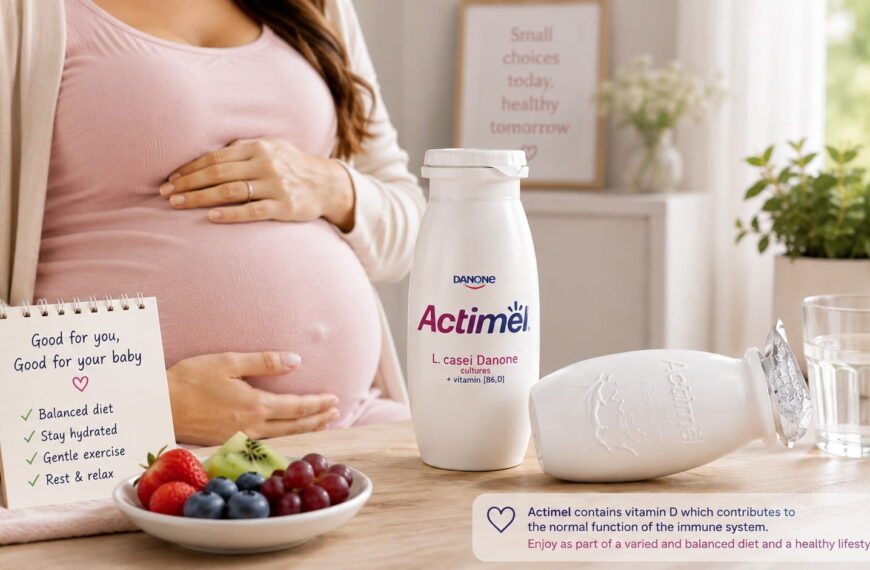
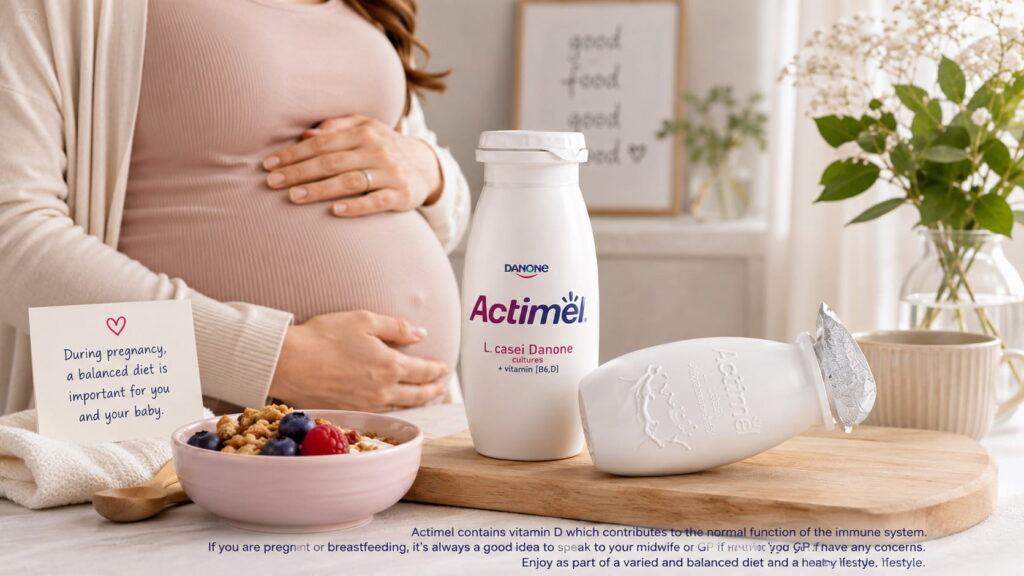
Yes. Actimel is generally considered safe during pregnancy. It’s made from pasteurized milk, and its probiotic strain hasn’t been shown to harm healthy pregnant women. For most healthy pregnant women, around one bottle a day is a reasonable amount — there’s no official upper limit specific to Actimel, but drinking more is unlikely to provide additional probiotic benefit, and choosing a low-sugar variety is worth it if you have gestational diabetes.
If you’ve reached for a bottle out of habit and then paused with your hand on the fridge door, wondering whether it’s still okay now that you’re expecting, you’re not alone. Below is everything worth knowing before you make it part of your routine — the science, the sugar content, who should be more careful, and what to do if you’re breastfeeding too.
If you’re specifically wondering how many Actimel you can drink each day, jump straight to Daily Intake.
In this article:
- At a Glance
- Quick Facts
- What Is Actimel Made Of and Is It Pasteurised?
- Why Pasteurization Is the Real Safety Question
- What the Research Says About Probiotics and Pregnancy
- Can Actimel Help Digestion During Pregnancy?
- Can You Drink Actimel Every Day During Pregnancy?
- Is Actimel Safe While Breastfeeding?
- Actimel vs Yakult During Pregnancy
- How to Introduce Actimel Safely During Pregnancy
- Who Should Be Cautious About Actimel in Pregnancy
- Common Myths About Actimel and Pregnancy
- Best Probiotics During Pregnancy
- Alternatives to Actimel During Pregnancy
- Key Takeaways
- Is Actimel Safe in Pregnancy? The Bottom Line
- Frequently Asked Questions
- Sources
At a Glance
- Actimel is made with pasteurized milk.
- Safe for most healthy pregnant women, in all trimesters.
- Contains probiotics that may support digestion and gut comfort.
- Around one bottle a day is a reasonable amount for most people.
- Choose a lower-sugar variety if you’re managing blood sugar or gestational diabetes.
- Avoid it, or check with your doctor, if you have a milk allergy or a weakened immune system.
- Also considered safe while breastfeeding.
Quick Facts
| Question | Answer |
|---|---|
| Safe during pregnancy? | Yes |
| Pasteurized? | Yes |
| Contains probiotics? | Yes — L. casei Danone plus standard yogurt cultures |
| Safe in the first trimester? | Yes |
| Safe while breastfeeding? | Yes |
| Suitable with gestational diabetes? | Yes, choose a low-sugar or 0%-added-sugar variety |
| Reasonable daily amount | About one bottle |
What Is Actimel Made Of and Is It Pasteurised?
What is Actimel? Actimel is a fermented milk drink made by Danone. Alongside the standard yogurt cultures (Lactobacillus bulgaricus and Streptococcus thermophilus), it contains a proprietary strain called L. casei Danone, listed on the label as Lactobacillus paracasei CNCM I-1518 (also referred to as L. casei DN-114 001). Most versions are fortified with vitamin D and vitamin B6, and some ranges add extra calcium.
Yes, Actimel is pasteurised — every standard bottle is made from pasteurized milk. That single fact is what separates a safe probiotic drink from a genuine food-safety risk, so it’s worth understanding why it matters so much.
Typical Nutritional Profile (per 100 ml)
Exact numbers shift a little between flavors and the 0%-added-sugar range, so always check your own bottle’s label.
| Nutrient | Approximate amount |
|---|---|
| Energy | 55–65 kcal |
| Protein | 2.8–3 g |
| Carbohydrates | 9–10 g |
| Sugars | 4–10 g (varies by range) |
| Fat | under 1.5 g |
| Vitamin D | ~0.75 µg (about 15% of daily intake) |
| Vitamin B6 | ~0.21 mg |
| Calcium | ~120 mg |
Pregnancy increases your calcium needs, and Actimel contributes some — but it should only be a small part of your total intake, alongside milk, cheese, leafy greens, and other calcium-rich foods.
Why Pasteurization Is the Real Safety Question
When people worry about dairy in pregnancy, the underlying fear usually isn’t “probiotics” — it’s Listeria. Unpasteurized dairy products can carry Listeria monocytogenes, a bacterium that’s usually harmless to healthy adults but can cause serious complications in pregnancy, including miscarriage, premature labor, or a severe infection in the newborn.
NHS guidance on foods to avoid in pregnancy specifically flags unpasteurized milk, cream, yoghurt, and butter because of this listeria risk — pasteurized dairy is treated very differently and is considered part of a normal pregnancy diet. Pasteurization is designed to destroy harmful bacteria, including Listeria monocytogenes, before fermentation even begins. Because Actimel is pasteurized, it doesn’t carry that risk.
So if you’re checking labels in the dairy aisle, pasteurization — not the presence of live cultures — is the thing to look for.
What the Research Says About Probiotics and Pregnancy
When it comes to safe probiotics during pregnancy, the research is fairly reassuring. Probiotics have been studied fairly extensively in pregnant populations over the past two decades, and the picture that emerges is reassuring rather than alarming. Reviews looking at Lactobacillus and Bifidobacterium strains, the same family Actimel’s cultures belong to, haven’t turned up evidence of increased miscarriage risk, birth defects, or serious maternal complications tied to their use.
Some research also points to modest benefits: easier digestion, less bloating, and in a few trials, some support for vaginal microbial balance and a possible reduction in eczema risk for the baby. It’s worth being upfront, though — there isn’t a large body of research testing Actimel specifically in pregnant women. Most of the safety picture comes from studies on the individual bacterial strains and on fermented dairy more broadly, not from trials on this exact bottled product. The takeaway is reassuring, but it’s reassurance by extension, not a guarantee backed by Actimel-specific trials.
Can Actimel Help Digestion During Pregnancy?
Pregnancy hormones, progesterone in particular, slow down digestion. That’s part of why constipation and bloating become such common complaints, especially in the second and third trimesters. At the same time, your immune system is doing a delicate balancing act: tolerating the baby while still trying to protect you from illness.
This is the context that makes probiotic drinks appealing during pregnancy. A daily fermented dairy drink won’t fix every digestive complaint, but for some women it takes the edge off.
- Digestion. Live cultures can support gut motility and ease constipation and bloating, both extremely common in pregnancy.
- Immune support. Some trial data suggests regular probiotic intake is linked to fewer minor infections, though the effect size varies between strains and studies.
- Nutrition. Actimel provides calcium and protein, and fortified versions add vitamin D — useful, though it should sit alongside a balanced diet, not replace one.
None of this makes Actimel a treatment for anything. Think of it as a supportive habit, not a medical intervention.
Can You Drink Actimel Every Day During Pregnancy?
For most healthy pregnant women, yes. One bottle a day is a reasonable amount — there’s no official upper limit specific to Actimel, but drinking more isn’t likely to add extra probiotic benefit; it mostly just adds sugar and calories. Occasionally having two bottles is unlikely to cause harm, but there’s no real advantage to it either.
If you’re watching your glucose levels, check the label: some Actimel varieties carry added sugar, while others (look for “0% added sugar” ranges) don’t. That distinction matters more than the probiotic content does.
Is Actimel Safe While Breastfeeding?
Actimel is generally considered compatible with breastfeeding because it’s made from pasteurized milk and there’s no evidence that its probiotic cultures pose a risk to healthy breastfeeding mothers or babies. Probiotic bacteria largely stay in the digestive tract rather than passing into breast milk in any meaningful amount. It’s generally fine while nursing unless you have a milk allergy or another specific reason to limit dairy — in which case, check with your doctor.
Actimel vs Yakult During Pregnancy
Yakult is the other fermented milk drink people often compare against Actimel. Both are pasteurized and both are considered safe in pregnancy, but they differ in a few practical ways:
| Actimel | Yakult | |
|---|---|---|
| Pasteurized | Yes | Yes |
| Probiotic strain | L. casei Danone (L. paracasei CNCM I-1518) | L. casei Shirota |
| Sugar (per 100 ml, standard version) | ~10 g | ~14 g (Yakult Light is lower, closer to Actimel’s 0%-sugar range) |
| Protein | ~3 g per 100 ml | Under 1.5 g per 100 ml |
| Fortified with vitamins | Yes — D and B6 | No |
| Bottle size | 100 ml | 65 ml |
Neither is “safer” than the other in pregnancy — the pasteurization is what matters most, and both clear that bar. The practical differences (sugar, protein, fortification) are what should actually guide your choice, especially if you’re managing gestational diabetes, where Yakult’s higher sugar content per serving is worth factoring in.
How to Introduce Actimel Safely During Pregnancy
If you haven’t had Actimel before and want to start during pregnancy, easing in tends to work better than diving in at full serving size:
- Mention it at your next appointment — especially if you have gestational diabetes, lactose intolerance, or an immune condition.
- Start small. Half a bottle for the first day or two lets you see how your gut responds before committing to a full daily serving.
- Watch for reaction. Mild bloating or gas in the first few days is common and usually settles. Ongoing discomfort is a sign to stop and reassess.
- Choose your variety deliberately. A 0%-added-sugar option is the safer default if you’re monitoring blood sugar.
Storage Tips
- Keep it refrigerated, ideally below 5°C (41°F).
- Don’t leave a bottle out of the fridge for more than 2 hours.
- Don’t drink from a swollen, bulging, or damaged bottle — that’s a sign of spoilage, not just reduced probiotic activity.
- Discard it once it’s past the use-by date. Expired dairy is a food-safety issue in pregnancy regardless of the probiotic content, so this isn’t a “safe to stretch a day or two” situation.
Who Should Be Cautious About Actimel in Pregnancy
Actimel is fine for most pregnant women, but a few groups should pause and think it through, ideally with their doctor or midwife.
- Gestational diabetes. Sugar content, not the probiotics, is the concern. A low-sugar or 0%-added-sugar version is the safer pick, and it’s worth running your overall dairy intake past your care provider.
- Lactose intolerance or milk allergy. Actimel is still a dairy product. If lactose typically causes you bloating, gas, or diarrhea, or if you have a true milk protein allergy, this isn’t the probiotic source for you.
- Weakened immune systems. This is rare, but if you’re immunocompromised (for example, undergoing chemotherapy or living with an organ transplant), check with your doctor before adding any live-culture probiotic to your diet. The risk is low, but it’s the kind of thing worth a quick conversation rather than a guess.
Common Myths About Actimel and Pregnancy
“Live bacteria in a drink means it’s risky for pregnancy.” Not the case here. The strains in Actimel are non-pathogenic and have a long history of use in fermented food. The bacteria that actually pose a pregnancy risk (Listeria, Salmonella) are killed off by pasteurization before fermentation even starts.
“Any probiotic is basically the same as any other.” Not quite — strain specificity matters. Research on one strain doesn’t automatically apply to another, which is part of why this article is careful to separate “probiotics in general are well studied” from “Actimel’s exact strain has been tested in large pregnancy trials.”
“You can’t drink it in the first trimester.” There’s no trimester-specific restriction. Because pasteurization is what makes it safe, that safety profile holds from early pregnancy through delivery.
Best Probiotics During Pregnancy
If you’re weighing up Actimel against other options, the search for the best probiotics while pregnant usually comes down to a few practical factors rather than one single “winner”:
- Pasteurization first. Whatever you choose — a drink, a yogurt, or a capsule — pasteurized or heat-treated is non-negotiable for anything fermented from milk.
- Strain and dose matter more than marketing. Look for a labeled strain (like Lactobacillus rhamnosus, Bifidobacterium lactis, or Actimel’s L. casei Danone) rather than a vague “probiotic blend,” and a CFU count in the billions rather than millions.
- Low sugar wins over flavor. Between a sugary flavored yogurt drink and a plain or 0%-added-sugar version, the plain option is generally the better daily pick in pregnancy.
- Food first, supplement second, unless dairy isn’t for you. For most pregnant women, a food source like Actimel, plain yogurt, or kefir covers the bases. A dedicated prenatal probiotic supplement is worth considering if you’re dairy-free, have specific digestive symptoms, or your doctor recommends targeting a particular strain.
There’s no single product that outranks all the others across every category — it genuinely depends on your sugar tolerance, dairy tolerance, and whether you’d rather drink, eat, or swallow a capsule to get there.
Alternatives to Actimel During Pregnancy
If Actimel doesn’t suit your taste, budget, or dietary needs, there are other ways to get similar benefits:
- Plain yogurt with live cultures — no added sugar, and Greek yogurt adds extra protein.
- Kefir, made from pasteurized milk, offers a broader range of bacterial and yeast strains.
- Pregnancy-specific probiotic supplements, if you’d rather skip dairy altogether — check with your provider on strain and dose.
- Lactose-free probiotic drinks or yogurts, for anyone who reacts to regular dairy.
None of these are strictly “better” than Actimel — they’re just different delivery methods with different sugar, calorie, and strain profiles.
Key Takeaways
- Actimel is made from pasteurized milk.
- Safe for healthy pregnant women, in all trimesters and while breastfeeding.
- One bottle daily is usually enough — more doesn’t add extra benefit.
- Low-sugar or 0%-added-sugar versions are preferable if you’re managing blood sugar or gestational diabetes.
- Avoid expired dairy products, regardless of probiotic content.
- Speak with your doctor or midwife first if you’re immunocompromised or allergic to milk.
Is Actimel Safe in Pregnancy? The Bottom Line
Actimel is a reasonably safe, pasteurized probiotic drink that can support digestion and general gut health during pregnancy, within sensible limits. It’s not a substitute for prenatal vitamins, a balanced diet, or your regular antenatal care — it’s a small supporting player, not the main event.
A quick practical checklist:
- Choose pasteurized Actimel (all standard retail versions are).
- Stick to around one bottle a day.
- Pick a low-sugar variety if you have gestational diabetes or are watching your blood sugar.
- Skip it, or check with your doctor first, if you’re lactose intolerant, allergic to milk, or immunocompromised.
- Keep it refrigerated and drink it before the use-by date.
- Treat it as a support to your diet, not a replacement for balanced nutrition.
If anything about your pregnancy makes you unsure — a new symptom, an existing condition, or just a nagging doubt — a two-minute conversation with your doctor or midwife is always the better move than guessing.
Frequently Asked Questions
Can Actimel cause miscarriage?
No. There’s no evidence linking pasteurized probiotic drinks like Actimel to miscarriage. The main pregnancy risk in dairy comes from unpasteurized products, which Actimel is not.
Can Actimel help with pregnancy constipation?
It may help. Probiotics can support gut motility, and many women find fermented dairy drinks ease bloating and irregularity. It’s not guaranteed to work for everyone, though, and increasing fiber and water intake still matters more.
Is Actimel safe in the first trimester?
Yes. Its safety profile doesn’t change by trimester, since the key factor, pasteurization, applies throughout pregnancy.
Is Actimel safe if I have gestational diabetes?
It can still fit, but choose a 0%-added-sugar variety and keep it to a small, planned part of your day rather than an extra treat on top of your usual meals. Your doctor or a dietitian can help you fit it into your glucose targets.
Can Actimel cause diarrhoea in pregnancy?
Some people notice temporary gas, bloating, or looser stools when first introducing any probiotic, including Actimel. This usually settles within a few days. If it doesn’t, or it’s severe, check in with your doctor rather than pushing through it.
Can Actimel help with morning sickness?
No — there’s currently no good evidence that Actimel reduces nausea or morning sickness. It’s a digestive and immune-support drink, not a nausea remedy.
Can you drink expired Actimel during pregnancy?
No. Discard any dairy product, probiotic or not, once it’s past its use-by date. This is a general food-safety rule in pregnancy, not specific to Actimel.
Does Actimel help the baby’s immune system?
Some early research suggests maternal probiotic intake may influence a baby’s developing immune system, including a possible reduction in eczema risk, but this area is still being studied and isn’t settled science yet.
Can Actimel interact with any medications?
There are no well-documented interactions between Actimel and common pregnancy medications or prenatal vitamins. Still, it’s worth mentioning everything you take regularly, including food-based supplements, at your next appointment.
Are all Actimel flavors equally suitable?
The core probiotic strain is the same across flavors, but sugar content varies. Fruit flavors tend to run higher in sugar than the 0%-added-sugar range, so check the label if that’s a concern for you.
Is Actimel better than a probiotic supplement?
Neither is clearly “better” — they’re just different delivery methods. Food-based probiotics like Actimel are generally well tolerated and come with the added bonus of calcium and protein; supplements let you target specific strains at a higher, more precise dose. Your doctor can help you decide which fits your situation.
How much Actimel is safe per day?
About one bottle a day is a reasonable amount for most healthy pregnant women. There’s no official upper limit specific to Actimel, but drinking more isn’t likely to add extra benefit — it mainly adds sugar and calories.
Is Actimel pasteurised?
Yes. Every standard bottle of Actimel is made from pasteurised milk, which is what makes it safe from a Listeria standpoint during pregnancy. This applies across the range, including the classic and 0%-added-sugar varieties — but if you’re ever unsure about an imported or unfamiliar version, check the label.
How many Actimel can you drink per day?
Most guidance points to one bottle a day as a sensible amount during pregnancy. This gives you the intended dose of live cultures and vitamins without an unnecessary bump in sugar and calories.
Is it ok to drink 2 Actimel a day?
Occasionally, yes — having two bottles in a day isn’t known to cause harm for a healthy pregnant woman. It’s just not necessary: probiotics don’t work on a “more is better” basis, so a second bottle mainly adds extra sugar and calories rather than extra benefit. If you’re doing it regularly rather than occasionally, it’s worth mentioning to your doctor, especially if you’re managing gestational diabetes.
Is Actimel good for weight loss?
Not really, and pregnancy isn’t a time to be aiming for weight loss anyway. Actimel isn’t a weight-loss drink — there’s no solid evidence that it burns fat or meaningfully changes body weight on its own. Outside of pregnancy, some people use it as a lower-calorie swap for sugary snacks, but during pregnancy the goal is steady, healthy weight gain guided by your care provider, not restriction.
What are the main probiotics and pregnancy warning signs to watch for?
The probiotics themselves rarely cause serious problems. The warnings worth knowing are: avoid unpasteurized fermented dairy or homemade cultures of unknown origin, stop and check with your doctor if you develop persistent diarrhea, fever, or severe abdominal pain after starting any probiotic, and get medical advice first if you’re immunocompromised. Mild, short-lived bloating or gas when you first start isn’t a warning sign — it’s a normal adjustment.
Can I drink Actimel on an empty stomach?
Yes. There’s no evidence that drinking it on an empty stomach is unsafe. Some people simply find dairy easier to tolerate after eating something first, so it’s more about personal comfort than any pregnancy-specific rule.
Is Actimel safe in the third trimester?
Yes. Its safety profile doesn’t change by trimester — pasteurization is the key safety factor, and that holds true from early pregnancy right through to delivery.
Can probiotics cause contractions?
There’s no evidence that probiotics, including those in Actimel, trigger contractions or early labor. If you’re experiencing contractions, they’re not something to attribute to a probiotic drink — mention them to your doctor or midwife directly.
Sources
- NHS — Foods to avoid in pregnancy
- ACOG — Listeria and Pregnancy
- Danone UK — Actimel product and nutrition information
- Dugoua JJ, Machado M, Zhu X, Chen X, Koren G, Einarson TR. Probiotic safety in pregnancy: a systematic review and meta-analysis of randomized controlled trials of Lactobacillus, Bifidobacterium, and Saccharomyces spp. J Obstet Gynaecol Can. 2009;31(6):542-552.
Related Articles: