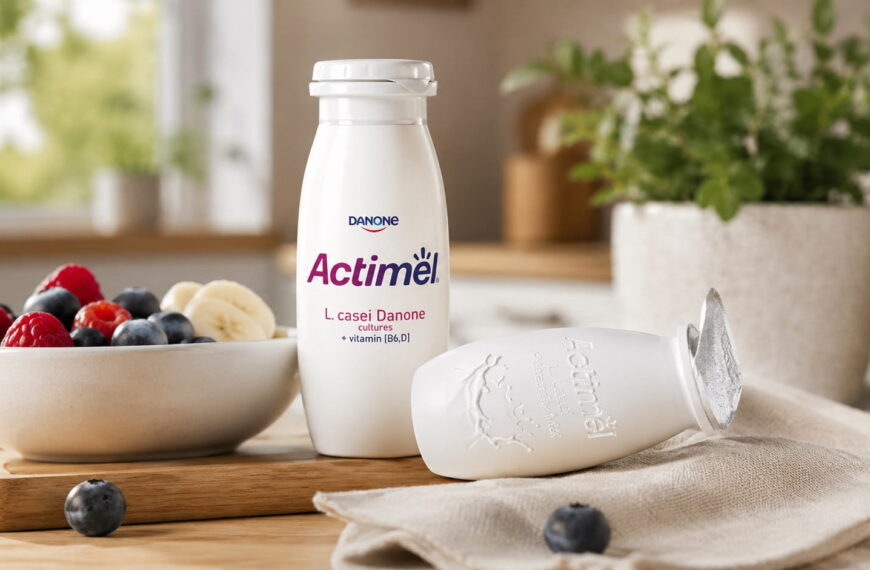

If you’ve ever stood in the dairy aisle holding a little bottle of Actimel, wondering whether it’s actually doing anything for your body, you’re not alone. “Is Actimel good for you?” is one of the most common questions I get asked in clinic, usually from someone who’s just finished a course of antibiotics, or a parent asking if it’s fine to give one to their teenager every morning.
I’m McLee Tembo, Health Consultant and Founder of NFH Clinic. I’ve spent years helping patients separate genuine nutrition science from clever marketing, and Actimel sits in an interesting middle ground: it’s not a miracle drink, but it’s not nothing either. Let’s go through exactly what it can and can’t do for you, based on the evidence and on what I actually see in practice.
What Is Actimel and What’s In It?
Actimel is a fermented dairy shot made by Danone. Each small bottle typically contains:
- A live probiotic strain called Lactobacillus casei Danone (also sold under the name L. paracasei CNCM I-1518)
- Vitamin D
- Vitamin B6
- Milk protein, carbohydrates, and in most standard versions, some added sugar
It’s designed to be drunk daily, in one quick shot, as a small addition to your normal diet — not a meal replacement, and not a supplement in the medical sense.
Is Actimel Good for You? The Short Answer
Yes, for most healthy adults, Actimel is safe and can offer modest benefits — mainly around gut comfort and topping up Vitamin D and B6. But it’s not a cure, a detox, or an immune “boost” in the way adverts sometimes imply. Its real value depends heavily on your starting diet, your gut health, and why you’re drinking it in the first place.
Let’s break each part down.
Actimel Health Benefits: What It Actually Does
1. Gut and Digestive Support
This is where Actimel earns most of its reputation. The L. casei strain it contains has been studied for its role in supporting a balanced gut microbiome. The NHS notes there’s some evidence probiotics can help with certain digestive issues, including easing IBS symptoms, though it’s cautious about broader health claims. Separately, a 2017 Cochrane review of 31 randomised trials found that probiotics, as a category, can reduce the risk of antibiotic-associated diarrhoea — though the strongest evidence sits with specific strains rather than probiotics generally.
That said, probiotics are strain-specific. What works for one product doesn’t automatically transfer to another, and results vary from person to person depending on your existing gut flora and how consistently you take it.
2. Immune Nutrient Support (Not an Immune “Boost”)
Vitamin D and Vitamin B6 both play a genuine role in normal immune function. A standard bottle contributes a meaningful chunk of your daily Vitamin D needs, which matters if your diet or sun exposure is already low.
But here’s the honest clinical view: these vitamins support the immune system that’s already working normally. They don’t supercharge it beyond that. If your diet is already balanced, don’t expect Actimel to noticeably change how often you get sick.
3. Is Actimel Convenient for a Busy Lifestyle?
Compared to capsules, powders, or remembering to eat yogurt with breakfast, a pre-portioned drink is genuinely easier to stick with. For patients who struggle with consistency, that alone can make a difference — adherence is often the deciding factor in whether a habit actually helps you.
Is Actimel Good for IBS?
This is one of the questions I get asked most, so it deserves its own section. Some people with IBS report that probiotic drinks like Actimel ease bloating and irregularity, particularly IBS with a diarrhea-predominant pattern. The evidence for probiotics in IBS overall is mixed — some strains help certain symptom clusters, others show little effect, and response is genuinely individual.
My advice to patients: try it consistently for at least four weeks and track your symptoms — this lines up with NHS guidance on giving probiotics a fair trial period before judging results. If it helps, keep going. If nothing changes, don’t force it — your money is often better spent on soluble fibre or a low-FODMAP approach guided by a dietitian.
Is Actimel Good for Weight Loss?
Not really, and I want to be upfront about this rather than dance around it. Actimel isn’t designed as a weight-loss product, and there’s no solid evidence that the probiotic strain it contains drives fat loss. Some sugar-sweetened versions can even work against a calorie deficit if you’re drinking more than one a day without accounting for it.
If weight management is your goal, choose the 0% added sugar version if you want to include Actimel at all, and treat it as a small nutritional extra — not a strategy.
How Many Actimel Can You Drink Per Day?
For most healthy adults, one bottle a day is the standard serving, and that’s genuinely all you need to get the intended benefit. The vitamins and probiotic culture are dosed for a single daily shot, not for stacking.
Is It OK to Drink 2 Actimel a Day?
Occasionally, yes — it won’t harm most healthy adults. But drinking two or more daily, every day, isn’t necessary and isn’t more effective. You’ll simply be taking in extra sugar and calories without extra benefit, since the probiotic dose beyond one serving doesn’t appear to add proportional gut benefit.
What Happens If You Drink Too Much Actimel?
Overdoing it — several bottles a day, consistently — can lead to a few unwanted effects:
- Mild bloating or gas as your gut adjusts to a higher probiotic load
- Extra sugar intake, which matters for blood sugar control and weight
- Loose stools in some people, ironically the opposite of the digestive comfort you’re after
None of this is dangerous for most people, but it’s a good reminder that more isn’t automatically better with probiotics.
Does Actimel Have a Lot of Sugar?
This is where I want patients to slow down and read labels rather than trust the front-of-pack marketing. Standard Actimel Original contains around 74 kcal and roughly 11g of sugar per 100g bottle — a little over a third of the recommended daily free-sugar limit for an adult, according to UK nutrition panel data. The 0% Fat, 0% Added Sugar version cuts this dramatically, down to around 27–29 kcal and roughly 3g of naturally occurring milk sugar per bottle, with no added sweeteners.
Why this matters clinically:
- Regular added sugar intake affects metabolic health over time
- It matters more if you have insulin resistance, prediabetes, or are managing weight
- The probiotic benefit doesn’t depend on the sugar — so choosing the low-sugar version costs you nothing in terms of gut support
My practical tip: always flip the bottle and check the nutrition panel. Formulations vary by country and change over time, so don’t assume the version on your shelf matches what you read online.
Who Should Avoid Actimel?
Actimel is dairy-based, so a few groups should think twice:
- Milk allergy — avoid entirely
- Severe lactose intolerance — fermentation reduces lactose but doesn’t remove it fully, so symptoms are still possible
- Immune-compromised patients — speak to your doctor before adding any live-culture product
- Pregnancy — Actimel itself is generally considered safe as a pasteurised, live-culture dairy product, but if you’re pregnant and introducing any new probiotic to your routine, it’s worth a quick check with your midwife or GP first
- Chronic, unexplained digestive symptoms — these need proper clinical evaluation, not a daily yogurt drink as a workaround
Is Actimel Good for Adults?
Yes — Actimel is formulated and marketed primarily for adults and teenagers, and it’s perfectly appropriate for healthy adults as part of a normal diet. It’s not specifically designed for young children, and if you’re considering it for a child under three, check with your GP or pediatrician first, since probiotic and vitamin needs differ at that age.
Actimel vs Yakult: What’s the Difference?
Both are fermented probiotic drinks, but they’re not identical:
| Actimel | Yakult | |
|---|---|---|
| Base | Dairy (milk-based) | Fermented milk, lower dairy content |
| Main strain | L. casei Danone | L. casei Shirota |
| Vitamins added | Vitamin D and B6 | Typically none added |
| Serving size | ~100g | ~65-100ml, smaller shot |
Neither is objectively “better” — they use different, patented probiotic strains, and the research behind each is strain-specific. If you’re choosing between them, it often comes down to taste preference and whether you want the added vitamins Actimel includes.
Is Actimel Good for You? What Reddit and Real Users Say
Beyond clinical studies, anecdotal reports — including plenty of discussion on forums like Reddit — tend to echo what the research suggests: many people notice mild digestive improvements, particularly around antibiotic courses or occasional bloating, while others notice no difference at all. That split is expected with probiotics, since individual gut microbiomes respond differently to the same strain.
Actimel in Practice: Real Patient Examples From My Clinic
During antibiotics: A 32-year-old patient with a history of antibiotic-associated diarrhea added a daily probiotic drink alongside her prescription. She reported noticeably less digestive discomfort compared to previous antibiotic courses — a pattern I see often enough to recommend it as a reasonable, low-risk addition during treatment.
General wellness: A 40-year-old patient with no digestive complaints asked if Actimel would improve his immunity. After explaining that the vitamins support — rather than boost — immune function, he chose to focus on sleep, exercise, and diet quality instead, which is usually where the bigger gains are.
Mild bloating: A 27-year-old with occasional bloating tried a probiotic drink alongside increasing her fibre intake. Symptoms improved slightly, but the combination of habits mattered more than the drink alone.
What the Evidence Says About Actimel
Pulling this together, current probiotic research consistently points to a few honest conclusions:
- Effects are strain-specific — you can’t generalize from one probiotic to another
- The strongest evidence is for antibiotic-associated diarrhea and some IBS symptom patterns
- Evidence for general immune “boosting” in already-healthy people is weak to modest
- Diet quality and lifestyle habits outweigh any single product
Who Benefits Most From Actimel?
Likely to notice a difference:
- People currently on antibiotics
- Those with low Vitamin D intake
- People wanting a convenient, low-effort probiotic source
- Those with mild, occasional digestive discomfort
Less likely to notice much:
- People who already eat a nutrient-dense, varied diet
- Anyone expecting a dramatic immune or weight-loss effect
Practical Guidance for Drinking Actimel Safely
If you decide to include Actimel in your routine:
- Stick to one bottle a day — that’s the effective dose
- Choose the 0% added sugar version where available
- Don’t rely on it instead of fibre, sleep, or exercise — it complements those habits, it doesn’t replace them
- Check the label each time you buy, since formulations shift by market and over time
- If you have a chronic digestive condition, get it properly assessed rather than self-treating with a yogurt drink
FAQs
Is it healthy to drink Actimel every day?
For most healthy adults, one bottle a day is safe and can offer modest gut and vitamin support. Those with lactose intolerance, milk allergy, or a compromised immune system should check with a doctor first.
Does Actimel really help your immune system?
It contributes Vitamin D and B6, which support normal immune function — but it doesn’t boost immunity beyond healthy baseline levels. Overall diet and lifestyle matter far more.
Is Actimel good for gut health?
Yes, to a reasonable degree. The L. casei strain may help maintain microbiome balance and ease mild digestive discomfort, though individual results vary.
Is Actimel good for weight loss?
No — it isn’t designed for this, and there’s no solid evidence it drives fat loss. Choose the sugar-free version if you’re managing weight.
How many Actimel can you drink a day?
One bottle daily is the intended serving. Drinking two occasionally won’t cause harm, but more isn’t more effective.
What happens if you drink too much Actimel?
Possible mild bloating, loose stools, or unnecessary extra sugar intake — not dangerous, but not beneficial either.
Is Actimel good for adults?
Yes, it’s formulated for adults and teens as part of a normal diet.
Actimel vs Yakult — which is better?
Neither is universally better; they use different probiotic strains and serving sizes. Choice usually comes down to taste and whether you want the added vitamins in Actimel.
Who should avoid Actimel?
Anyone with a milk allergy, severe lactose intolerance, or an immune-compromising condition should avoid it or check with a doctor first.
Final Verdict: Is Actimel Good for You?
Yes, with realistic expectations. Actimel can be a genuinely useful, low-effort addition to your diet — particularly around antibiotic courses, mild digestive discomfort, or as a convenient Vitamin D top-up. It is not essential, not a weight-loss tool, and not a substitute for the fundamentals: real food, fibre, sleep, and movement.
Use it as one small piece of a bigger picture, and it can genuinely earn its place in your fridge.
Still not sure if Actimel — or a different approach to your gut health — is right for you? Book a one-to-one consultation with NFH Clinic and we’ll look at your diet, symptoms, and goals together, rather than guessing from a label.
Sources
- NHS — Probiotics
- NHS — Good foods to help your digestion
- Goldenberg JZ, et al. Probiotics for the prevention of Clostridium difficile-associated diarrhea in adults and children. Cochrane Database of Systematic Reviews
- Danone — official Actimel UK product and ingredient information
- UK retailer nutrition panel data (Actimel Original and 0% Added Sugar ranges)
Related Articles: