
Quick answer: Yes, chronically elevated cortisol can raise blood pressure. The strongest evidence points to reduced nitric oxide activity, which normally lets blood vessels relax, combined with increased vessel sensitivity to constricting hormones, activation of the renin-angiotensin system, and some degree of sodium and fluid retention. Over time, this combination can drive persistent hypertension, particularly in people under chronic stress or with an underlying condition like Cushing’s syndrome.
A few years into running NFH Clinic, I noticed a pattern I couldn’t ignore. Client after client would walk in with the same combination: creeping blood pressure numbers, disrupted sleep, a stressful job, and a growing belly they couldn’t explain with diet alone. Their doctors had them on antihypertensives, sometimes two or three, and the numbers still wouldn’t budge. Almost none of them had ever had their cortisol checked.
That’s the gap this article is meant to close. Cortisol isn’t just “the stress hormone” you read about in wellness blogs, it’s a genuine driver of high blood pressure, and the connection between cortisol and hypertension is backed by a growing body of clinical research.
Overview
This article breaks down exactly how cortisol raises blood pressure, who’s most at risk, the symptoms that tend to show up first (especially in women), how doctors test for it, and what actually works to bring both cortisol and blood pressure down, alongside your prescribed medical treatment, not instead of it.
Quick facts
| Condition linked to cortisol | Hypertension (high blood pressure), particularly resistant hypertension |
| How common | 27.3% of resistant hypertension patients had hypercortisolism in a 2026 U.S. study (MOMENTUM) |
| Main mechanisms | Reduced nitric oxide (leading driver), vessel constriction, RAAS activation, sodium retention |
| Who’s most affected | Shift workers, caregivers, people with sleep apnea, chronic anxiety, or long-term corticosteroid use |
| How it’s tested | Salivary cortisol, 24-hour urinary cortisol, dexamethasone suppression test, ACTH test |
| Is it reversible | Often yes, with treatment of the underlying cause and consistent lifestyle changes over weeks to months |
Key takeaways
- Cortisol helps regulate blood pressure normally, but chronic elevation pushes it too high.
- Excess cortisol raises blood pressure mainly by suppressing nitric oxide and increasing vessel reactivity, with sodium retention playing a smaller supporting role, not stress alone.
- Persistent high blood pressure despite medication can be a sign of undiagnosed hypercortisolism.
- Lifestyle changes that improve sleep and stress regulation support both cortisol and blood pressure.
- Rapid weight gain, muscle weakness, or resistant hypertension warrant medical evaluation for an endocrine cause.
In this article:
- The Numbers: How Common Is Cortisol-Driven Hypertension?
- What Is Cortisol, and What Does It Actually Do?
- How Does Cortisol Increase Blood Pressure?
- Cortisol Hypertension: Acute vs. Chronic Effects
- Who's Most at Risk of Cortisol-Related Hypertension?
- Symptoms of High Cortisol Levels in Females
- How Is High Cortisol Diagnosed? (Cortisol Test Options)
- When Should You See a Doctor About Cortisol and Hypertension?
- Treatment for High Cortisol and How to Lower It Alongside Blood Pressure
- Frequently Asked Questions
- Where NFH Clinic Fits In
- References
The Numbers: How Common Is Cortisol-Driven Hypertension?
This isn’t a fringe theory. In March 2026, a large multicenter study called MOMENTUM screened over 1,000 patients with resistant hypertension, meaning blood pressure that stays high despite three or more medications, and found that 27.3% of them had hypercortisolism, elevated cortisol from an internal source rather than medication. That’s specific to the hardest-to-treat cases. Zoom out to ordinary, garden-variety high blood pressure and the pattern still holds: clinical researchers reviewing decades of human studies estimate that cortisol dysregulation may play a role in as much as 30% of all essential hypertension, not just the resistant, treatment-defying kind.
Put those two figures together and the takeaway is clear: cortisol testing is being overlooked in a meaningful share of people whose blood pressure “just won’t respond.”
What Is Cortisol, and What Does It Actually Do?
Cortisol is a steroid hormone made by your adrenal glands, two small structures that sit on top of your kidneys, under direction from your brain’s HPA axis (hypothalamus, pituitary, and adrenal glands working together). It follows a daily rhythm: highest in the early morning to help you wake up and get moving, lowest at night so your body can rest and repair.
Cortisol’s function goes well beyond stress. It regulates blood sugar, controls inflammation, influences metabolism, and helps your body respond to physical or emotional demands. In short bursts, it’s protective. The trouble starts when cortisol stays elevated for weeks or months, whether from chronic stress, poor sleep, untreated anxiety, prolonged corticosteroid use, or an underlying condition like Cushing’s syndrome.
What’s a normal cortisol level?
| Time of Day | Typical Range (blood, mcg/dL) |
|---|---|
| Morning (around 8 a.m.) | 6 – 23 |
| Afternoon/Evening | 3 – 13 |
| Late night (should be lowest) | Below 5 |
Reference ranges vary by lab, so treat this as a general guide, not a diagnosis. What matters more than a single number is whether your rhythm has flattened, meaning cortisol stays elevated at night instead of dropping, which is a common pattern in chronic stress and is itself linked to higher blood pressure.
How Does Cortisol Increase Blood Pressure?
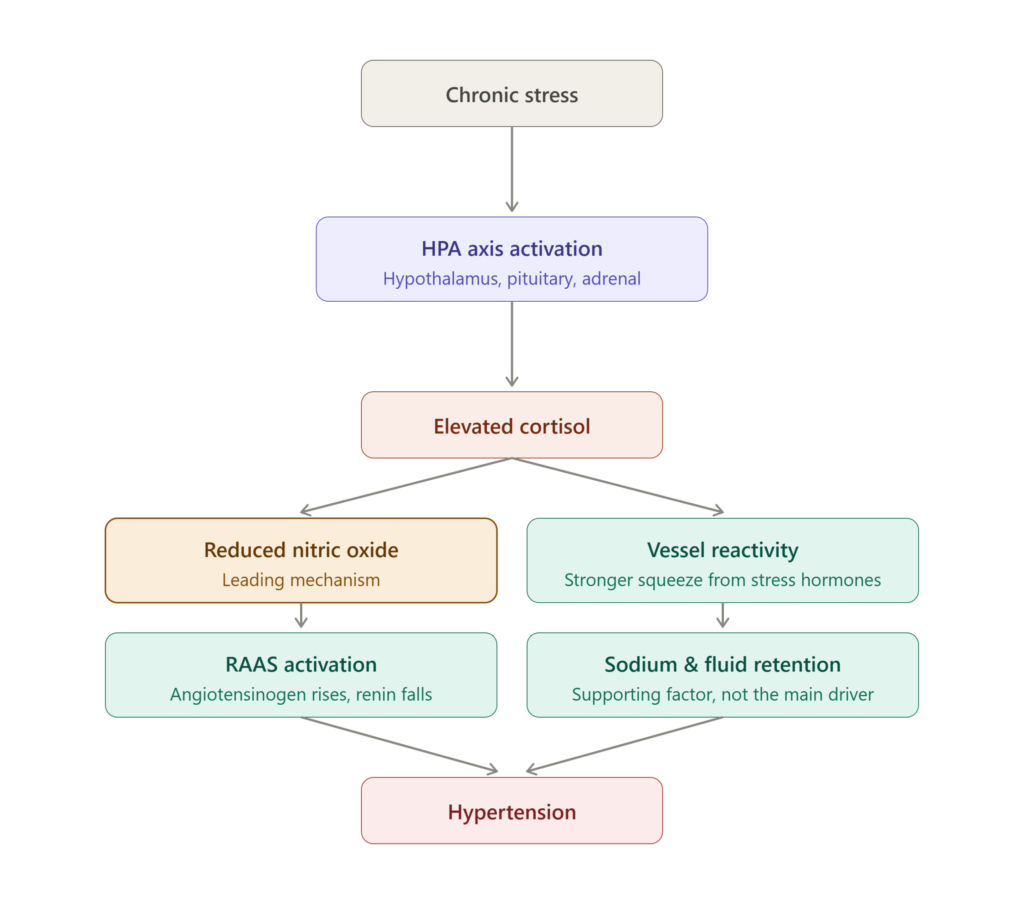
This is the question I get asked most often, and it deserves a proper answer instead of the usual one-liner about “fight or flight.” Cortisol raises blood pressure through several overlapping mechanisms:
1. Sodium and fluid retention
At higher concentrations, cortisol binds to mineralocorticoid receptors in the kidneys, the same receptors aldosterone normally uses, causing the kidneys to hold onto more sodium and water. This was long assumed to be the main driver of cortisol hypertension. More recent human studies complicate that picture: blocking this pathway with a mineralocorticoid antagonist doesn’t reliably stop the blood pressure rise, which tells researchers sodium retention is a contributing factor rather than the whole explanation.
2. Increased vascular reactivity
Cortisol makes your blood vessels more sensitive to substances that constrict them, like adrenaline and angiotensin II. Even normal levels of these compounds produce a stronger squeezing effect on your arteries when cortisol is elevated.
3. Suppressed nitric oxide, the leading candidate mechanism
Nitric oxide is what allows blood vessels to relax and widen. Human studies on cortisol-induced hypertension consistently point to reduced nitric oxide activity as the strongest single mechanism, more so than fluid retention or nervous system overactivity. Chronically high cortisol blunts this relaxation response, so vessels stay more constricted than they should.
4. Activation of the renin-angiotensin system
Excess cortisol boosts the liver’s production of angiotensinogen, a precursor molecule in the same hormone pathway that regulates blood pressure and fluid balance. Curiously, this happens even as renin and circulating angiotensin II typically fall, which is part of why cortisol-related hypertension is easy to miss on standard testing that looks for high renin.
5. Weight gain and insulin resistance
Long-term cortisol elevation tends to redistribute fat to the abdomen and worsen insulin sensitivity, both of which independently raise cardiovascular risk and add to the blood pressure burden over time.
Cortisol doesn’t just add stress to your day, it physically reshapes how your kidneys, blood vessels, and hormone systems manage pressure. That’s why someone can be doing “everything right” with diet and exercise and still have blood pressure that won’t come down, if unmanaged stress and cortisol are sitting underneath it.
Cortisol Hypertension: Acute vs. Chronic Effects
Not all cortisol elevation is a problem. The distinction between a short-term spike and long-term elevation is the whole story of cortisol hypertension. Occasional stress spikes cortisol and blood pressure briefly, then both return to baseline. Chronic stress keeps that tap running, and over months and years, repeated elevation has also been linked to arterial stiffening and a higher rate of cardiovascular events, independent of cholesterol and other traditional risk factors.
| Acute Cortisol Spike | Chronic Cortisol Elevation | |
|---|---|---|
| Duration | Minutes to hours | Weeks to months or longer |
| Purpose | Adaptive, helps you respond to a demand | Pathological once prolonged |
| Effect on blood pressure | Brief rise, then returns to baseline | May sustain hypertension over time |
| Common trigger | A single stressful event, exercise, waking up | Chronic stress, poor sleep, untreated anxiety, endocrine disorders |
| Reversibility | Resolves on its own | Often reversible with treatment, but takes weeks to months |
If your blood pressure rises briefly during a stressful meeting and settles afterward, that’s a normal, adaptive response. It’s the second column, sustained elevation, that turns into clinical hypertension.
Who’s Most at Risk of Cortisol-Related Hypertension?
Cortisol-driven blood pressure problems tend to cluster in certain groups. You may be at higher risk if you:
- Work rotating night shifts or chronically irregular hours
- Are a long-term caregiver for a family member
- Have untreated sleep apnea
- Live with chronic anxiety or unmanaged depression
- Carry excess weight, particularly around the abdomen
- Use corticosteroid medications long-term
- Have a diagnosed or undiagnosed adrenal or pituitary condition
If several of these apply to you alongside resistant hypertension, it’s worth raising cortisol specifically with your doctor rather than assuming it’s “just stress.”
Symptoms of High Cortisol Levels in Females
Cortisol dysregulation often shows up differently in women than in men, and it’s frequently mistaken for something else entirely: perimenopause, thyroid issues, or simple burnout. Common signs to watch for include:
- Persistent fatigue that doesn’t improve with sleep
- Weight gain concentrated around the midsection, face, or upper back
- Irregular or missed menstrual cycles
- Difficulty falling or staying asleep despite feeling exhausted
- Mood changes, anxiety, or irritability out of proportion to the situation
- Thinning skin, easy bruising, or slow-healing wounds
- Persistent high blood pressure that resists standard treatment
- Elevated blood sugar or new insulin resistance
- Hair thinning or increased facial hair growth
None of these symptoms alone confirms high cortisol. But when several show up together, especially alongside blood pressure that isn’t responding to medication, it’s worth investigating cortisol rather than treating each symptom in isolation.
How Is High Cortisol Diagnosed? (Cortisol Test Options)
A few tests can clarify what’s happening:
- Salivary cortisol testing, often done late at night, checks whether your natural cortisol rhythm has flattened out, which is common in chronic stress states.
- 24-hour urinary free cortisol measures total cortisol output over a full day.
- Morning serum cortisol and, when indicated, a dexamethasone suppression test help rule out or confirm conditions like Cushing’s syndrome.
- ACTH testing determines whether excess cortisol is coming from the adrenal glands themselves or a signal from the pituitary gland.
When Should You See a Doctor About Cortisol and Hypertension?
Seek medical evaluation, not just lifestyle changes, if you notice:
Know your numbers. Current U.S. guidelines define hypertension starting at 130/80 mmHg, not the older 140/90 threshold many people still remember:
| Category | Systolic (mmHg) | Diastolic (mmHg) |
|---|---|---|
| Normal | Below 120 | Below 80 |
| Elevated | 120–129 | Below 80 |
| Stage 1 hypertension | 130–139 | 80–89 |
| Stage 2 hypertension | 140 or higher | 90 or higher |
Beyond the numbers themselves, also watch for:
- Hypertension that stays uncontrolled despite three or more medications (resistant hypertension)
- Rapid weight gain, especially with purple stretch marks
- Unexplained muscle weakness
- Frequent, unexplained bruising
- Recurrent headaches paired with severely elevated blood pressure
If any of these apply and no one has checked your cortisol, that’s a specific, low-cost question to bring to your next appointment, not a vague concern to mention in passing.
Questions worth asking your doctor
- Could my blood pressure be related to a hormone problem rather than only lifestyle factors?
- Should I be screened for hypercortisolism given my current medications and symptoms?
- Which test makes the most sense for me: salivary, urinary, or a dexamethasone suppression test?
- If my cortisol is elevated, would that change my current blood pressure treatment plan?
- Are any of my current medications capable of raising cortisol or blood pressure as a side effect?
Treatment for High Cortisol and How to Lower It Alongside Blood Pressure
Treatment depends on the underlying cause. If a tumor or a specific condition like Cushing’s syndrome is driving the excess cortisol, that requires medical or surgical management, and no amount of lifestyle change substitutes for that. But for the far more common scenario, chronic stress-driven cortisol elevation, there’s a genuine, evidence-supported path forward.
Medical treatment may include:
- Surgery, when a pituitary or adrenal tumor is the cause
- Cortisol-lowering medications prescribed and monitored by an endocrinologist
- Adjusting or tapering corticosteroid medications, when those are the source
- Treating underlying sleep apnea, which independently elevates both cortisol and blood pressure
- Structured weight management, since excess weight and cortisol elevation often reinforce each other
- Standard blood pressure medications, used alongside the above rather than instead of them
This medical layer is where your physician leads. What follows is the lifestyle layer, which works alongside it.
1. Prioritize consistent, quality sleep
Poor sleep is one of the strongest drivers of elevated cortisol. A consistent sleep and wake time, even on weekends, helps restore your natural cortisol rhythm faster than almost anything else.
2. Build in structured stress management
This isn’t about eliminating stress, that’s not realistic. It’s about a regular practice that downregulates your nervous system. Breathwork, progressive muscle relaxation, mindfulness-based stress reduction, and short daily walks all have measurable effects on cortisol output.
3. Move regularly, but don’t overtrain
Moderate exercise lowers baseline cortisol and improves blood pressure over time. Excessive, high-intensity training without adequate recovery can do the opposite, so the type and volume of exercise matters as much as doing it at all.
4. Reduce caffeine and alcohol, particularly later in the day
Both interfere with cortisol regulation and sleep quality, compounding the problem.
5. Rebalance sodium and potassium intake
Since cortisol drives sodium retention, a diet built around whole foods, adequate potassium from vegetables and fruit, and lower processed sodium supports blood pressure independent of cortisol status. A DASH-style eating pattern is well suited to this.
6. Consider supplements carefully, and only alongside guidance
| Supplement | Evidence for Cortisol | Blood Pressure Benefit | Notes |
|---|---|---|---|
| Magnesium | Moderate | Indirect, via sleep and vascular tone | Generally well tolerated |
| Ashwagandha | Moderate | Indirect | Avoid with certain thyroid conditions or during pregnancy |
| Phosphatidylserine | Limited to moderate | Indirect | Based on small studies |
| Omega-3 fatty acids | Moderate for cardiovascular support | More direct cardiovascular benefit | Not a direct cortisol reducer |
These supplements complement, not replace, addressing the root cause and any prescribed medication. They can also interact with blood pressure drugs, so this is exactly the kind of decision that benefits from professional guidance rather than guesswork.
7. Treat blood pressure and cortisol as connected, not separate, problems
This is where standard hypertension care often falls short. Medication controls the numbers, but if chronic cortisol elevation is still driving the underlying physiology, you’re managing a symptom rather than the cause.
Frequently Asked Questions
Can stress alone cause hypertension?
Stress alone doesn’t guarantee hypertension in every person, but chronic, unmanaged stress is a well-documented contributing factor, largely through its effect on cortisol and the cardiovascular system over time.
Can cortisol cause temporary high blood pressure?
Yes. A short-term cortisol spike, from an acute stressful event, will typically raise blood pressure briefly, and both return to normal once the stressor passes. It’s sustained elevation that causes lasting hypertension.
Can cortisol cause hypertension without Cushing’s syndrome?
Yes. Cushing’s syndrome is the most extreme form of cortisol excess, but milder, chronic elevation from stress, poor sleep, or lifestyle factors can still meaningfully raise blood pressure without meeting the criteria for Cushing’s.
Can blood pressure return to normal after cortisol decreases?
Often, yes, particularly if the elevation was driven by lifestyle and stress rather than a structural adrenal or pituitary problem. Improvement usually takes weeks to months of consistent change, not days.
Does high cortisol affect diastolic blood pressure specifically?
Cortisol can raise both systolic and diastolic blood pressure, since it affects vascular tone and fluid balance, both of which influence the resting pressure between heartbeats as well as the peak pressure during them.
Can anxiety permanently raise blood pressure?
Anxiety itself is more associated with temporary spikes, but chronic anxiety that keeps cortisol elevated over months or years can contribute to sustained hypertension, especially when combined with poor sleep and reduced physical activity.
Expert summary: Cortisol is essential for normal health, but prolonged elevation can contribute to hypertension, primarily through suppressed nitric oxide activity and heightened blood vessel reactivity, with sodium retention and renin-angiotensin activation playing supporting roles. If you have resistant high blood pressure, poor sleep, central weight gain, or symptoms suggesting excess cortisol, speak with your healthcare provider about whether further evaluation is appropriate. Lifestyle changes can meaningfully improve cortisol regulation, but medical causes such as Cushing’s syndrome require proper diagnosis and treatment first.
Where NFH Clinic Fits In
This is precisely the gap our stress and hypertension coaching at NFH Clinic was built to close. We don’t replace your doctor or your prescribed medication, and we won’t ever suggest you should. What we do is work alongside your medical treatment to address the lifestyle and stress-physiology side of your blood pressure: building a personalized plan around sleep, structured stress reduction, movement, and nutrition, with regular check-ins to track how your body is actually responding.
If your blood pressure has been stubborn despite doing “all the right things,” or you recognize some of the cortisol symptoms above in yourself, it’s worth having a real conversation about what’s driving it rather than just adjusting the dose again.
Ready to find out if cortisol is behind your blood pressure numbers? Book a consultation with NFH Clinic and let’s look at the whole picture, not just the reading on the cuff.
References
- The Mount Sinai Hospital / Mount Sinai School of Medicine. “This overlooked hormone could be why your blood pressure won’t drop.” ScienceDaily, March 30, 2026. — MOMENTUM study results, presented at the American College of Cardiology’s Annual Scientific Session.
- American Heart Association Newsroom. “Elevated stress hormones linked to higher risk of high blood pressure and heart events.”
- Endocrine Society. “Endocrine-Related Hypertension.” Endocrine Library.
- American Heart Association Journals (Hypertension). “Cortisol, Cortisone, and Cardiovascular Disease.”
- Whitworth JA, Williamson PM, Mangos G, Kelly JJ. “Cardiovascular Consequences of Cortisol Excess.” Vascular Health and Risk Management, 2005. — review of human studies on cortisol-induced hypertension mechanisms and prevalence in essential hypertension.
- Verywell Health. “What Happens to Your Blood Pressure When Your Cortisol Levels Are High?”
Related Articles: