
In this article
- 30-30-30 Wellness Routine Guidelines: Quick Answer
- 30-30-30 Wellness Routine Guidelines: Key Takeaways
- What Is the 30-30-30 Wellness Routine?
- How the 30-30-30 Rule Works
- What the 30-30-30 Wellness Routine Doesn't Mean
- Scientific Evidence for the 30-30-30 Wellness Routine
- Benefits of the 30-30-30 Wellness Routine
- Risks of the 30-30-30 Wellness Routine
- Who Should Try the 30-30-30 Wellness Routine?
- Who Should Avoid the 30-30-30 Wellness Routine?
- Should You Try the 30-30-30 Wellness Routine? A Quick Decision Guide
- Step-by-Step Beginner Guide to the 30-30-30 Wellness Routine
- 30-30-30 Wellness Routine: 30-Day Starter Plan
- 30-30-30 Morning Routine Checklist
- 30-30-30 Wellness Routine Guidelines PDF and Printable Resources
- 30-30-30 Protein Guide
- 30-30-30 Protein Food Examples
- 30-30-30 Exercise Examples
- 30-30-30 Walking Plan
- 30-30-30 Strength Training Ideas
- 30-30-30 Meal Planning Tips
- 30-30-30 Breakfast Examples
- Sample 30-30-30 Daily Schedule
- 30-30-30 Wellness Routine: Realistic Results Timeline
- Common Mistakes in the 30-30-30 Wellness Routine
- Expert Tips for the 30-30-30 Wellness Routine
- When to Stop or Modify the 30-30-30 Routine
- 30-30-30 Wellness Routine: Myths vs. Facts
- 30-30-30 Wellness Routine Comparison Tables
- How Men Can Benefit From the 30-30-30 Wellness Routine
- How Women Can Benefit From the 30-30-30 Wellness Routine
- 30-30-30 Wellness Routine for Older Adults
- 30-30-30 Wellness Routine for Busy Professionals and Shift Workers
- 30-30-30 Wellness Routine Guidelines: Frequently Asked Questions
- Conclusion: Is the 30-30-30 Wellness Routine Worth It?
30-30-30 Wellness Routine Guidelines: Quick Answer
The 30-30-30 rule became popular because it promises a simple morning routine for weight loss without strict dieting. But does it actually work? The honest answer is yes — and no. The routine builds on habits that nutrition and exercise research genuinely support, but it isn’t a scientifically validated weight-loss formula in its own right.
What it is: The 30-30-30 wellness routine is a morning habit stack. Eat 30 grams of protein within 30 minutes of waking up, then do 30 minutes of low-intensity, steady-state exercise like walking. There’s no calorie counting and no food elimination involved.
Early research on high-protein breakfasts and morning low-intensity cardio supports parts of the method, but no clinical trial has tested the exact “30-30-30” combination as a single protocol. It works best as a consistency tool, not a magic formula.
30-30-30 Wellness Routine Guidelines: Key Takeaways
- The routine combines two habits: a 30g protein breakfast and 30 minutes of low-intensity movement, both within the first hour of waking.
- It was popularized on social media by biohacker Gary Brecka and traces back to Tim Ferriss’s The 4-Hour Body.
- The individual components — protein-forward breakfasts and daily low-intensity cardio — have real support in nutrition and exercise science.
- The specific “30 grams, 30 minutes, 30 minutes” framing itself hasn’t been tested as one unit in peer-reviewed trials.
- It’s not a diet. You still need an overall calorie deficit to lose fat.
- It may help with satiety, blood sugar stability, and muscle preservation when paired with adequate daily protein.
- It’s generally beginner-friendly, but people with diabetes, certain heart conditions, or eating disorder history should adapt it with medical guidance.
What Is the 30-30-30 Wellness Routine?
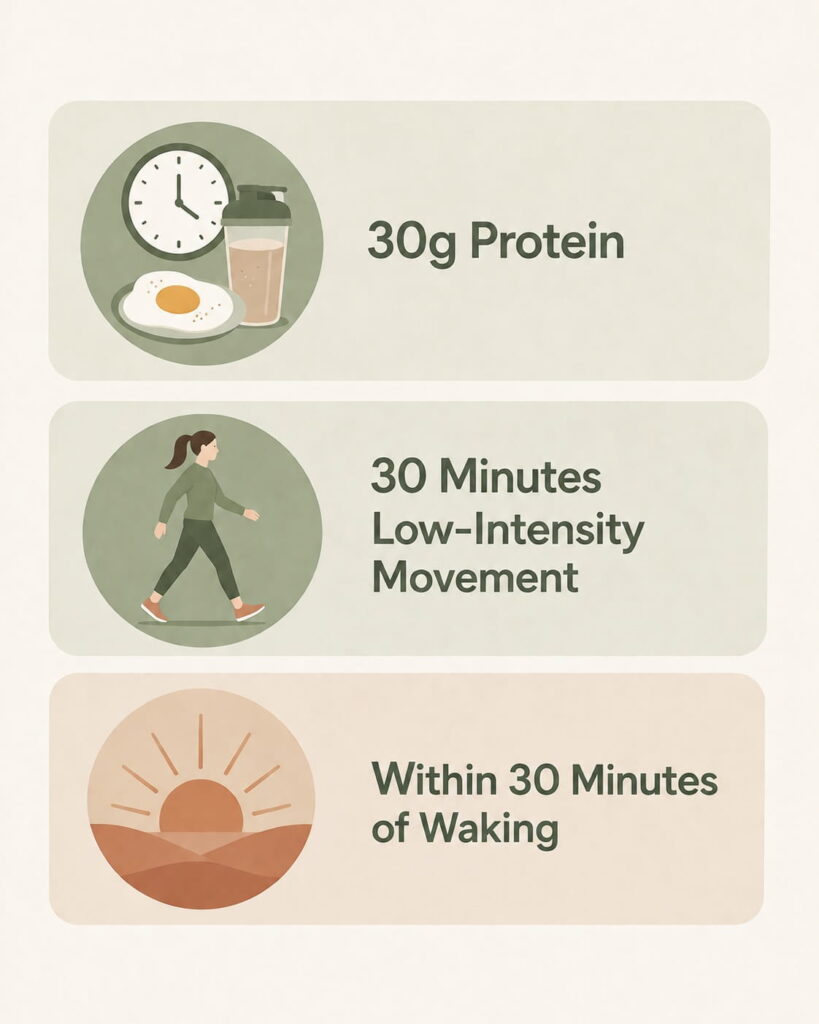
The 30-30-30 wellness routine is a simple morning framework built around two actions performed back-to-back:
- Eat 30 grams of protein within 30 minutes of waking up.
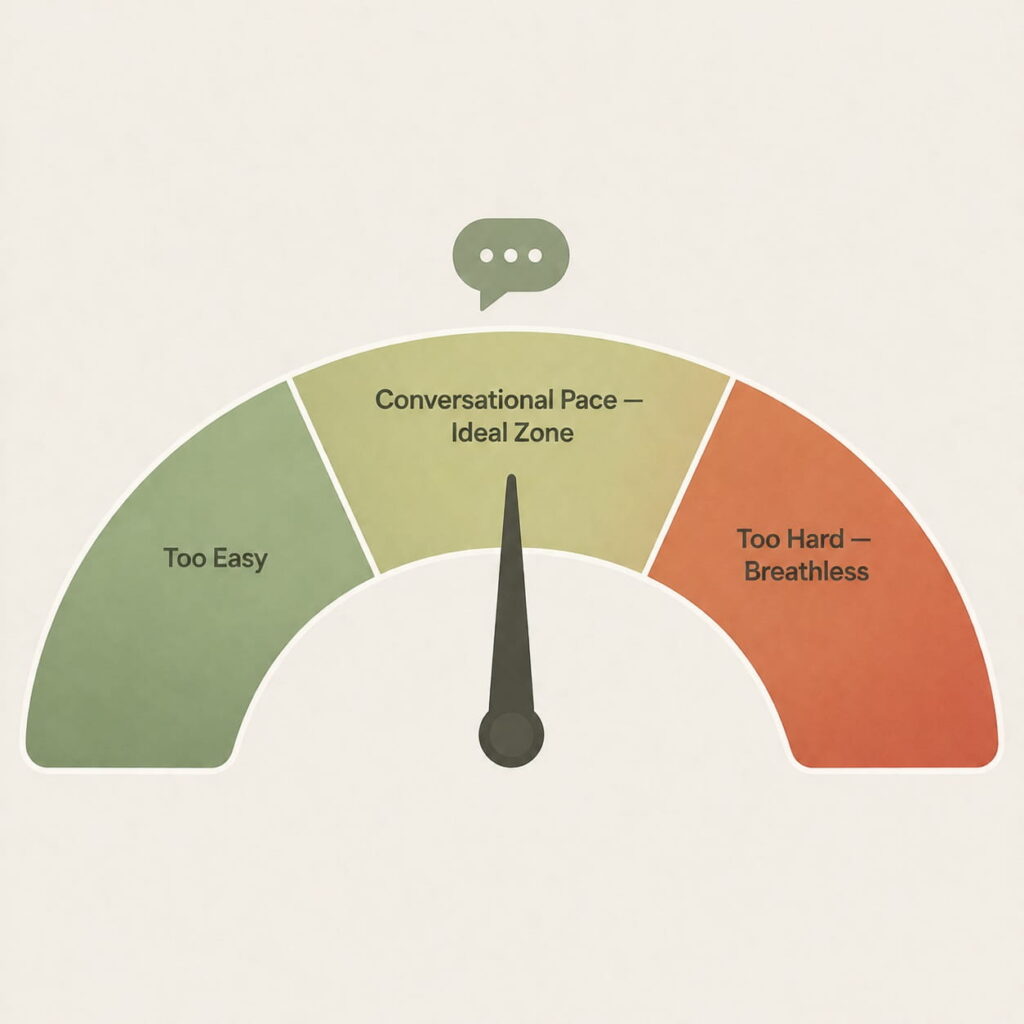
- Move for 30 minutes at low intensity — think brisk walking, easy cycling, or swimming at a pace where you can still hold a conversation.
That’s the entire method. There’s no macro tracking, no banned food groups, and no requirement for intense training. The routine does not involve making any other changes to your diet or workout routine — no counting calories, no restricting, and no intense workouts.
The idea gained mainstream traction after biologist and human performance coach Gary Brecka discussed it publicly, but the concept traces back further to Tim Ferriss, who described a similar approach in his book “The 4-Hour Body.” From there it moved onto TikTok and Instagram, where it built a following of millions of people posting before-and-after transformations they credit to the plan.
It’s worth distinguishing this from a similarly named trend: despite the similar-sounding name, the 30-30-30 rule has nothing to do with the viral 12-3-30 treadmill workout.
How the 30-30-30 Rule Works
The routine rests on two physiological levers.
Lever 1: Front-loading protein. Eating a protein-forward meal early in the day is thought to support satiety, reduce hunger hormone activity, and give your body amino acids to work with after an overnight fast. A dietitian interviewed on the topic explained that eating protein within 30 minutes of waking is meant to prevent muscle breakdown, support satiety, and help regulate hunger hormones like ghrelin, and that high-protein meals have been shown to suppress ghrelin, increasing feelings of fullness.
Lever 2: Fasted or near-fasted low-intensity movement. Walking or other easy cardio shortly after waking, before or shortly after eating, is intended to optimize metabolism, improve insulin sensitivity, and encourage fat loss over time through consistent daily practice. The intensity matters: this is meant to be gentle. Your heart rate shouldn’t rise much, and you should still be able to hold a conversation without going breathless.
Put together, the theory is that a stable blood sugar response plus a light metabolic “nudge” first thing in the morning sets a better tone for appetite, energy, and fat metabolism for the rest of the day. None of this replaces the fundamentals of body composition change — total daily protein, total daily activity, sleep, and overall calorie balance still do most of the work.
Quick Tip: Preparing your breakfast the night before makes it far easier to actually hit the 30-minute window — decision fatigue, not lack of willpower, is what derails most mornings.
What the 30-30-30 Wellness Routine Doesn’t Mean
The name makes this routine sound stricter than it is. A few common misreadings are worth clearing up before you start:
- You don’t have to hit the 30-minute mark exactly. Eating your protein at minute 40 instead of minute 25 will not undo the routine. Consistency across weeks matters far more than precision on any single morning.
- You don’t need exactly 30 grams every day. Getting close — 25 to 35 grams — still delivers the intended benefit. Treat it as a target, not a pass/fail test.
- Walking isn’t the only option. Cycling, swimming, an elliptical, or even a brisk household chore session all satisfy the “low-intensity movement” part of the routine.
- You don’t need protein powder or supplements. Whole foods like eggs, yogurt, and cottage cheese work just as well, and often better, than processed shakes or bars.
- It isn’t a replacement for healthy eating overall. A great breakfast doesn’t cancel out a poor lunch, dinner, or snacking pattern. The routine is a foundation, not the whole structure.
Scientific Evidence for the 30-30-30 Wellness Routine
Here’s where nuance matters. The individual pieces of the 30-30-30 routine have decent research behind them individually. The exact combination, timed exactly this way, has not been studied as its own protocol.
On the protein side
There is research suggesting a threshold effect for muscle protein synthesis. One industry-produced breakdown of the concept states that studies show consuming 30 grams of protein at breakfast can produce roughly a 30 percent increase in muscle protein synthesis compared to eating just 10 grams. Muscle-centric medicine researcher Dr. Gabrielle Lyon has argued that a threshold intake of around 30 grams of high-quality protein per meal is needed to meaningfully stimulate muscle protein synthesis, and that consistently falling short of that threshold may have negative effects on metabolic health over time.
On the exercise side
Low-intensity steady-state (LISS) cardio, especially in a fasted or lightly-fed state, has long been discussed in exercise physiology as a way to preferentially use fat for fuel, though the total-calorie-burned difference between fasted and fed cardio over a full day is smaller than social media often implies.
On the combined protocol
Independent experts are candid that direct evidence is thin. One fitness-industry review noted plainly that scientific research on the precise 30-30-30 breakdown is limited. When one health outlet posed the idea directly to a leading muscle and protein researcher, Professor Stuart Phillips was asked what he thought of the “30-30-30” framing specifically — reflecting that the scientific community treats the packaged rule as a simplified, motivational version of well-established but separate principles, rather than a clinically validated stand-alone method.
How this fits general health guidance
Public health bodies generally recommend adults get at least 150 minutes of moderate-intensity activity per week, which a daily 30-minute walk comfortably exceeds. Daily protein needs vary by body weight, age, and activity level rather than a single fixed number, so the 30-gram breakfast target is best treated as a helpful anchor within your broader daily intake, not a universal requirement. And regardless of meal timing or exercise habits, sustained weight loss ultimately comes down to maintaining a consistent energy deficit over time — the 30-30-30 routine can support that goal, but it doesn’t override it.
Common Mistake: Many people assume the rule guarantees fat loss. It doesn’t. If your total daily calorie intake still runs above what your body uses, you can follow the routine perfectly and still gain weight.
Bottom line: Treat 30-30-30 as an evidence-informed habit heuristic, not a peer-reviewed clinical protocol. The underlying science (adequate morning protein, daily low-intensity movement) is solid. The specific packaging is a simplification designed for adherence, not a lab-tested formula.
Benefits of the 30-30-30 Wellness Routine
- Better satiety and fewer mid-morning cravings, thanks to a protein-forward start to the day.
- More stable energy, since a balanced breakfast can blunt the blood sugar spikes and crashes that come from a carb-only breakfast.
- A built-in, low-barrier exercise habit. Thirty minutes of walking is achievable for most fitness levels, which helps people who struggle to start exercising at all.
- Support for muscle maintenance, especially useful during a calorie deficit, when insufficient protein raises the risk of losing muscle along with fat.
- A structured but flexible framework. Because there’s no food elimination or intense training requirement, adherence tends to be higher than with restrictive diets.
- Improved insulin sensitivity over time, from the combination of consistent movement and balanced meals — though this is a general benefit of regular low-intensity exercise, not unique to this specific timing.
Risks of the 30-30-30 Wellness Routine
- It is not a substitute for total daily nutrition. Hitting 30g of protein at breakfast means nothing if the rest of the day is calorie-dense and protein-poor.
- Exercising first thing on an empty stomach can cause lightheadedness in some people, particularly those with blood sugar regulation issues.
- Rigid timing can create stress. Treating “within 30 minutes of waking” as a hard rule may add unnecessary anxiety for people with unpredictable mornings, shift work, or caregiving responsibilities.
- It can be mistaken for a weight-loss guarantee. Fat loss ultimately requires a calorie deficit; the routine supports that goal but doesn’t replace it.
- Protein sourcing matters. Relying on heavily processed protein bars or sugary protein shakes to “hit 30g fast” can undercut the wellness intent of the routine.
Who Should Try the 30-30-30 Wellness Routine?
- Beginners who want a low-complexity entry point into healthier habits.
- People who currently skip breakfast or eat low-protein breakfasts (pastries, sugary cereal, coffee only).
- People who want to build a consistent walking habit without overhauling their entire routine.
- Busy professionals who want a routine that doesn’t require a gym.
- Anyone in a fat-loss phase who wants extra support for appetite control and muscle retention.
Who Should Avoid the 30-30-30 Wellness Routine?
- People with diabetes or blood sugar regulation conditions should talk to their care team before combining fasted exercise with a new breakfast pattern, since timing changes can affect medication and glucose response.
- People with a history of disordered eating may find rigid rules around timing and macros counterproductive; a flexible, individualized approach guided by a professional is safer.
- People with cardiovascular conditions starting a new exercise habit should get medical clearance first, regardless of intensity level.
- Pregnant or postpartum individuals should check with their OB-GYN before adopting new exercise or nutrition timing rules.
- Anyone on medication that requires food (some blood pressure or thyroid medications, for example) should coordinate meal timing with their prescriber.
Should You Try the 30-30-30 Wellness Routine? A Quick Decision Guide
Use this simple flow to see if the routine fits your situation:
- Want support with weight loss?
- Need help with appetite control?
- Do you already eat breakfast most days?
- Yes → Try the full 30-30-30 routine as written.
- No → Start with the protein habit alone for a week or two, then layer in the 30-minute walk once eating soon after waking feels normal.
- Do you already eat breakfast most days?
- Mainly want a movement habit, not weight loss? → Keep the 30-minute walk and treat the protein target as optional.
- Need help with appetite control?
- Have diabetes, a heart condition, or an eating disorder history? → Talk to your doctor or a registered dietitian before adopting fixed meal-timing or exercise rules — see Who Should Avoid It.
- Work nights or have an unpredictable schedule? → Apply the same two habits relative to your wake-up time, not the clock — see Busy Professionals and Shift Workers.
Step-by-Step Beginner Guide to the 30-30-30 Wellness Routine
- The night before: Prep your protein source (overnight oats with protein powder, hard-boiled eggs, Greek yogurt) so decision fatigue doesn’t derail your morning.
- Wake up and hydrate. A glass of water helps rehydrate after sleep and can make you feel ready to eat sooner.
- Eat your 30g protein meal within 30 minutes of waking. Don’t stress about it being “perfect” — close is fine, especially when starting out.
- Head out (or onto a treadmill, bike, or pool) for 30 minutes of low-intensity movement. Keep effort conversational.
- Track how you feel, not just the numbers. Energy, hunger, and mood are just as important as the scale in the first few weeks.
- Repeat daily, but allow flexibility. Missing a day or shifting the order (exercise first, then protein) won’t undo your progress.
- Layer in the rest of your nutrition. The other meals of your day still need balance, fiber, and adequate calories — 30-30-30 is a foundation, not the whole house.
30-30-30 Wellness Routine: 30-Day Starter Plan
| Week | Focus | Protein Goal | Movement Goal |
|---|---|---|---|
| Week 1 | Build the habit | 20–30g at breakfast | 15–20 min walk, most days |
| Week 2 | Full protein target | 30g at breakfast | 20–25 min walk daily |
| Week 3 | Full routine | 30g within 30 min of waking | 30 min low-intensity movement |
| Week 4 | Consistency + variety | 30g, rotate food sources | 30 min, rotate walk/cycle/swim |
Starting at a reduced target in week one and building up is a realistic way to avoid the all-or-nothing burnout that derails most new routines.
30-30-30 Morning Routine Checklist
- Water first thing
- Protein source ready (prepped night before)
- 30g protein eaten within 30 minutes of waking
- Comfortable shoes / workout clothes ready
- 30 minutes of low-intensity movement completed
- Conversational pace maintained throughout
- Hunger and energy noted for the day
30-30-30 Wellness Routine Guidelines PDF and Printable Resources
You can turn the tables and lists in this guide into your own printable toolkit. Screenshot or copy each of the following into a notes app, planner, or printed page:
- One-page checklist — use the Morning Routine Checklist above as-is.
- Weekly habit tracker — draw a 7-column grid (Mon–Sun) with two rows: “30g protein ✓” and “30 min movement ✓.” Check off each box daily.
- Grocery shopping list — pull directly from the Protein Food Examples table: eggs, Greek yogurt, cottage cheese, protein powder, smoked salmon, turkey sausage, tofu, edamame.
- Protein cheat sheet — keep the food-and-gram table on your fridge so you’re not recalculating combinations every morning.
- Morning planner — use the Sample Daily Schedule as a fill-in-the-blank template for your own wake time.
- Beginner worksheet — combine the 30-Day Starter Plan table with your own notes on energy, hunger, and mood each week.
30-30-30 Protein Guide
Thirty grams is more than most people’s default breakfast provides. A slice of toast with peanut butter and a coffee, for comparison, is typically under 15 grams of protein. To hit 30 grams, most people need to combine at least two protein-dense foods or use a concentrated source like protein powder, cottage cheese, or eggs plus Greek yogurt.
A simple rule of thumb for building your own combinations: pick one “anchor” (eggs, cottage cheese, or a protein shake) and one “booster” (Greek yogurt, protein powder, nuts, or seeds) to close the gap.
30-30-30 Protein Food Examples
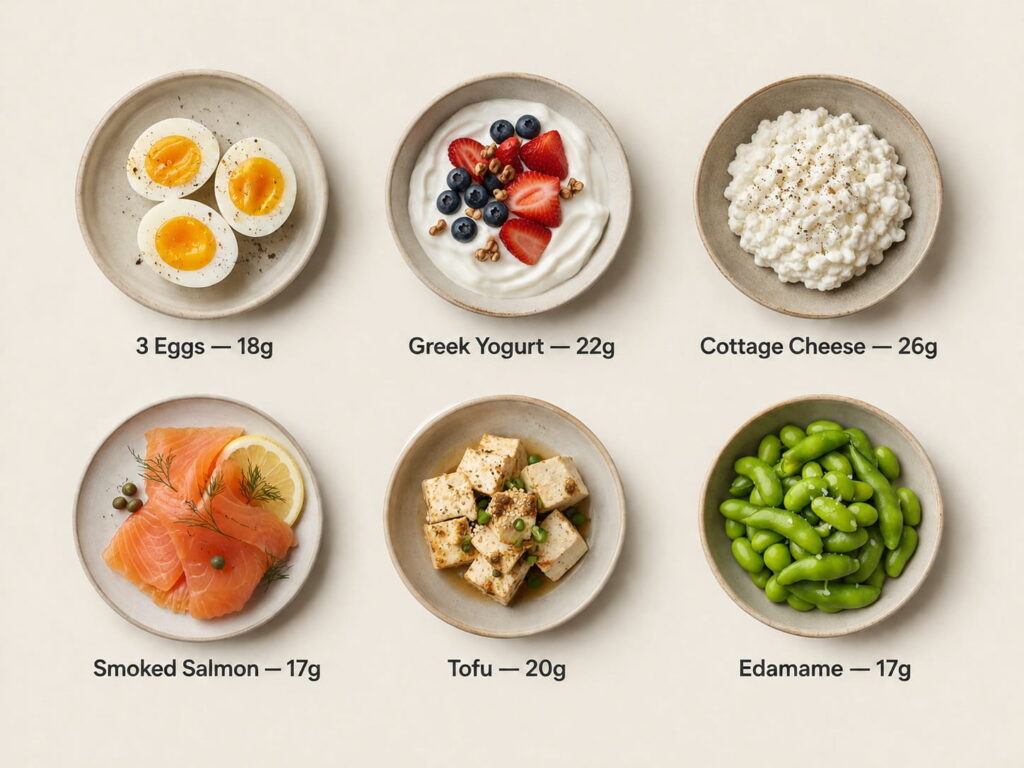
| Food | Approximate Protein | Notes |
|---|---|---|
| 3 large eggs | ~18g | Pair with Greek yogurt or cheese to reach 30g |
| Greek yogurt (1 cup) | ~20–23g | Choose plain to control added sugar |
| Cottage cheese (1 cup) | ~25–28g | Works well with fruit for a sweet option |
| Protein powder (1 scoop) | ~20–25g | Fastest way to close a protein gap |
| Smoked salmon (3 oz) | ~17g | Pairs well with eggs |
| Turkey sausage (3 links) | ~15–18g | Combine with eggs for a full 30g meal |
| Tofu (1 cup, firm) | ~20g | Solid vegetarian and vegan option |
| Edamame (1 cup) | ~17g | Good plant-based add-in |
| Skyr or high-protein yogurt | ~15–19g per serving | Check labels; brands vary widely |
| Peanut or almond butter (2 tbsp) | ~7–8g | Best as a booster, not a stand-alone source |
30-30-30 Exercise Examples
Low-intensity, steady-state movement is the goal — not a hard workout. Good options include:
- Brisk walking (outdoors or treadmill)
- Easy stationary or outdoor cycling
- Swimming at a relaxed pace
- Elliptical at low resistance
- Gentle rowing
- Incline walking at a slow-to-moderate pace
The common thread: you should be able to breathe comfortably and hold a conversation the entire time.
30-30-30 Walking Plan
| Level | Pace | Duration | Notes |
|---|---|---|---|
| Beginner | Comfortable, easy | 15–20 min | Build up gradually in week one |
| Intermediate | Brisk, conversational | 25–30 min | Add light incline if using a treadmill |
| Advanced | Brisk with intervals of pace | 30 min | Occasional short bursts of faster walking are fine — just return to conversational pace |
30-30-30 Strength Training Ideas
While the classic routine calls for low-intensity cardio, some people fold light resistance work into their 30 minutes once cardio becomes easy. If you want to add strength elements without exceeding “low intensity”:
- Bodyweight circuits (squats, lunges, glute bridges) at an easy, controlled pace
- Light resistance bands for upper body
- Slow-tempo dumbbell work at low weight
- Mobility and stability work (yoga flows, controlled stretching)
Keep in mind: true strength training at meaningful intensity falls outside the “low-intensity” definition of the routine. Many people do their 30-30-30 walk in the morning and save heavier resistance training for later in the day.
30-30-30 Meal Planning Tips
- Batch-prep protein on weekends (hard-boil a dozen eggs, portion cottage cheese, pre-blend smoothie bags for the freezer).
- Keep a “30g formula” list on your fridge so you’re not recalculating every morning.
- Balance the rest of your day. Protein-forward breakfasts work best alongside fiber-rich, whole-food meals for lunch and dinner.
- Watch added sugar in flavored yogurts and protein products — read labels rather than assuming “protein” means “healthy.”
- Hydrate before and after your walk, especially in warmer climates.
30-30-30 Breakfast Examples
- Three-egg omelet with spinach and a side of Greek yogurt
- Protein smoothie: protein powder, milk or a fortified plant milk, banana, spinach, chia seeds
- Cottage cheese bowl with berries, a drizzle of honey, and chopped walnuts
- Overnight oats made with protein powder and topped with almond butter
- Turkey sausage with two eggs and avocado
- Tofu scramble with black beans and salsa for a plant-based option
Sample 30-30-30 Daily Schedule
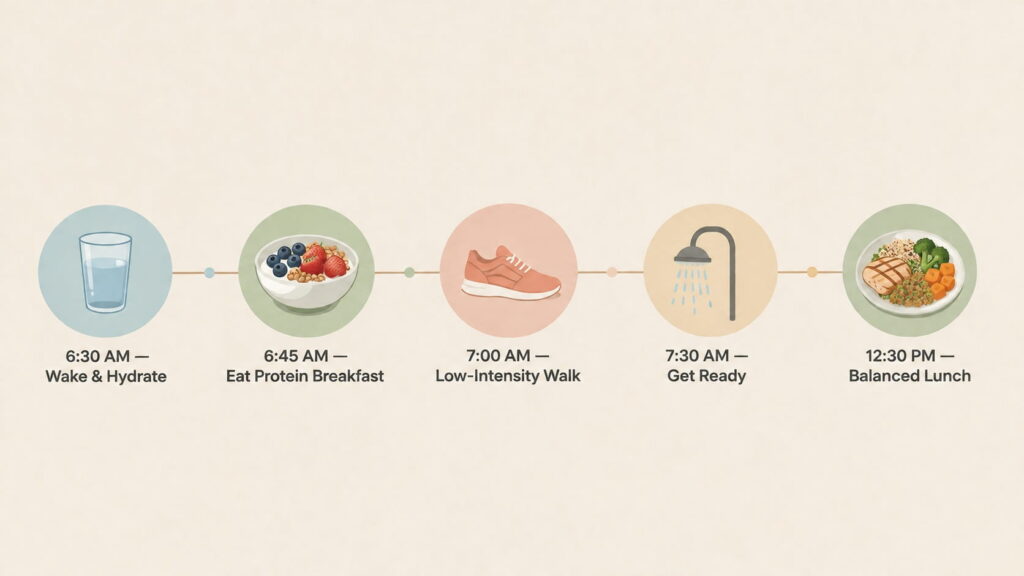
| Time | Activity |
|---|---|
| 6:30 AM | Wake up, drink water |
| 6:45 AM | Eat 30g protein breakfast |
| 7:00 AM | 30 minutes of low-intensity walk or cycle |
| 7:30 AM | Shower, get ready |
| 12:30 PM | Balanced lunch (protein, fiber, vegetables) |
| 3:00 PM | Optional strength training or activity |
| 7:00 PM | Balanced dinner |
| 10:00 PM | Wind down, prep tomorrow’s protein source |
30-30-30 Wellness Routine: Realistic Results Timeline
| Timeframe | Likely Changes |
|---|---|
| 1 week | Better routine consistency; the habit starts to feel automatic |
| 2 weeks | Reduced mid-morning hunger for many people |
| 1 month | Improved habit adherence and possible early body composition changes, depending on overall diet and activity |
| 3 months | More noticeable health improvements if the routine is maintained alongside balanced nutrition and consistent activity |
Individual results vary widely based on starting point, total daily calorie balance, sleep, and consistency — the timeline above reflects general patterns, not guarantees.
Common Mistakes in the 30-30-30 Wellness Routine
- Treating “30 minutes after waking” as a strict deadline and skipping the routine entirely when mornings run late.
- Relying only on processed protein bars or sugary shakes to hit the protein number quickly.
- Going too hard on the “exercise” portion. High-intensity intervals defeat the purpose of a low-intensity, sustainable habit.
- Ignoring the rest of the day’s nutrition, assuming a good breakfast cancels out a poor lunch and dinner.
- Expecting dramatic results in days. This is a habit-building tool, not a rapid transformation hack.
- Skipping hydration before a fasted or lightly-fed morning walk.
- Comparing your protein sources to someone else’s macros instead of building a routine that fits your own schedule and preferences.
Expert Tips for the 30-30-30 Wellness Routine
- Prioritize whole-food protein sources over ultra-processed ones whenever your schedule allows.
- If mornings are tight, split the routine: protein immediately, movement an hour or two later, rather than skipping the walk altogether.
- Track consistency, not perfection — a habit tracker or simple calendar check-mark system works better than obsessing over exact grams and minutes.
- If you have any underlying health condition, loop in your doctor or a registered dietitian before adopting new meal-timing or exercise rules.
- Reassess after 3–4 weeks. If energy, hunger, and adherence are improving, keep going. If it feels unsustainable, adjust the framework rather than abandoning healthy habits altogether.
Expert Insight: Morning protein helps many people feel fuller through the late morning, but consistency over weeks matters far more than hitting the timing perfectly every single day.
When to Stop or Modify the 30-30-30 Routine
Most people tolerate this routine well, but stop and check in with a doctor or dietitian if you notice:
- Persistent dizziness or lightheadedness, especially during or after the morning walk.
- Ongoing fatigue that doesn’t improve after the first one to two weeks of adjustment.
- Symptoms of low blood sugar — shakiness, confusion, or cold sweats — particularly if you take medication that affects glucose levels.
- Exercise intolerance, such as an unusually rapid heart rate or shortness of breath even at a low, conversational pace.
- Digestive discomfort tied to a sudden increase in protein or a specific protein source.
These signs don’t necessarily mean the routine is wrong for you — they usually mean it needs adjusting (timing, intensity, or protein source) with professional input, rather than pushing through discomfort.
30-30-30 Wellness Routine: Myths vs. Facts
| Myth | Fact |
|---|---|
| It’s a fad diet that eliminates food groups | It doesn’t restrict any food group or require calorie counting |
| It guarantees fat loss on its own | Fat loss still depends on overall calorie balance across the whole day |
| The exact protocol is clinically proven | The underlying principles have support; the exact combined protocol hasn’t been directly tested in trials |
| You must do cardio, never strength work | Some people substitute light resistance work once cardio becomes easy |
| Missing the 30-minute window ruins the routine | Consistency over days and weeks matters far more than a single morning’s timing |
| It’s only for weight loss | Many people use it purely for energy, satiety, and habit-building, independent of weight goals |
30-30-30 Wellness Routine Comparison Tables
30-30-30 Rule vs. Traditional Weight Loss Approaches
| Factor | 30-30-30 Routine | Traditional Calorie-Counting Weight Loss |
|---|---|---|
| Tracking required | None | Detailed calorie/macro tracking |
| Flexibility | High | Varies, often lower |
| Focus | Morning habit stack | Total daily intake and expenditure |
| Best for | Habit-building, beginners | People who want precise control |
| Guarantees fat loss alone | No | Only if a deficit is maintained |
30-30-30 vs. Intermittent Fasting
| Factor | 30-30-30 Routine | Intermittent Fasting |
|---|---|---|
| Eating window | Eat soon after waking | Delay eating for hours |
| Core mechanism | Protein timing + movement | Extended fasting window |
| Exercise requirement | Built in | Not required |
| Compatibility | Can conflict with strict fasting windows | Some fasting protocols allow morning workouts, fasted |
30-30-30 vs. High-Protein Diet
| Factor | 30-30-30 Routine | General High-Protein Diet |
|---|---|---|
| Protein focus | Concentrated at breakfast | Spread evenly across meals |
| Exercise component | Explicit and required | Not inherently included |
| Structure | Simple, single daily habit | Broader dietary overhaul |
| Ease of adoption | High | Moderate, depends on meal planning skills |
30-30-30 vs. Mediterranean Diet
| Factor | 30-30-30 Routine | Mediterranean Diet |
|---|---|---|
| Scope | One morning habit stack | Full dietary pattern (all meals) |
| Food focus | Protein-forward breakfast | Vegetables, fish, olive oil, whole grains |
| Exercise requirement | Built in | Not inherently part of the pattern |
| Evidence base | Individual components studied; combined protocol untested | Extensively studied for long-term heart and metabolic health |
30-30-30 vs. DASH Diet
| Factor | 30-30-30 Routine | DASH Diet |
|---|---|---|
| Primary goal | Habit-building, appetite control | Blood pressure management |
| Structure | Two daily actions | Specific daily sodium, fruit, vegetable, and dairy targets |
| Tracking required | Minimal | Moderate, especially sodium |
| Best for | General wellness beginners | People managing or preventing hypertension |
30-30-30 vs. Keto
| Factor | 30-30-30 Routine | Ketogenic Diet |
|---|---|---|
| Macronutrient rules | None beyond the breakfast protein target | Very low carbohydrate, high fat |
| Flexibility | High | Low; requires sustained carb restriction |
| Exercise requirement | Built in | Not inherently included |
| Sustainability | Generally easier for beginners | Can be difficult to maintain long-term |
30-30-30 vs. Paleo
| Factor | 30-30-30 Routine | Paleo Diet |
|---|---|---|
| Food restrictions | None | Excludes grains, legumes, dairy, processed foods |
| Focus | Morning timing and movement | Food quality and sourcing all day |
| Ease of adoption | High | Moderate to difficult, depending on current diet |
30-30-30 vs. 75 Hard
| Factor | 30-30-30 Routine | 75 Hard |
|---|---|---|
| Intensity | Low, beginner-friendly | Very high; strict daily rules over 75 days |
| Exercise requirement | 30 minutes, low intensity | Two 45-minute workouts daily, one outdoors, no exceptions |
| Flexibility | High | None; missing a day means restarting from day one |
| Best for | Sustainable habit-building | People seeking an intense mental-toughness challenge |
30-30-30 vs. 12-3-30 Workout
| Factor | 30-30-30 Routine | 12-3-30 Workout |
|---|---|---|
| What it targets | Morning protein + general movement | A specific treadmill cardio session |
| Components | Two habits (nutrition and exercise) | One habit (incline treadmill walking) |
| Equipment | None required | Treadmill with incline function |
| Can they be combined? | Yes — the 12-3-30 protocol can serve as your 30-minute movement block | Works as a stand-alone cardio routine |
How Men Can Benefit From the 30-30-30 Wellness Routine
Men often have higher baseline protein needs due to greater average lean mass, making the 30g breakfast target easier to fit into overall daily protein goals. The built-in walking habit also offers a low-impact way to add cardiovascular activity alongside strength training, which many men already prioritize.
How Women Can Benefit From the 30-30-30 Wellness Routine
For women, a protein-forward breakfast can help offset the appetite swings some experience across the menstrual cycle, and it supports muscle maintenance during any fat-loss phase — an area research shows women are often under-prioritized in when following unstructured or overly restrictive diets. The gentle exercise component also makes it accessible during times when higher-intensity training may not feel appropriate.
30-30-30 Wellness Routine for Older Adults
Adequate morning protein plays a meaningful role in counteracting age-related muscle loss, known as sarcopenia, which accelerates with age and inactivity. Getting enough protein earlier in the day, rather than backloading it at dinner, may help older adults use that protein more effectively for muscle maintenance.
Low-intensity walking is one of the safest, most joint-friendly ways for older adults to build a consistent activity habit, but a few extra precautions help:
- Balance exercises (standing on one foot, heel-to-toe walking) can be added on non-fatigued days to reduce fall risk alongside the daily walk.
- Walking safety matters more with age — well-fitted shoes, even walking surfaces, and avoiding early-morning ice or low-light conditions all reduce injury risk.
- Hydration needs may be higher than expected, since the sense of thirst can become less reliable with age.
- Medication timing should be reviewed with a doctor or pharmacist before shifting breakfast or exercise timing, especially for blood pressure, blood sugar, or blood thinning medications.
This population should confirm any new routine with their physician, especially if managing chronic conditions or taking multiple medications.
A note on children: This routine is designed for adults. Growing children and teenagers have different, higher-stakes nutritional needs, and rigid adult-oriented rules around meal timing or macronutrient targets shouldn’t be imposed on them without guidance from a pediatrician or pediatric dietitian.
30-30-30 Wellness Routine for Busy Professionals and Shift Workers
The appeal for busy professionals is the low time cost and zero learning curve. No gym membership, no meal-tracking app, and no cooking skills required — just a prepped protein source and a walk, which can double as a commute, a dog walk, or a phone-call time block.
Night-shift and rotating-shift workers can apply the same two habits relative to their own wake-up time rather than the clock on the wall. If your “morning” starts at 7 PM, eat your 30 grams of protein within 30 minutes of waking then, and take your 30-minute walk before your shift begins. The underlying principle — protein soon after waking, plus daily low-intensity movement — doesn’t depend on sunlight or a specific hour, only on consistency relative to your own sleep-wake cycle.
30-30-30 Wellness Routine Guidelines: Frequently Asked Questions
Does the 30-30-30 rule actually work?
The individual components — a protein-rich breakfast and daily low-intensity movement — are well-supported habits for satiety, muscle maintenance, and general health. The exact combined protocol hasn’t been tested as a stand-alone method in clinical trials, so results vary by individual and depend heavily on your overall diet and activity level.
How much protein should I eat?
The routine calls for 30 grams at breakfast, but your total daily protein needs depend on your body weight, activity level, and goals. Many adults aiming to preserve muscle during fat loss benefit from spreading protein evenly across all meals, not just breakfast.
What counts as low-intensity exercise?
Movement where you can comfortably hold a conversation — brisk walking, easy cycling, swimming, or a relaxed elliptical session. If you’re breathing too hard to talk, you’ve likely exceeded the intended intensity.
Can I drink coffee first?
Yes. Coffee itself isn’t a barrier to the routine.
- Black coffee doesn’t count toward your protein target but is generally fine before your walk.
- Coffee with milk adds a small amount of protein and is also fine.
- Protein coffee (coffee blended with protein powder or collagen) can count toward your 30-gram goal if you prefer a drinkable breakfast.
- Caffeine before walking is generally well tolerated at low intensity, though it can worsen jitteriness in sensitive individuals — pay attention to how you personally respond.
Should I exercise before or after eating protein?
Either order works, and the routine’s name doesn’t require a strict sequence. Eating first gives you more immediate energy for the walk and may suit people prone to lightheadedness on an empty stomach. Exercising first, then eating, is preferred by some who feel a fasted walk sharpens focus and appetite. Choose based on how your body responds — there’s no strong evidence that one order is meaningfully better than the other for most healthy adults.
What if I wake up late or oversleep?
The routine isn’t ruined by a late start. You have two practical options: still eat your protein breakfast and take your walk later in the day, just not within the original 30-minute window, or shift both habits later relative to your actual wake time rather than skipping them. Skipping the routine entirely on an off day is far less useful than adapting the timing.
Can I skip breakfast?
The routine is built around eating within 30 minutes of waking, so it isn’t compatible with extended fasting by design. If you prefer to fast longer, you can still apply the movement principle and adjust your protein timing to fit your eating window.
Can vegetarians follow it?
Yes. Eggs, Greek yogurt, cottage cheese, tofu, edamame, and plant-based protein powders can all help vegetarians reach 30 grams at breakfast.
Can diabetics follow it?
People with diabetes should talk to their healthcare provider first, since meal timing and fasted exercise can affect blood sugar and medication needs. It can often be adapted safely with medical guidance.
Can I lose belly fat?
The routine can support fat loss as part of an overall calorie deficit, but it doesn’t target fat loss in any specific body area. Spot reduction isn’t physiologically possible with any method.
How long until results?
Most people notice improvements in energy, fullness, and consistency within two to four weeks. Visible body composition changes typically take longer and depend on overall diet quality and calorie balance.
Where can I download a PDF guide?
Use the checklist and 30-day starter plan in this article as your framework — print or screenshot the tables above to build your own printable tracker.
Conclusion: Is the 30-30-30 Wellness Routine Worth It?
The 30-30-30 wellness routine works because it’s simple: eat enough protein early, move gently every day, and repeat. It isn’t a clinically validated weight-loss protocol on its own, and it won’t replace the basics of good overall nutrition and consistent activity. But as a low-barrier entry point into healthier mornings, and a genuinely evidence-informed nudge toward better satiety, more stable energy, and a daily movement habit, it holds up well. Start small, stay consistent, and adjust it to fit your life rather than forcing your life to fit the rule.
Related Articles: