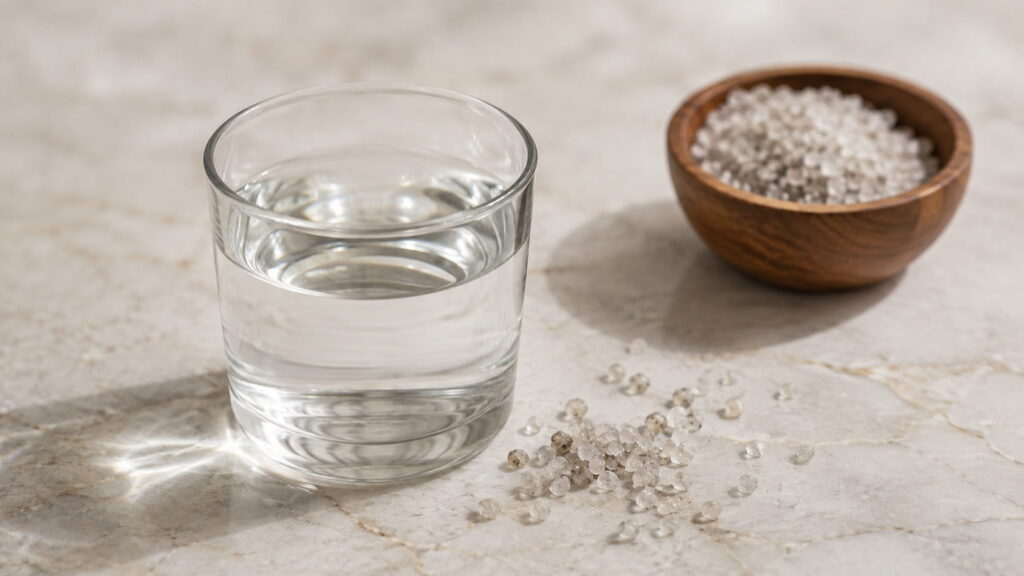
If you have scrolled through wellness videos lately, you have probably seen someone dropping a flake of grey salt into their morning water and calling it a health hack. Celtic sea salt benefits have become one of the most talked-about topics in natural wellness circles, and it is easy to see why: the salt looks natural, feels artisanal, and comes with a long list of claimed benefits, from hydration to clearer skin.
But how much of that is actually true?
Quick Answer
Celtic sea salt is an unrefined sea salt that provides sodium and small amounts of trace minerals. It can support fluid and electrolyte balance the same way any salt does, but current evidence does not show it offers major health advantages over ordinary salt. It is not fortified with iodine, and too much of it, like too much of any salt, can raise blood pressure.
| Question | Short answer |
|---|---|
| Healthier than table salt? | Not clearly, the sodium content is similar |
| Contains minerals? | Yes, but usually in small amounts |
| Uniquely hydrating? | No, sodium is sodium, regardless of source |
| Lowers blood pressure? | No |
| Helps weight loss? | No good evidence |
| Contains iodine? | Usually not |
| Safe to drink in water? | In small amounts, yes, but not a daily requirement |
| How much per day? | Follow total sodium guidance, not a Celtic-specific dose |
Key takeaways:
- Celtic sea salt is unrefined and retains natural moisture and trace minerals, but it is still primarily sodium chloride.
- Its trace minerals are real but too small in amount to meaningfully affect your nutrient intake.
- By weight, its sodium content is comparable to table salt, so it offers no advantage for blood pressure.
- It is usually not iodized, so relying on it as your main salt can leave a gap in dietary iodine.
- Its clearest, evidence-backed use is as a flavourful everyday salt and a situational electrolyte source around heavy sweating or exercise.
In this article:
- What Is Celtic Sea Salt?
- Celtic Salt Minerals: What Does It Actually Contain?
- Celtic Sea Salt Benefits: What Is Actually Supported?
- How Strong Is the Evidence, Claim by Claim
- Celtic Sea Salt in Water: Benefits and Risks
- How to Use Celtic Sea Salt
- How Much Celtic Salt Should You Take a Day?
- Celtic Sea Salt Side Effects, Dangers, Pros and Cons
- Who Should Limit Celtic Salt
- Celtic Sea Salt vs Table Salt vs Himalayan Salt
- How to Choose the Best Celtic Sea Salt
- Frequently Asked Questions
- Bottom Line
💬 At NFH Clinic, we get asked about Celtic sea salt benefits often enough that we felt it was worth laying out exactly what the evidence supports and where the marketing gets ahead of it. Our approach throughout this guide is simple: separate what comes from sodium itself, which any salt provides, from what is genuinely unique to Celtic salt.
What Is Celtic Sea Salt?
Celtic sea salt, also known as sel gris or grey salt, is traditionally harvested from shallow clay-lined ponds along the coast of Brittany in France. Seawater is left to evaporate naturally under the sun and wind, and the salt is hand-raked from the pond floor using methods that go back centuries. Because it is minimally processed, it keeps some natural moisture and a light grey colour from the surrounding clay.
The term “Celtic salt” is also used more loosely in the marketplace to describe unrefined, moist grey sea salts in general, not only salt from Brittany. If a specific origin matters to you, check the label rather than assuming every product marketed as Celtic salt was harvested the same way or in the same place.
Regular table salt, by comparison, is mined, heavily refined and stripped of almost everything except sodium chloride, then usually mixed with anti-caking agents and fortified with iodine.
Celtic Salt Minerals: What Does It Actually Contain?
This is where a lot of the marketing gets ahead of the science. Celtic sea salt does contain trace minerals such as magnesium, calcium, potassium and iron, and some brands list dozens of trace elements on their packaging. That part is true.
What often gets left out is the amount. These minerals sit in tiny quantities, and the exact profile varies from batch to batch and brand to brand. Dietitians have pointed out that you would need to eat unsafe amounts of salt to get any meaningful nutritional benefit from its trace mineral content [Mayo Clinic Press]. So it is fair to say Celtic salt contains more minerals than heavily refined table salt. It is not fair to treat it as a mineral supplement or a reliable way to meet your magnesium, calcium or potassium needs.
Worth knowing early: unlike iodized table salt, Celtic sea salt is usually not fortified with iodine. That matters if it makes up most of the salt in your diet, and we cover it in more detail below.
Celtic Sea Salt Benefits: What Is Actually Supported?
1. Celtic Sea Salt Benefits for Hydration and Electrolyte Balance
Sodium is an electrolyte, and electrolytes help your body hold onto and move fluid properly. Sodium-containing drinks can genuinely help when you have lost a lot of fluid and salt, through heavy sweating, for example.
That said, adding a pinch of Celtic salt and a bit of sugar or honey to water is not the same thing as a medically formulated oral rehydration solution. A proper ORS uses specific, tested concentrations of sodium and glucose to maximise fluid absorption. Homemade salted water can be a reasonable everyday electrolyte top-up, but for significant dehydration caused by vomiting, diarrhoea or illness, use a properly formulated rehydration solution rather than relying on a DIY mix.
Important: there is no good evidence that Celtic sea salt hydrates you better than ordinary salt simply because it contains trace minerals. The hydration benefit comes from the sodium, which any salt provides.
2. Celtic Sea Salt Benefits for Digestion
Your body uses chloride, part of sodium chloride, to help produce hydrochloric acid in the stomach. That is a real physiological role. It does not mean eating extra Celtic salt improves digestion. There is no good clinical evidence that Celtic sea salt treats bloating, indigestion, constipation or low stomach acid. If digestive symptoms are a regular issue for you, that is worth raising with a healthcare provider rather than addressing with salt.
3. Celtic Sea Salt Benefits for Skin
Research on bathing in magnesium-rich salt water has found improvements in skin barrier function, hydration and a reduction in redness and roughness [Rupa Health]. This is genuine research, but it studied magnesium-rich bathing solutions generally, not Celtic sea salt specifically, and it does not prove the minerals are being meaningfully absorbed through skin. Treat this as a possible cosmetic benefit rather than a proven medical treatment. Salt scrubs and soaks can feel soothing and help exfoliate, but they can also sting or irritate eczema, cuts and any broken skin, so avoid using salt on damaged areas.
4. Celtic Sea Salt Benefits for Hair
There is no strong evidence that eating Celtic sea salt makes hair grow faster, thicker or stronger. Topical sea salt sprays can add texture and grip to hair strands, which is why they are popular in styling products, but that is a cosmetic styling effect, not a sign of improved hair health.
5. Celtic Sea Salt Benefits for Teeth and Oral Health
A warm salt water rinse is a long-standing home remedy for minor gum irritation, mouth ulcers and recovery after dental procedures, since saline can help reduce bacteria and soothe inflamed tissue. Celtic salt works fine for a rinse like this, but so does ordinary table salt, there is nothing Celtic-specific about the benefit. One caution: a salt water rinse is different from scrubbing your teeth with coarse salt crystals, which can be abrasive to enamel and gums. Rinsing is fine, brushing with salt is not recommended. Either way, this is not a substitute for brushing, flossing or seeing your dentist.
6. Celtic Sea Salt Benefits for Athletes
This is one of the more genuinely useful cases for Celtic salt, though the right amount depends on the activity:
- Short, moderate workouts: most people do not need extra sodium beyond a normal diet.
- Long-duration or hot-weather exercise: electrolyte losses climb, and a sodium-containing drink can become useful.
- Heavy or “salty” sweaters: individual sodium losses vary a lot, and some people genuinely need more replacement than others.
- Endurance events: a commercially formulated electrolyte product offers more predictable, tested sodium and potassium concentrations than a homemade pinch-of-salt mix.
A pinch of Celtic salt in water is a reasonable, low-additive option for casual training. It will not outperform a properly formulated sports drink for serious endurance work.
7. Celtic Sea Salt Benefits for Immune System
Some sources claim Celtic salt boosts immunity directly. There is no solid evidence for that. What is accurate is that proper hydration and electrolyte balance, which sodium supports, help the body function well overall, including fluid balance in the mucosal linings of the respiratory tract. That is a supportive, indirect role, not a direct immune boost.
8. Celtic Sea Salt Benefits for Women
There are no established health benefits from Celtic sea salt that are unique to women. What women more often search for in this context is how salt intake interacts with pregnancy, the menstrual cycle, hydration, iodine and blood pressure, and the honest answer on each is the same as for anyone else: sodium needs don’t change dramatically by sex, iodine still matters, and Celtic salt is not a treatment for any of these. If you are pregnant or managing a health condition, check your sodium and iodine intake with your doctor rather than adjusting it based on salt marketing.
9. Celtic Sea Salt Benefits for Weight Loss
Celtic sea salt does not cause meaningful weight loss and does not burn fat, there is no mechanism by which it would. Reducing high-sodium processed foods can be a useful part of improving overall diet quality, but that is a benefit of eating less processed food, not a special effect of switching salt types.
10. Celtic Sea Salt Benefits for Thyroid Health
Table salt in most countries is fortified with iodine specifically because the thyroid needs iodine to produce hormones. Celtic sea salt usually is not iodized. This does not mean Celtic salt harms your thyroid, it simply means it will not support it either.
If Celtic salt makes up most of the salt in your diet, make sure your overall eating pattern includes iodine from other sources, such as seafood, dairy or eggs, depending on what you eat. People with thyroid disease should not use Celtic salt, or any salt, as an iodine treatment.
11. Celtic Sea Salt Benefits for High Blood Pressure
No. Celtic sea salt is not a treatment for high blood pressure, and it is not a blood-pressure-friendly alternative to table salt.
By weight, the most accurate way to compare salts, Celtic sea salt and table salt contain a similar amount of sodium. Some brands show less sodium per teaspoon simply because their larger, moister crystals take up more space in the spoon, not because the salt itself is lower in sodium. Some people confuse the presence of trace minerals with a blood-pressure-lowering effect. Sodium content is what matters most for blood pressure, and that stays roughly the same across salt types.
The American Heart Association recommends keeping sodium under 2,300 mg a day, and ideally closer to 1,500 mg if you already have high blood pressure [American Heart Association]. Switching to Celtic salt will not meaningfully change those numbers unless you are also reducing the total amount you use.
How Strong Is the Evidence, Claim by Claim
| Claim | Evidence |
|---|---|
| Provides sodium and electrolytes | Strong, this is simply what salt does |
| Better hydration than regular salt | Not established |
| Contains trace minerals | Established, but quantities are small and vary by product |
| Helps digestion | Insufficient evidence |
| Improves skin | Limited, mostly from magnesium-bath research generally |
| Improves hair growth | Insufficient evidence |
| Lowers blood pressure | No, excess sodium can worsen it |
| Promotes weight loss | No good evidence |
| Boosts immunity | No good evidence |
| Supports thyroid function | Not a reliable iodine source |
| Detoxifies the body | No good evidence |
Celtic Sea Salt in Water: Benefits and Risks
Adding a small pinch to a glass of water is the most common way people use Celtic salt outside of cooking, usually somewhere around an eighth of a teaspoon per glass. That works out to roughly 200 to 250 mg of sodium, a modest amount compared with the 2,300 mg daily ceiling most adults are working with.
For most healthy people eating a normal diet, there is no established need to drink salted water routinely, since regular meals already provide sodium. Where it makes more practical sense is before or during long exercise sessions, hot-weather work, or anywhere you are sweating heavily (see the electrolyte balance and athlete sections above for the caveats on that). Outside of those situations, treat it as a flavour preference rather than a health habit, and see the FAQs below for the detox and daily-use questions this often raises.
How to Use Celtic Sea Salt
Celtic Sea Salt Benefits for Cooking
Its briny, complex flavour works well as a finishing touch on roasted vegetables, grilled meat and salads. Many people find they use less of it than table salt simply because the flavour is more pronounced. It is less ideal for baking recipes that need precise, fine measurements, since crystal size varies by brand.
In water: a small pinch dissolved in a glass of water, covered in more detail in the section above.
Topically: mix it with a carrier oil such as olive or coconut oil for a gentle body scrub, or add a handful to a warm bath. Avoid using it on broken or irritated skin.
How Much Celtic Salt Should You Take a Day?
There is no separate guideline for Celtic salt specifically, it falls under the same sodium recommendations as any other salt. The FDA and American Heart Association recommend adults keep total sodium under 2,300 mg a day, which works out to roughly 5.8 g of salt, from all sources combined, not just what you add yourself [FDA]. If you have high blood pressure, kidney issues or heart disease, your target may be closer to 1,500 mg of sodium, around 3.8 g of salt, so check with your doctor.
These are limits on total sodium from your whole diet. They are not a recommended amount of Celtic salt to deliberately consume on top of your normal eating.
Celtic Sea Salt Side Effects, Dangers, Pros and Cons
Celtic salt is generally safe for most healthy adults in normal culinary amounts. A few things are worth knowing before you get too enthusiastic with the shaker.
Pros: distinctive flavour and texture, minimally processed compared with refined table salt, contains small amounts of trace minerals, free from anti-caking agents in most products, works well as a finishing salt and in homemade skincare.
Cons: sodium content is comparable to table salt, so overuse still raises blood pressure risk, usually not iodized, trace minerals aren’t enough to replace mineral-rich foods, more expensive than ordinary salt for a similar sodium load, and little clinical evidence for many of the more dramatic claims circulating online.
Who Should Limit Celtic Salt
Talk to your doctor before increasing your sodium intake, from any salt, if you have high blood pressure, heart failure, kidney disease or another condition requiring a sodium-restricted diet. Switching from table salt to Celtic salt does not solve the underlying problem if you have been told to cut back on sodium, since the trace minerals do not cancel out sodium’s effects.
Celtic Sea Salt vs Table Salt vs Himalayan Salt
| Celtic Sea Salt | Table Salt | Himalayan Pink Salt | |
|---|---|---|---|
| Sodium by weight | About 38 to 40% | About 39 to 40% | About 38 to 40% |
| Sodium per level tsp | Roughly 1,800 to 2,000 mg* | Roughly 2,300 mg | Roughly 1,700 to 2,000 mg* |
| Iodine | Usually not fortified | Usually fortified | Usually not fortified |
| Trace minerals | Present, small amounts, varies by product | Mostly stripped during refining | Present, small amounts |
| Processing | Minimal, often hand-harvested | Heavily refined | Mined, minimally processed |
| Best suited for | Finishing dishes, cooking, water | Everyday cooking, baking, iodine intake | Finishing dishes, cooking |
*Lower per-teaspoon figures for Celtic and Himalayan salt come from crystal size, not lower sodium by weight. Coarser, moister crystals pack less densely into a spoon, so a level teaspoon holds fewer crystals overall. Gram for gram, all three are close in sodium content.
Different salt types can taste and look quite different without producing dramatically different health effects. All three are still primarily sodium chloride, and none of them should be treated as a health food in large amounts.
How to Choose the Best Celtic Sea Salt
If you decide to use Celtic salt, a few things help you evaluate a genuine product rather than a marketing story: check the label for harvesting location and production method rather than assuming Brittany origin, look for unrefined, additive-free options without anti-caking agents, check that sodium content is listed clearly so you can track your intake, and buy from established natural food retailers or specialty grocers, widely available in the UK as well as the US, rather than unverified online sellers.
There is no single product that suits everyone. Choose based on your budget, how you plan to use it, and whether you prefer fine or coarse crystals.
Frequently Asked Questions
Is Celtic sea salt healthier than table salt?
Not clearly. The sodium content is comparable by weight, and the main practical differences are the trace mineral content, which is small, and iodine, which table salt has and Celtic salt usually does not.
Is Celtic salt good for high blood pressure?
No. It contains roughly the same sodium as table salt, so it will not lower your blood pressure. Reducing total sodium intake matters far more than switching salt types.
How much Celtic salt should you take a day?
There is no separate limit for Celtic salt. It counts toward your total daily sodium, which should stay under 2,300 mg, or closer to 1,500 mg if you have high blood pressure.
Can you drink Celtic salt water every day?
You can, in small amounts, but most healthy people don’t need to. It becomes more useful around long or intense exercise, heat exposure or heavy sweating.
Can you use Celtic salt every day in cooking?
Yes, there’s nothing wrong with using it as your everyday culinary salt, as long as your total sodium from all foods stays within the daily limits covered above. It doesn’t need to be reserved for special occasions or used in addition to your regular salt.
Does Celtic sea salt contain iodine?
Usually not. If it is your main salt, make sure you’re getting iodine elsewhere, through seafood, dairy, eggs or occasional use of iodized salt.
Does Celtic salt help with weight loss?
No. There is no mechanism by which it burns fat or boosts metabolism.
Is Celtic sea salt good for digestion?
There isn’t good clinical evidence that it improves digestion specifically, though the chloride in any salt plays a role in normal stomach acid production.
Does Celtic salt help with sinus congestion or breathing?
Not in the way it’s often marketed. Salt therapy, or halotherapy, which involves inhaling fine salt particles in a controlled setting, has some research behind it as a complementary approach for conditions like sinusitis and mild asthma. That is a different thing from eating or drinking Celtic salt, which has no evidence for respiratory benefits. Saline nasal rinses, which you can make with any food-grade salt, are the one salt-and-water application with solid evidence for easing congestion, and they are not specific to Celtic salt either.
Is Celtic sea salt good for your skin?
It may offer a cosmetic benefit as an exfoliant or in a magnesium-rich bath soak, but Celtic-specific clinical evidence is limited, and it can irritate broken or sensitive skin.
Does Celtic salt help hair growth?
No good evidence for that. Sea salt sprays can add texture to hair, which is a styling effect, not a hair-health benefit.
Does Celtic sea salt detox the body?
No. There’s no good evidence that salt water detoxifies the body. Your liver and kidneys handle waste processing, and concentrated salt water just adds sodium.
What are the dangers of Celtic sea salt?
Mainly the same as any salt: too much sodium over time raises blood pressure and heart disease risk. It also lacks iodine, unlike fortified table salt.
Is Celtic sea salt available in the UK?
Yes, it’s widely stocked in health food shops, specialty grocers and online retailers across the UK. Check the label rather than assuming every product has the same origin or mineral content.
What is the best Celtic sea salt?
There’s no single best option for everyone. Look for an unrefined product with a clearly labelled sodium content, no unnecessary additives, and a harvesting method you’re comfortable with, then choose based on your budget and how you plan to use it.
Bottom Line
Celtic sea salt is not a miracle mineral supplement, and it will not detox your body, cure your thyroid or melt away fat. What it is: a less processed, flavourful salt that provides sodium and small amounts of trace minerals, and that can support hydration and electrolyte balance the same way any salt does, particularly around exercise. Used in place of, not in addition to, your regular salt, it’s a perfectly reasonable choice.
The real advice, whether you use Celtic salt or the plain white kind in your cupboard, stays the same: keep your total sodium intake in check, get your iodine from somewhere in your diet, and talk to a healthcare professional if you have a condition that requires careful sodium management.
If you would like personalised guidance on sodium intake, hydration or general nutrition, reach out to our team at NFH Clinic. We’re happy to help you build a plan that fits your actual health needs, not just what’s trending this week.
References
- Mayo Clinic Press, Does Celtic Sea salt have health benefits?
- American Heart Association, How Much Sodium Should I Eat Per Day?
- U.S. Food and Drug Administration, Sodium in Your Diet
- WebMD, Sea Salt vs. Table Salt: What’s the Difference?
- Rupa Health, Celtic Salt Health Benefits and Usage Tips
Related Articles: