
If you’re a teen who feels your chest tighten before a test, or a parent watching your teenager avoid parties, phone calls, or school mornings, you already know anxiety is more than “just worry.” It’s real, it’s exhausting, and it deserves real tools, not vague advice to “just relax.”
I’m McLee Tembo, Health Consultant and Founder of NFH Clinic. Over the years, I’ve worked with hundreds of families navigating teenage anxiety, and I’ve seen the same pattern again and again: teens don’t need more lectures about anxiety. They need simple, practical skills they can use in the moment: at their locker, before a game, or lying awake at 1 a.m.
This guide gives you both the reasoning behind why anxiety happens and the exact tools to use when it shows up. At the end, you can download our free Anxiety Coping Skills Workbook for Teens PDF, a printable set of worksheets you can start using today.
Quick answer: The most effective anxiety coping skills for teens include deep breathing, grounding techniques, challenging anxious thoughts, regular physical activity, healthy sleep habits, journaling, mindfulness, and talking to a trusted adult. These tools calm the body in the moment while building long-term resilience against anxiety.
Overview: Anxiety Coping Skills for Teens
Anxiety is one of the most common challenges facing teenagers today, showing up as racing thoughts, physical symptoms, school avoidance, and strained relationships. It’s also highly manageable. This guide breaks down what teen anxiety looks like, why it happens in the adolescent brain, and more than 25 practical coping skills, organized by situation, that teens and parents can start using immediately. It also covers when everyday worry crosses into something that needs professional support, plus a free downloadable workbook to practice the techniques covered here.
Key Takeaways
- Anxiety is a normal stress response that becomes a problem when it starts limiting daily life: school, friendships, sleep, or activities.
- Coping skills fall into three categories: immediate-relief (breathing, grounding), cognitive (challenging anxious thoughts), and daily-habit (sleep, exercise, journaling), and the right one depends on the situation.
- Avoidance brings short-term relief but reinforces anxiety long-term; facing triggers gradually, through exposure, is what actually reduces fear over time.
- Social media, phone calls, and video calls are increasingly common, and often overlooked, anxiety triggers for teens.
- Lifestyle strategies (sleep, movement, nutrition) support coping skills but aren’t a substitute for therapy when anxiety is persistent or severe.
- If anxiety lasts most days for several weeks, affects grades, or comes with signs of depression, it’s time to involve a mental health professional.
Quick Facts
| Typical onset | Anxiety often first appears in childhood or early adolescence and can intensify during the teen years |
| How common it is | Roughly 1 in 5 U.S. teens report anxiety symptoms in any given two-week period; an estimated 1 in 4 teens experience an anxiety disorder at some point during adolescence¹ |
| Most common triggers | Exams, social media, bullying, family conflict, performance pressure |
| Leading non-drug treatment | Cognitive Behavioral Therapy (CBT) |
| Fastest-acting coping skills | Box breathing, 5-4-3-2-1 grounding, cold water reset |
| Skills that build long-term resilience | Exercise, consistent sleep, journaling, challenging anxious thoughts |
| When to seek professional help | Anxiety most days for 2+ weeks, or interfering with school, sleep, or relationships |
¹ Sources: CDC survey data and research published in American Family Physician; see References section below.
In this article:
- Crisis Resources
- What Anxiety in Adolescence Really Looks Like
- Types of Anxiety in Teens: Is It Generalized, Social, or Something Else?
- Could This Be More Than Normal Stress? A Quick Self-Check
- Anxiety Coping Skills for Teens, Organized by Situation
- Common Anxiety Triggers in Teens
- Anxiety Activities for Youth
- Social Anxiety in Teens
- Anxiety at School
- Phone and Social Media Anxiety
- Panic Attack Toolkit: How to Help a Teenager With Anxiety and Panic Attacks
- Natural Remedies for Teen Anxiety
- Anxiety Coping Mistakes to Avoid
- How to Help a Teenager With Anxiety: A Parent's Playbook
- If You're a Teen: How to Tell Your Parents You Need Help
- The 60-Second Calm Plan: Calming Skills for Anxiety in Teens
- Free Printable Anxiety Worksheets for Teens (Coping Skills Workbook PDF)
- When Teen Anxiety Needs Professional Treatment
- Bottom Line
- Frequently Asked Questions
- References and Further Reading
Crisis Resources
If your teen is in immediate danger, call 911 (U.S.) or your local emergency number. For mental health crises specifically:
| Location | Resource | Contact |
|---|---|---|
| United States | 988 Suicide & Crisis Lifeline | Call or text 988 |
| United States | Crisis Text Line | Text HOME to 741741 |
| United Kingdom | Anxiety UK | 03444 775 774 |
| Canada | Anxiety Canada | Anxiety Canada |
| Australia | SANE Help Centre | 1800 187 263 |
These lines are free, confidential, and available around the clock. Reaching out is never an overreaction.
What Anxiety in Adolescence Really Looks Like
Anxiety isn’t one thing. In teens, it shows up as:
- A racing heart before school, even on ordinary days
- Avoiding group chats, parties, or raising a hand in class
- Trouble falling asleep because the brain won’t “switch off”
- Stomachaches or headaches with no clear medical cause
- Snapping at family over small things
- Constant reassurance-seeking (“Are you sure I did that right?”)
One teen I worked with put it simply: “I thought I was the only one who felt sick before school.” She wasn’t. Nearly every teenager experiences this at some point: the difference is whether it passes or takes over.
Some anxiety is normal. The teenage brain is still wiring itself for handling stress, social pressure, and identity, so a certain amount of nervous energy is developmentally expected. The problem starts when anxiety begins running the show: skipping school, dropping friendships, or avoiding things your teen actually wants to do.
The Science Behind Teen Anxiety (In Plain English)
Understanding why anxiety happens makes it easier to manage. Here’s the short version:
- The amygdala is your brain’s alarm system. It reacts to anything that feels threatening, even a text left on “read.”
- Cortisol and adrenaline flood the body once the alarm sounds, causing the racing heart, sweaty palms, and tight chest.
- Fight, flight, or freeze is the automatic response that follows: you either confront the stressor, avoid it, or shut down entirely.
- The prefrontal cortex, the logical, decision-making part of the brain, is still developing through the teen years, which is part of why emotions can feel bigger and harder to manage during adolescence.
- Neuroplasticity is the good news: the brain can build new, calmer response patterns with repeated practice. Every time a teen uses a coping skill instead of avoiding a fear, they’re rewiring that response.
This is exactly why coping skills work better than “just calm down.” They interrupt the alarm system at the source: the breath, the body, or the thought pattern, instead of fighting the feeling directly.
The Anxiety Cycle (and How Coping Skills Break It)
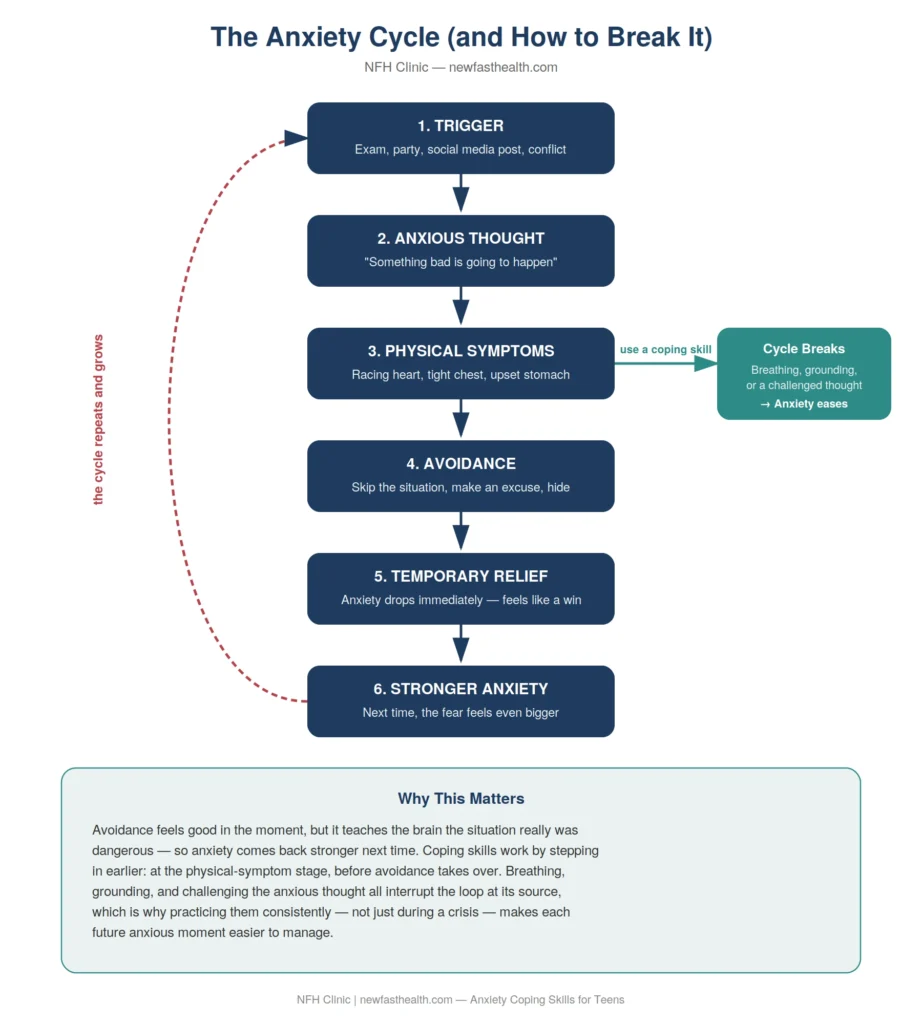
Anxiety tends to follow a predictable loop:
Trigger → Anxious Thought → Physical Symptoms → Avoidance → Temporary Relief → Stronger Anxiety Next Time
Avoidance feels good in the moment, which is exactly the problem. It teaches the brain that the situation really was dangerous, so the fear comes back even bigger the next time around. Coping skills work by stepping into that loop early, usually right at the physical-symptoms stage, before avoidance has a chance to take over. That’s why practicing calming skills for anxiety consistently, not just during a crisis, makes each future anxious moment a little easier to face.
Types of Anxiety in Teens: Is It Generalized, Social, or Something Else?
Not all teen anxiety looks the same, and knowing the general category can help you pick the right coping approach or describe symptoms accurately to a doctor. The most common types seen in adolescence include:
- Generalized Anxiety Disorder (GAD): persistent, hard-to-control worry about a wide range of everyday things, school, health, family, the future, that lasts most days for six months or more.
- Social Anxiety Disorder: intense fear of judgment or embarrassment in social situations, covered in detail in the Social Anxiety in Teens section below.
- Panic Disorder: repeated, unexpected panic attacks along with ongoing fear of having another one.
- Specific Phobias: intense, focused fear of a particular thing or situation, such as needles, heights, or flying.
- Separation Anxiety: excessive fear about being away from parents or home; more common in younger children but can persist into the teen years.
- Obsessive-Compulsive Disorder (OCD): intrusive, unwanted thoughts paired with repetitive behaviors aimed at reducing the distress those thoughts cause.
Anxiety also tends to run in families and shows up somewhat more often in girls than boys, though it affects teens of every gender. It’s common for a teen to experience more than one type at once. Only a licensed clinician can formally diagnose an anxiety disorder, but recognizing which pattern fits can make the self-check below, and the conversation with a professional, much more useful.
Could This Be More Than Normal Stress? A Quick Self-Check
Before diving into coping skills, it helps to know what you’re dealing with. Check off anything that’s applied to you (or your teen) over the past few weeks:
- ☐ I worry most days, even about small things
- ☐ I avoid school, activities, or plans because of anxiety
- ☐ I get stomachaches, headaches, or nausea before stressful events
- ☐ I replay conversations or mistakes for hours afterward
- ☐ I’ve had a panic attack, or something that felt like one
- ☐ Anxiety is affecting my grades or focus
- ☐ I’m pulling away from friends or family
If several of these have applied for more than two or three weeks, it’s worth talking to a doctor, school counselor, or therapist. This isn’t a diagnostic tool, just a starting point for a conversation. Occasional worry is a normal part of being a teenager; anxiety that consistently limits daily life is not something to just wait out.
Anxiety Coping Skills for Teens, Organized by Situation
Rather than one long list, here are coping skills grouped by when you’d actually use them, because the tool that works during a panic attack isn’t the same one that works for everyday stress.
Immediate-Relief Coping Skills (Use These in the Moment)
1. Box Breathing. Breathe in for four counts, hold for four, breathe out for four, hold for four. Repeat five times. Slow breathing signals the nervous system that there’s no real danger, lowering heart rate within minutes.
2. The 5-4-3-2-1 Grounding Technique. Name five things you can see, four you can touch, three you can hear, two you can smell, and one you can taste. This pulls attention out of anxious thoughts and into the present moment.
3. Progressive Muscle Relaxation. Tense one muscle group for five seconds, then release. Work from feet to shoulders. This teaches the body the difference between tension and relaxation.
4. The “Name It to Tame It” Trick. Simply saying, “I’m feeling anxious right now,” out loud or in writing, reduces the intensity of the emotion by activating the thinking part of the brain.
5. Cold Water Reset. Splashing cold water on the face or holding an ice pack to the cheeks triggers the body’s dive reflex, which slows the heart rate quickly, one of the fastest resets for a panic spike.
6. Anchor Breathing With a Phrase. Pair each exhale with a short calming phrase, like “I am safe right now.” Repetition gives the mind something steady to hold onto.
Cognitive Coping Skills (Challenging Anxious Thoughts)
This is the same approach used in cognitive behavioral therapy (CBT) and in the thought-record worksheets popularized by resources like Therapist Aid. Here’s what it looks like in practice:
| Situation | Anxious Thought | Feeling (0–10) | Evidence For | Evidence Against | Balanced Thought | New Feeling |
|---|---|---|---|---|---|---|
| Presentation tomorrow | “Everyone will laugh at me.” | Anxious, 8/10 | “I stumbled on words before.” | “Most people are focused on their own turn, not judging mine.” | “I might feel nervous, but I’ve gotten through presentations before.” | Anxious, 4/10 |
7. Challenge the Anxious Thought. Ask: Is this thought fact or fear? What’s the evidence for and against it? What would I tell a friend thinking this?
8. Worry Time. Set aside 10 minutes a day, same time daily, to write down every worry. Outside that window, jot the worry down and revisit it later. Most worries feel smaller once you look at them again.
9. Reframe “What If” Into “Even If.” Anxious brains love “what if” spirals. Flip it: “Even if that happens, here’s how I’d handle it.” This shifts focus from fear to coping.
10. The Probability Check. Ask, on a scale of 0–100, how likely is this fear to actually happen? Most catastrophic thoughts score under 10% once examined honestly.
11. Separate Thoughts From Facts. Practice the sentence: “I’m having the thought that…” instead of “This is true.” It creates distance between the anxious brain and reality.
Daily-Habit Coping Skills (Build Resilience Over Time)
12. Protect Sleep. Anxiety and poor sleep feed each other. Teens need 8–10 hours nightly. A consistent bedtime, dimmed lights an hour before bed, and phones charging outside the bedroom make a measurable difference within a week or two.
13. Move the Body Daily. Even 20 minutes of walking, dancing, or shooting hoops lowers cortisol and boosts mood-regulating chemicals like serotonin. Consistency matters more than intensity.
14. Journaling. Writing down thoughts, even messy and unfiltered, helps teens process emotions instead of bottling them up. Try: “Today I felt… because… next time I’ll…”
15. Limit Doom-Scrolling. Set screen-free windows, especially the hour before bed.
16. Build a “Calm Kit.” A small box with a stress ball, favorite playlist, written coping-skills list, and a comforting scent gives teens something tangible to reach for during a spike.
17. Practice Gratitude. Writing down three specific things that went right each day, however small, retrains the brain to notice safety instead of only scanning for threats.
Stress Coping Skills for Teens: Which One Actually Works?
Not every stress coping skill for teens works the same way: some calm you down in minutes, others build resilience over weeks. Here’s how the main options compare:
| Coping Skill | Works in Minutes | Builds Long-Term Resilience |
|---|---|---|
| Box breathing | ✓ | ✗ |
| Grounding (5-4-3-2-1) | ✓ | ✗ |
| Cold water reset | ✓ | ✗ |
| Exercise | ✗ | ✓ |
| Sleep routine | ✗ | ✓ |
| Journaling | ✗ | ✓ |
| Challenging anxious thoughts (CBT-style) | Sometimes | ✓✓ |
| Therapy (CBT, ACT, exposure) | Sometimes | ✓✓✓ |
A good rule of thumb: use the quick calming skills for anxiety in the moment, and lean on the daily-habit and cognitive skills to lower your overall anxiety baseline over time.
Bonus: Distress Tolerance Skills (Borrowed From DBT)
Beyond the 25 skills above, Dialectical Behavior Therapy (DBT) offers a few extra tools worth having on hand, especially for anxiety that spikes fast and feels unbearable in the moment:
- The STOP skill: Stop, Take a step back, Observe what’s happening internally and externally, then Proceed with a choice instead of a reaction.
- TIPP: a fast body-based reset using Temperature (cold water on the face), Intense exercise (a minute of jumping jacks), Paced breathing, and Progressive muscle relaxation, useful when anxiety feels too big for talking it through.
- Radical acceptance: acknowledging a painful situation exactly as it is, without fighting it, which often reduces the added suffering that comes from resisting reality.
These pair well with a therapist trained in DBT, but the STOP skill and TIPP in particular are simple enough for a teen to use solo.
How to Know If Your Coping Skills Are Actually Working
It’s easy to practice a coping skill for a week, not feel instantly cured, and assume it isn’t working. Real progress usually looks smaller and slower than that. Signs a coping skill is genuinely helping include:
- Anxiety spikes still happen, but they peak lower or pass faster than before
- It takes a bit more to trigger the same level of anxiety
- Recovery time after a stressful event gets shorter
- The teen starts reaching for the skill on their own, without being reminded
The weekly tracker in the free workbook below is built for exactly this: rating anxiety daily and noting which skill was used makes patterns visible after just a week or two, patterns that are easy to miss day-to-day but obvious in hindsight.
Common Anxiety Triggers in Teens
Anxiety rarely appears out of nowhere. The most common triggers we see at NFH Clinic include:
- Exams and academic pressure
- Bullying, in person or online
- Family conflict or divorce
- Breakups and relationship stress
- Social media comparison
- Performance pressure (sports, arts, competitions)
- College or future-planning decisions
- Chronic illness, their own or a family member’s
- Major life changes (moving, new school, family loss)
Recognizing the trigger doesn’t make the anxiety disappear, but it does make it easier to choose the right coping skill for that specific situation rather than reacting the same way to everything.
Anxiety Activities for Youth
Coping skills don’t always have to feel clinical. These activities build the same regulation skills in a lower-pressure, more engaging way, useful for younger teens, group settings, or anyone who finds worksheets tedious:
- Anxiety scavenger hunt: find items around the house that match each of the five senses for grounding practice
- Nature walk: 15–20 minutes outside, no phone, noticing sounds and sights
- Coloring or doodling: occupies the hands and quiets racing thoughts
- Journaling prompts: “What’s one thing I’m proud of this week?”
- Music therapy: building a personal “calm down” playlist
- Yoga or stretching: combines movement with breath control
- Art therapy: drawing “what anxiety feels like” as a shape or color
- Progressive muscle relaxation game: tense-and-release, turned into a follow-along routine
- Mindfulness bingo: a card of small mindful actions (listen to one full song without multitasking, name 3 sounds you hear, etc.)
- Gratitude jar: writing one good thing on a slip of paper daily and collecting them over a month
Social Anxiety in Teens
Social anxiety behaves differently from general worry: teens with social anxiety often fear judgment more than the situation itself. Helpful, targeted strategies include:
- Exposure in small steps. Fear tends to shrink with gradual, repeated exposure rather than all-or-nothing avoidance. A simple exposure ladder looks like this:
- Speak once in class (answer a question)
- Speak twice in class
- Join a small group discussion
- Give a short presentation
- Speak in front of the full class
- Scripted openers. Having a go-to line (“Hey, mind if I sit here?”) lowers the mental load of social entry.
- Post-event review limits. Anxious teens often replay social moments for hours. Set a firm five-minute limit on “replaying” after an event, then redirect to another activity.
Social Anxiety Worksheets for Teens
If you’d like something more structured than a list, social anxiety worksheets typically walk through three steps: naming the specific feared situation (e.g., “answering a question in class”), rating anxiety about it from 0–10, and mapping it onto an exposure ladder like the one above. Our free downloadable workbook below includes a blank thought-record worksheet that works well for social anxiety specifically, so just swap in social situations as the “trigger” column.
Anxiety at School
School is one of the most common anxiety triggers for teens, and it deserves specific strategies:
- Presentations: Rehearse out loud beforehand, and use box breathing right before speaking.
- Exams: Break studying into short blocks with breaks, and practice the probability check on thoughts like “I’m going to fail.”
- Lunch or social anxiety: Identify one low-pressure person or group ahead of time rather than facing the whole cafeteria “cold.”
- Bullying-related anxiety: Document incidents, involve a trusted adult early, and know that reporting isn’t “overreacting,” it’s protecting yourself.
- Morning anxiety and school refusal: Keep mornings predictable, build in a five-minute buffer for anxious moments, and avoid last-minute rushing, which amplifies stress.
If school refusal is happening regularly, that’s a signal to loop in a school counselor or therapist rather than trying to manage it at home alone.
Phone and Social Media Anxiety
This is one of the fastest-growing sources of teen anxiety, and it goes beyond just “too much screen time”:
- Doomscrolling: endless negative content increases baseline anxiety without a teen realizing it’s happening
- Comparison and FOMO: curated posts create a distorted sense of what everyone else’s life looks like
- Cyberbullying: a major, often hidden, driver of both anxiety and depression in teens
- Sleep disruption: blue light and late-night scrolling delay sleep onset and reduce sleep quality
- Validation-seeking: checking likes or views repeatedly reinforces an anxious loop of needing external approval
- Phone call and voice-note anxiety: a newer but very real pattern. Many teens feel more anxious about a phone call or voice memo than a text, because it feels less “editable” and more exposed
- Video call anxiety: Zoom classes or FaceTime calls can trigger the same self-conscious spiral as in-person interaction, sometimes worse, because teens can see their own face on screen
What helps: scheduled screen-free blocks, muting or unfollowing comparison-triggering accounts, turning off read receipts, and normalizing that texting first, rather than calling, is a completely acceptable coping strategy, not something to be ashamed of.
Panic Attack Toolkit: How to Help a Teenager With Anxiety and Panic Attacks
If your teen experiences panic attacks, having a clear, repeatable checklist reduces fear of the fear itself:
- ✔ Name it: “This is a panic attack. It will pass.”
- ✔ Slow breathing (4 in, 4 hold, 4 out, 4 hold)
- ✔ Grounding (5-4-3-2-1 technique)
- ✔ Cold water or ice pack to the face
- ✔ Call or text a trusted adult
- ✔ Repeat a calming phrase
- ✔ Wait it out: most panic attacks peak and ease within 10–20 minutes
- ✔ Don’t run from the situation if it’s safe to stay
This exact checklist, along with space to fill in a personal calming phrase and emergency contacts, is included in the free workbook below.
Natural Remedies for Teen Anxiety
Parents often ask about natural, non-medication options, especially for teenage girls navigating hormonal shifts alongside anxiety. These aren’t a replacement for professional treatment when anxiety is severe, but they meaningfully support the coping skills above:
- Magnesium-rich foods (leafy greens, nuts, seeds) support nervous system regulation
- Chamomile or lemon balm tea before bed has mild calming effects for many teens
- Reducing caffeine: energy drinks and excess caffeine can mimic and worsen anxiety symptoms
- Sunlight and outdoor time: 15–20 minutes daily supports vitamin D and mood regulation
- Consistent routine: predictability itself is calming to an anxious nervous system
- Omega-3-rich foods (salmon, walnuts, flaxseed) support brain and mood health
- Regular, balanced meals: skipped meals can cause blood sugar dips that mimic or intensify anxiety symptoms
- Staying hydrated: even mild dehydration can worsen fatigue and irritability
- Limiting nicotine and vaping: nicotine is a stimulant and can increase anxious feelings and heart rate
- Avoiding alcohol: it may feel calming short-term but disrupts sleep and worsens anxiety afterward
Always check with a healthcare provider before starting supplements, especially if your teen is on other medication.
Natural Remedies for Anxiety in Teenage Girls
Hormonal shifts around puberty and the menstrual cycle can amplify anxiety symptoms in teenage girls specifically. Alongside the general strategies above, it can help to track anxiety symptoms against the menstrual cycle to spot patterns, prioritize iron and B-vitamin-rich foods (hormonal changes can affect both), and build in extra rest during the days anxiety tends to spike. If mood or anxiety symptoms are consistently tied to a hormonal pattern and are disruptive, a doctor can help rule out or address underlying hormonal contributors alongside standard anxiety treatment.
When Coping Skills Aren’t Enough
It’s worth being honest about this: coping skills help manage anxiety, but they don’t always eliminate it. That’s not a failure on your part. For persistent, moderate, or severe anxiety, coping skills work best alongside professional support, not as a replacement for it. Think of them as the daily maintenance that makes therapy more effective, rather than a stand-alone cure.
Anxiety Coping Mistakes to Avoid
Not every coping attempt actually helps. Some common habits make anxiety worse over time:
- ❌ Bottling up emotions instead of naming them
- ❌ Avoiding everything that feels scary: avoidance shrinks a teen’s world and strengthens the fear
- ❌ Excess caffeine or energy drinks
- ❌ Staying up late scrolling instead of sleeping
- ❌ Doomscrolling as a distraction technique
- ❌ Alcohol or drug use to numb anxious feelings
- ❌ Harsh self-talk (“I’m so stupid, why can’t I just calm down”)
How to Help a Teenager With Anxiety: A Parent’s Playbook
If you’re the parent reading this, here’s what actually helps:
- Validate first, fix later. “That sounds really hard” lands better than “You have nothing to worry about.”
- Don’t rescue every time. Helping your teen avoid every anxious situation reinforces the anxiety. Support them through it, not around it.
- Model calm, not perfection. Teens absorb how adults handle stress more than what adults say about it.
- Watch for anxiety and depression together. The two frequently overlap. Watch for withdrawal, hopelessness, appetite changes, or loss of interest in things your teen used to enjoy.
- Know the panic attack basics. Keep your voice low and steady, stay physically near them, and lead them through slow counted breaths instead of firing off questions.
Mistakes Parents Should Avoid
What not to say:
- ❌ “Calm down.”
- ❌ “Stop worrying.”
- ❌ “It’s all in your head.”
- ❌ “Just be confident.”
What to say instead:
- ✔ “I’m here with you.”
- ✔ “That makes sense you’d feel that way.”
- ✔ “What would help right now?”
- ✔ “Let’s figure out one small step together.”
If You’re a Teen: How to Tell Your Parents You Need Help
Most of this article is written for both teens and parents, but this part is just for you. Bringing up anxiety with a parent can feel harder than the anxiety itself. A few things that make it easier:
- Plan what you want to say first. Even a few bullet points in your notes app can keep the conversation on track when you’re nervous.
- Be specific instead of vague. “I feel really nervous about going to school most mornings” lands better and gets taken more seriously than “I’m stressed.”
- Say what you’re asking for. If you want to see a therapist, say that directly. Parents can’t always tell whether you want advice, a listening ear, or professional support unless you say so.
- Pick a low-pressure moment. A car ride or a quiet evening often works better than right before something stressful.
- Bring in backup if you need to. A school counselor or another trusted adult can help start the conversation, or even be there when you have it, if that feels safer.
You don’t have to have it all figured out before you bring it up. “I’ve been feeling anxious a lot lately and I think I need some help” is enough to start.
The 60-Second Calm Plan: Calming Skills for Anxiety in Teens
When there’s no time to think through a whole worksheet, this five-step sequence is short enough to remember under pressure:
- Stop. Pause whatever you’re doing.
- Breathe. A few rounds of box breathing.
- Ground yourself. Quick 5-4-3-2-1 scan.
- Challenge one thought. Just one: ask if it’s fact or fear.
- Take one small action. Send the text, raise the hand, walk into the room.
It won’t erase anxiety completely, but it’s often enough to get through the next 60 seconds, and that’s usually all that’s needed.
Free Printable Anxiety Worksheets for Teens (Coping Skills Workbook PDF)
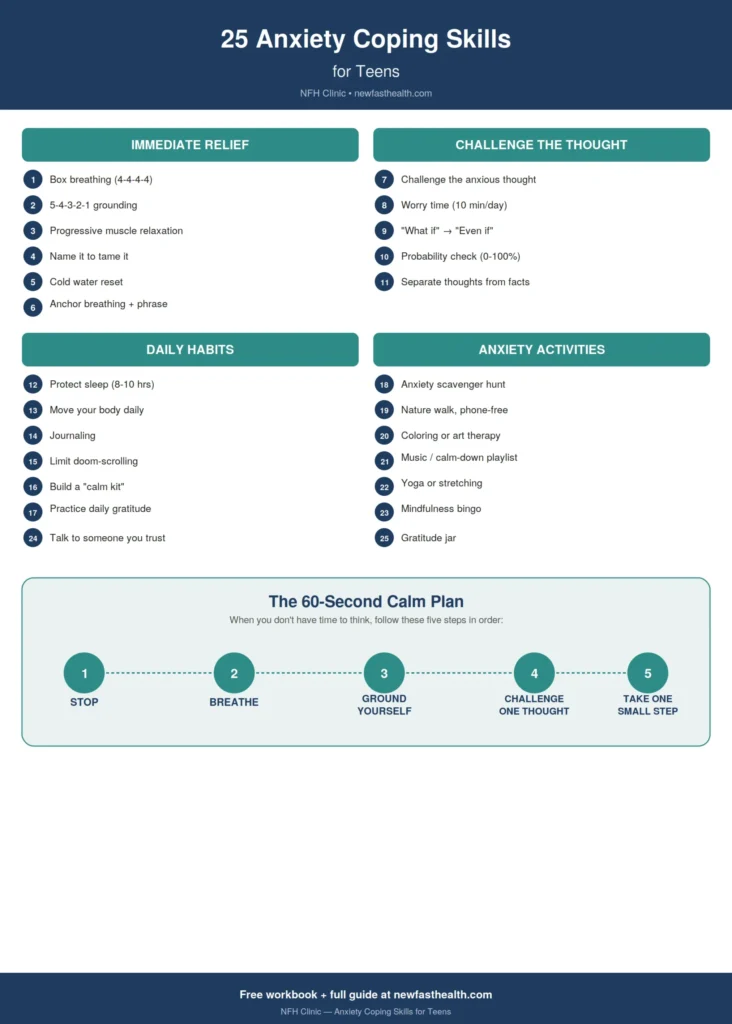
Reading about coping skills only goes so far. Practicing them is what actually changes the anxiety response. That’s why we put together a free, printable Anxiety Coping Skills Workbook for Teens, including:
- A plain-language psychoeducation page explaining anxiety, cortisol, and the fight-flight-freeze response
- A daily coping skills checklist
- A full CBT thought record worksheet (with the example above built in)
- A worry time log
- A complete panic attack action plan with space for personal contacts
- A weekly anxiety and trigger tracker with an end-of-week reflection
📥 Download the Free Anxiety Coping Skills Workbook for Teens (PDF), attached alongside this article. It’s free to print, use at home, or share with a school counselor. No sign-up required.
Anxiety Psychoeducation for Teens (PDF)
The first page of the workbook is a standalone anxiety psychoeducation page for teens: a plain-language explainer of what anxiety actually is, why the amygdala reacts the way it does, and how cortisol and adrenaline create physical symptoms. Many parents print this page separately to review with younger teens before moving into the worksheets, since understanding why the body reacts this way makes the coping skills that follow easier to buy into.
What a Good Anxiety Workbook for Teens Should Include
If you’re comparing other resources, here’s what to check for. The best anxiety workbooks and PDFs typically include:
- Trigger logs
- CBT-based thought worksheets
- Breathing practice guides
- An exposure hierarchy (like the social anxiety ladder above)
- A gratitude or reflection journal
- A mood tracker
When Teen Anxiety Needs Professional Treatment
Coping skills are powerful, but they’re not always enough on their own, and that’s okay. Consider professional teenage anxiety treatment if you notice:
- Anxiety lasting most days for several weeks or more
- School refusal or grades dropping sharply
- Physical symptoms with no medical explanation
- Panic attacks becoming more frequent
- Signs of depression alongside the anxiety
- Any mention of self-harm or hopelessness (seek help immediately in this case)
Interventions for Teens With Anxiety: Treatment Options Worth Knowing About
- Cognitive Behavioral Therapy (CBT): the most researched approach for teen anxiety, focused on identifying and reshaping thought patterns
- Acceptance and Commitment Therapy (ACT): teaches teens to accept anxious feelings without letting them dictate behavior
- Exposure Therapy: gradual, structured exposure to feared situations, similar to the ladder approach above
- Family Therapy: addresses home dynamics that may be reinforcing anxious patterns
- Dialectical Behavior Therapy (DBT): combines mindfulness with distress tolerance, emotional regulation, and interpersonal skills; often used when anxiety comes with intense emotional swings
- Medication Management: sometimes used alongside therapy for moderate to severe anxiety, under a prescriber’s supervision
- School Counseling: an accessible first step for academic or social anxiety
- Group Therapy: helps teens realize they aren’t alone, particularly useful for social anxiety
- Telehealth Therapy: a flexible, private option many teens find less intimidating than in-person sessions
At NFH Clinic, we work with teens and families to build a plan that fits their specific triggers, home life, and personality, rather than handing over a generic worksheet and calling it done.
Bottom Line
Anxiety in teens is common, but it’s not something your teen has to just live with. Small, consistent coping skills, a breathing technique here, a challenged thought there, a better bedtime routine, add up to real, lasting change. Start with one or two skills from this list this week, download the free workbook, and build from there.
If anxiety is starting to run your teen’s life rather than the other way around, you don’t have to figure it out alone. NFH Clinic is here to help your family find a path forward.
Frequently Asked Questions
What are the best anxiety coping strategies for teens?
Breathing techniques, grounding exercises, challenging anxious thoughts, regular exercise, and consistent sleep are the most effective, evidence-based starting points.
How can I help a teenager with anxiety and depression at the same time?
Validate their feelings, watch for withdrawal or hopelessness, keep communication open without pressure, and involve a mental health professional if symptoms persist beyond a few weeks.
How do I help a teenager during a panic attack?
Stay calm, stay close, and guide slow breathing rather than asking questions. Reassure them the feeling will pass: most panic attacks peak within 10–20 minutes.
Are there natural remedies for teen anxiety?
Yes. Magnesium-rich foods, calming teas like chamomile, reduced caffeine, sunlight exposure, and consistent routines can all support anxiety management alongside coping skills and, when needed, professional care.
What does social anxiety look like in teens?
Avoiding group settings, fear of being judged, physical symptoms before social events, and over-analyzing conversations afterward are common signs of social anxiety in teens.
When should teenage anxiety be professionally treated?
When anxiety disrupts school, friendships, sleep, or daily functioning for several weeks, it’s time to consult a mental health professional for a proper evaluation.
Can anxiety go away naturally, without treatment?
Mild, situational anxiety often eases with consistent coping skills and lifestyle changes. Persistent or worsening anxiety usually responds much faster with professional support.
Can teenagers outgrow anxiety?
Some teens do see anxiety ease with brain development and life experience, but many carry anxious patterns into adulthood without intervention. Learning coping skills early changes that trajectory.
Can anxiety affect grades?
Yes. Anxiety can impair concentration, memory, and test performance, and can lead to school avoidance, which compounds academic struggles.
Can anxiety make teenagers angry or irritable?
Yes. Irritability, snapping at family, or sudden anger is a common but often overlooked sign of anxiety in teens, especially boys.
Can anxiety cause physical symptoms like stomach pain or headaches?
Yes. Anxiety frequently shows up as physical symptoms, including stomachaches, headaches, muscle tension, and fatigue, because of the stress hormones released during the fight-flight-freeze response.
Can phones and social media worsen teen anxiety?
Yes. Doomscrolling, social comparison, cyberbullying, and disrupted sleep from late-night screen use are all linked to higher anxiety levels in teens.
How long does CBT for teen anxiety typically take?
Many teens see meaningful improvement within 12–16 weekly sessions, though this varies based on severity and consistency of practice between sessions.
References and Further Reading
This article reflects current, evidence-based approaches used in adolescent mental health care, including CBT, ACT, and exposure-based methods. For additional authoritative reading:
- National Institute of Mental Health: Anxiety Disorders
- National Institute of Mental Health: Child and Adolescent Mental Health
- Centers for Disease Control and Prevention: Anxiety and Depression in Children
- American Academy of Family Physicians: Anxiety Disorders in Children and Adolescents
- Anxiety and Depression Association of America: Teens and College Students
- HealthyChildren.org (American Academy of Pediatrics): Anxiety Disorders in Children
💬 If your teen is struggling with anxiety and you’re not sure where to start, NFH Clinic offers guidance, resources, and support tailored to your family’s needs. Download the free workbook above, or reach out to our team at newfasthealth.com to learn more.
Related Articles: