I get asked about shilajit almost every week at the clinic, usually by men in their 30s and 40s who read something online about it fixing their testosterone overnight. Let’s set the record straight from the start. Shilajit is not a miracle fix. But it is one of the more genuinely interesting natural compounds I’ve reviewed the research on, and there’s real clinical data behind several of its uses for men.
I’m McLee Tembo, founder of NFH Clinic. I’m an online health consultant, and most of my work involves helping men separate supplement hype from what the evidence actually supports. In this guide, I’ll walk you through what shilajit is, what the research says about its benefits for men, how to take it properly, and where the safety concerns actually lie. No fluff, no exaggerated claims, just what I’d tell a patient sitting across from me.
Quick Facts
| What it is | A mineral-rich resin that seeps from Himalayan and other mountain rock, formed over centuries from decomposed plant matter |
| Key compound | Fulvic acid, plus trace minerals (magnesium, potassium, calcium) |
| Typical dose | 250 to 500 mg daily, often split into two doses |
| Best-supported benefit | Testosterone support (90-day clinical trial) |
| Time to notice effects | 2 to 3 weeks for energy, 8 to 12 weeks for hormonal or fertility effects |
| Main safety concern | Heavy metal contamination in unpurified products |
| Who should check with a doctor first | Anyone on blood thinners or blood pressure medication, or with heart, kidney, or iron-related conditions |
Key Takeaways
- Shilajit has real, if small-scale, human trial evidence behind testosterone support and sperm quality, not just tradition
- It works gradually, over weeks, not as a fast-acting stimulant
- Product quality varies enormously, so third-party testing matters more than the brand’s marketing claims
- It supports overall health habits rather than replacing them, sleep and training still do the heavy lifting
- Anyone on regular medication, especially for blood pressure or blood thinning, should check with a doctor before starting
In this article:
- What Is Shilajit?
- Shilajit Benefits for Men: What the Research Shows
- Does Age Change What Shilajit Does For You?
- What to Expect, Week by Week
- Common Myths About Shilajit
- Shilajit Uses for Male Health: A Quick Summary
- How to Take Shilajit
- Shilajit Side Effects for Male Users
- What Shilajit Reviews for Men Actually Say
- Frequently Asked Questions About Shilajit Benefits for Men
- How Strong Is the Evidence?
- Bottom Line
What Is Shilajit?
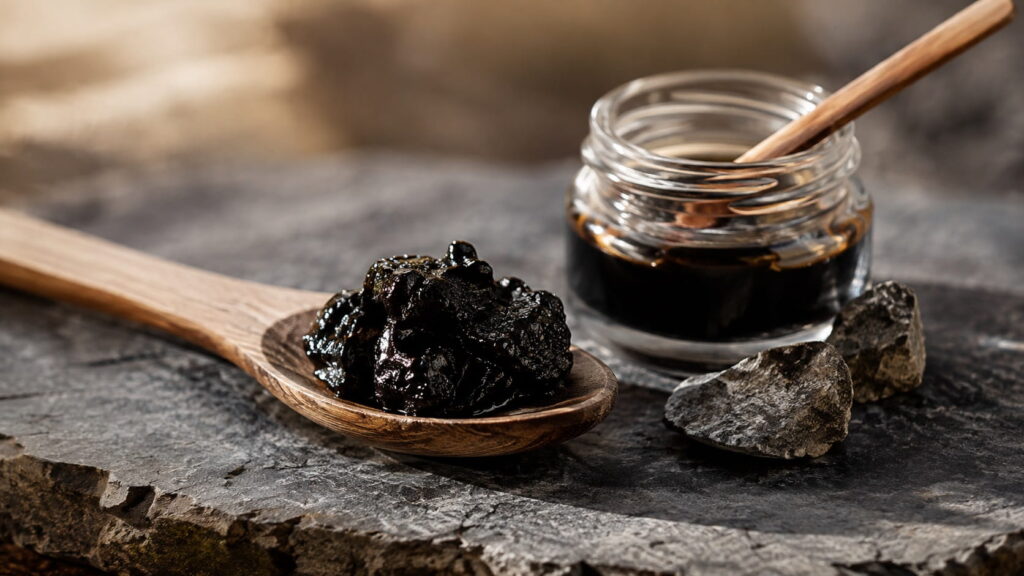
Shilajit is a thick, tar-like resin that seeps out of rock layers in high mountain ranges, most famously the Himalayas. It forms over centuries as plant matter slowly breaks down under pressure and gets compressed between rock strata. Once purified, it’s dark brown to black, sticky, and has a strong mineral smell that most people don’t love on first contact.
Its main active compound is fulvic acid, along with a wide mix of trace minerals, humic substances, and plant-derived organic compounds. Ayurvedic medicine has used it for thousands of years. Its Sanskrit name roughly translates to “conqueror of mountains and destroyer of weakness,” which tells you a lot about how it was traditionally viewed.
The important caveat here, and one I want to be upfront about, is that most human studies on shilajit are small. That doesn’t mean the findings are worthless, but it does mean you should treat the benefits below as promising rather than proven beyond doubt.
How Does Shilajit Actually Work?
There’s no single “magic ingredient” here, it’s more that fulvic acid does a few jobs at once. It acts as a carrier molecule, helping other nutrients and minerals move into cells more efficiently. It also behaves as an antioxidant, limiting the oxidative stress that can wear down cells involved in hormone production and energy metabolism. Separately, shilajit appears to support mitochondrial function, the process your cells use to generate usable energy. That’s the likely explanation for its effects on stamina and recovery. None of these mechanisms act instantly, which is part of why shilajit is a slow-build supplement rather than a same-day one.
Shilajit Benefits for Men: What the Research Shows
1. Testosterone Support
This is the benefit most men come looking for, and it’s also the one with the most direct human data behind it. In a controlled study published in Andrologia, healthy men aged 45 to 55 took 250 mg of purified shilajit twice daily for 90 days. By the end of the trial, the group taking shilajit showed a meaningfully greater rise in total and free testosterone compared with the placebo group.
That doesn’t mean shilajit will turn low testosterone into normal testosterone on its own. If you suspect you have clinically low T, get a blood test first. Shilajit works better as a support strategy than a standalone treatment for diagnosed hypogonadism.
2. Sperm Count and Fertility Support
One of the more encouraging trials looked at 60 men with low sperm counts (oligospermia) who took shilajit twice daily after meals for 90 days. Researchers recorded improvements in total sperm count in the majority of participants, along with gains in sperm motility for a smaller subset. This is one reason shilajit shows up so often in fertility-focused supplement stacks.
If fertility is your main concern, pair shilajit with a semen analysis before and after a few months of use, so you actually know whether it’s moving the needle for you specifically.
3. Effect of Shilajit on Erectile Dysfunction
This is a question I get constantly, so let’s be precise about it. There is no large clinical trial testing shilajit directly against erectile dysfunction. What we do have is indirect support. Shilajit’s effects on testosterone, circulation, and energy can influence some of the underlying factors that contribute to ED, particularly when low T or poor vascular health is part of the picture.
If ED has been a consistent issue rather than an occasional one, that’s worth a proper medical evaluation rather than a supplement-only approach. Shilajit may help around the edges, but it’s not a substitute for ruling out cardiovascular, hormonal, or psychological causes.
Does shilajit raise DHT along with testosterone? This one doesn’t have a direct study to point to. Since shilajit may raise total testosterone, and some testosterone naturally converts to DHT, it’s reasonable to assume a downstream effect, though nobody has measured it directly in a shilajit trial. If you’re prone to hair thinning or have a prostate condition, mention that to your doctor before starting.
4. Energy, Stamina, and Fatigue
Fulvic acid appears to support mitochondrial function, which is essentially your cells’ energy-production machinery. Animal research on chronic fatigue models found that shilajit pretreatment helped protect against fatigue-related mitochondrial dysfunction. Men who use it consistently often report steadier energy through the day rather than the jittery spike you get from stimulants. That lines up with how it’s traditionally been used, as a stamina-building tonic rather than a quick fix.
5. Muscle Strength and Recovery
A study on resistance-trained men found that 500 mg of shilajit daily for eight weeks was associated with better preservation of muscular strength under fatigue conditions. It also produced favorable changes in a marker linked to connective tissue turnover. It’s not a substitute for protein and progressive training, but as an adjunct for recovery, the early data is worth paying attention to.
6. Heart Health
Small human and animal studies suggest shilajit may support healthy cholesterol and triglyceride levels, partly through its antioxidant activity. It’s also been studied for protecting heart tissue in animal models exposed to cardiac stress. This is promising but still early-stage research, so it shouldn’t replace standard cardiovascular care, especially if you already have diagnosed heart disease.
7. Mental Clarity and Stress Resilience
Shilajit is often classified as an adaptogen, meaning it may help the body manage physical and mental stress more efficiently. Some of this ties back to its magnesium content, since magnesium plays a role in regulating cortisol and calming nervous system activity. Separately, researchers have looked at fulvic acid’s potential to interfere with the buildup of tau protein, a process linked to cognitive decline and, in more advanced cases, Alzheimer’s disease. This is one of shilajit’s more talked-about benefits online, but it’s important to be clear-eyed about it: the supporting research is mostly lab-based and preliminary, not proof that shilajit prevents or treats Alzheimer’s in humans.
8. Bone and Joint Strength
Shilajit’s mineral profile, including calcium, magnesium, and potassium, supports the basic building blocks of bone density. Small studies in postmenopausal populations have shown improvements in bone mineral density with regular use. Most of that research focused on women, but the underlying mineral support applies just as well to men managing joint discomfort or bone density concerns as they age.
9. Skin Health
Shilajit benefits for skin come largely from its antioxidant load. By limiting oxidative damage to skin cells, fulvic acid may help slow visible signs of aging and support the skin’s natural repair processes. This is more of a secondary benefit than a primary reason to take shilajit, but it’s a welcome side effect for men already using it for energy or testosterone support.
10. Immune Support
Shilajit’s antioxidant and mineral content gives it a reasonable case as a general immune supporter, though this is one of the least studied benefits in humans specifically. Think of it as a supporting player here rather than the headline reason to take it.
11. Altitude Sickness and Iron Levels
Two lesser-known uses round out the research, worth a mention even though neither is specific to men. Shilajit’s mineral density and antioxidant activity have been studied for easing symptoms of altitude sickness, like fatigue and low oxygen tolerance, in people traveling to high elevations. Separately, early research suggests fulvic acid may support iron absorption, which is why shilajit occasionally shows up in discussions around mild iron-deficiency fatigue. Both uses are backed by smaller or older studies, so treat them as interesting rather than settled.
Does Age Change What Shilajit Does For You?
Men in their 20s. If your testosterone is already in a healthy range, don’t expect a dramatic hormonal shift. Most of the benefit at this age shows up as steadier energy and slightly better workout recovery, not a noticeable T bump.
Men in their 30s and 40s. This is where testosterone naturally starts to decline for a lot of men, so shilajit’s support role tends to be more noticeable here, alongside stamina and stress resilience.
Men 50 and older. Bone density, cardiovascular support, and mental clarity tend to matter more at this stage, and shilajit’s mineral profile is arguably more relevant here than the testosterone angle alone. It’s also more important to check with a doctor first at this age, since the odds of being on blood pressure medication or blood thinners go up.
What to Expect, Week by Week
| Timeframe | What You May Notice |
|---|---|
| Week 1 | Usually little to nothing yet |
| Week 2 to 3 | Modest lift in daily energy for some men |
| Week 4 to 6 | Better workout stamina and recovery |
| Week 8 to 12 | Testosterone, libido, and fertility-related changes, if they’re going to happen |
Everyone’s timeline differs, and skipping a day here or there won’t undo your progress. Shilajit works through consistent daily use, not like a stimulant you feel within the hour.
Common Myths About Shilajit
“It boosts testosterone instantly.” No supplement does this legitimately. The clinical data behind shilajit’s testosterone effect comes from 90 days of consistent use, not a single dose.
“More is better.” Higher doses haven’t been shown to work faster or better, and they raise your odds of stomach upset or other side effects. Stick to the studied range.
“Raw resin is always superior to purified products.” Raw, unprocessed shilajit is actually the riskier option, since it hasn’t been screened for heavy metals or contaminants. Purification is a safety step, not a quality downgrade.
“It cures erectile dysfunction.” It doesn’t. At best, it may support some of the underlying factors involved.
“Natural means risk-free.” Shilajit can interact with medications and isn’t appropriate for everyone. Natural doesn’t mean unregulated risk disappears.
Shilajit Uses for Male Health: A Quick Summary
If you’re weighing where shilajit fits into your routine, here’s how most men actually use it:
- As a testosterone and libido support alongside training and diet
- To support fertility and sperm quality while trying to conceive
- As a daily energy and stamina aid, particularly for physically demanding jobs or training
- Post-workout, to support muscle recovery
- As a general wellness and stress-resilience supplement for men over 40
How to Take Shilajit
Shilajit comes in a few main forms, and the right one depends on your tolerance for its taste and how precise you want your dosing to be.
Resin. Considered the purest and most traditional form. You pinch off a pea-sized amount (roughly 300 to 500 mg) and dissolve it in warm water or milk. The taste is strong and earthy, and most first-timers need a few tries to get used to it.
Powder. A processed form of the resin, easier to measure and mix, with a milder taste. Works well stirred into warm milk or a smoothie.
Capsules. The most convenient option and the best choice if the taste is a dealbreaker. Shilajit capsule benefits come down to consistency: each capsule delivers a fixed dose, which makes it easier to track intake accurately, though you lose a bit of the absorption advantage that comes from taking it dissolved in liquid.
Shilajit Gold. You’ll see this labeled on a lot of premium products. “Gold” generally refers to a higher-grade, more heavily purified resin with a denser mineral and fulvic acid concentration, not a different compound. Shilajit Gold benefits for male users are essentially the same as standard purified shilajit, just at a potentially higher potency per gram, so start on the lower end of the dosing range if you’re using a gold-grade product.
Best Time to Take It
- Morning, on an empty stomach: the most common approach for energy and focus
- 30 minutes before training: favored by men using it for stamina and recovery
- Before meals: some practitioners prefer this for better absorption
Dosage by Goal
| Goal | Typical Daily Dose | Duration |
|---|---|---|
| General wellness | 300 to 500 mg, once daily | Ongoing, with periodic breaks |
| Testosterone support | 250 mg, twice daily | 8 to 12 weeks minimum |
| Fertility support | 200 to 250 mg, twice daily, after meals | 90 days, reassessed with testing |
| Muscle recovery | 500 mg, once daily | 8 weeks, aligned with training block |
Start at the lower end of any range for your first two weeks. This helps you spot any digestive or allergic reaction early, before you’re committed to a full dose.
On cycling. There’s no strong clinical requirement to cycle shilajit, but a common, sensible approach is 8 to 12 weeks on followed by 2 to 4 weeks off. This isn’t because shilajit stops working otherwise. It’s more a precaution to avoid your body adapting to it, and it gives you a natural checkpoint to reassess whether it’s actually doing anything for you.
Shilajit Side Effects for Male Users
This is the section most blogs on this topic rush through, and it’s the one I think matters most. Shilajit is generally well tolerated when it’s properly purified, but “generally well tolerated” isn’t the same as “risk-free.”
Shilajit benefits for men side effects to watch for include:
- Mild digestive upset, nausea, or loose stools, especially at higher starting doses
- Headache or dizziness in sensitive individuals
- Allergic reactions, including rash or itching, particularly with your first exposure
- A drop in blood pressure, which matters if you’re already on blood pressure medication
- Rare reports of a serious condition called pseudohyperaldosteronism, which can raise blood pressure and lower potassium levels
The biggest risk isn’t shilajit itself. It’s contamination. Raw, unpurified shilajit may contain heavy metals such as lead, arsenic, mercury, cadmium, and thallium, along with fungal contaminants, since supplements aren’t FDA-regulated the way medications are.
Here’s the part most articles skip: purification doesn’t automatically fix this. A 2025 study reviewed by Cleveland Clinic found that some purified, commercially sold shilajit products actually contained higher levels of thallium, a toxic heavy metal, than raw shilajit did. In other words, “purified” on a label isn’t a guarantee on its own. Third-party lab testing is what actually confirms it.
How to Choose a High-Quality Shilajit
Before you buy, check the label and the brand’s website for:
- Third-party lab testing for heavy metals
- A certificate of analysis (COA) you can actually view
- Fulvic acid content listed as a percentage, generally 50 percent or higher for resin
- GMP-certified manufacturing
- A clear country of origin
If a seller can’t show you a COA, skip it, regardless of how good the reviews look.
Who should avoid shilajit or check with a doctor first:
- Men with hemochromatosis or other iron-overload conditions
- Anyone on blood pressure medication or blood thinners
- Men with existing heart disease
- Anyone with an autoimmune condition, since its immune-modulating effects aren’t fully understood
- Men trying to conceive who are also managing a chronic kidney or liver condition
What Shilajit Reviews for Men Actually Say
Looking across patient feedback and product reviews, a pattern shows up consistently. Men report the clearest benefits around energy and stamina within the first two to three weeks. Testosterone-related and fertility-related benefits tend to take longer, usually eight weeks or more, before they’re noticeable. Taste is the single most common complaint, which is why capsules have become the preferred format for a lot of first-time users.
Take individual reviews with a grain of salt either way. Supplement quality varies enormously between brands, and a bad experience is just as likely to reflect a poorly purified product as it is to reflect shilajit itself not working.
Frequently Asked Questions About Shilajit Benefits for Men
Does shilajit increase testosterone?
Clinical research on middle-aged men found a measurable increase in testosterone after 90 days of consistent use. It’s a support strategy, not a replacement for medical treatment if you have diagnosed low T.
Can shilajit help with erectile dysfunction?
There’s no direct clinical trial on shilajit and ED specifically, but its effects on testosterone and circulation may help indirectly. Persistent ED deserves a full medical workup first.
How long does it take shilajit to work?
Energy-related benefits are often noticeable within two to three weeks. Testosterone, fertility, and recovery benefits generally need eight to twelve weeks of consistent use before you can fairly judge them.
Is shilajit safe to take every day?
For most healthy men, yes, when the product is properly purified and third-party tested. I’d still follow the cycling approach above, roughly 8 to 12 weeks on and 2 to 4 weeks off, to avoid building tolerance and let your body reset.
What’s the difference between shilajit resin, powder, and capsules?
They’re the same core compound in different formats. Resin is the most traditional and potent per gram, powder is easier to dose and mix, and capsules are the most convenient but slightly less flexible for dose adjustment.
Does shilajit interact with medications?
It can interact with blood pressure medication and blood thinners in particular. Check with your doctor if you’re on either before starting.
Is shilajit vegan-friendly?
Yes. It’s a mineral-rich, plant and rock-derived resin, with no animal products involved.
Can women take a shilajit product marketed for men?
Chemically, yes; “men’s” shilajit is usually just standard purified shilajit with men’s-health marketing on the label, not a different formula. That said, shilajit affects hormone levels, so women, especially those who are pregnant, breastfeeding, or managing a hormone-sensitive condition, should check with a doctor before using it.
How Strong Is the Evidence?
Here’s a quick honest breakdown, so you can weigh the marketing against what’s actually been studied in humans.
| Benefit | Human Evidence |
|---|---|
| Testosterone | Moderate |
| Fertility and sperm quality | Moderate |
| Energy and stamina | Limited |
| Muscle recovery | Limited |
| Erectile dysfunction | Indirect only |
| Heart health | Preliminary |
| Skin | Preliminary |
| Bone density | Preliminary (mostly studied in women) |
| Altitude sickness | Preliminary |
| Iron absorption | Preliminary |
“Moderate” here means small but real controlled trials in humans. “Preliminary” means mostly animal studies, lab research, or a single small human trial. None of it rises to the level of large-scale, long-term proof, which is normal for a supplement this under-studied.
Bottom Line
Shilajit has more legitimate research behind it than most trending men’s health supplements, particularly around testosterone support, fertility, and physical stamina. That said, the studies are still small and the supplement industry around it is loosely regulated, so where you buy it matters just as much as whether you take it.
It’s also worth saying plainly: sleep, resistance training, a healthy weight, and solid nutrition still do more for your testosterone and energy than any supplement, shilajit included. Think of it as support for those fundamentals, not a replacement for them.
My advice to every patient who asks me about shilajit is the same. Choose a purified, third-party tested product. Start low, and give it at least eight weeks before judging the results. Loop in your doctor if you’re on any regular medication or managing a chronic condition. Used that way, it’s a reasonable addition to a broader health routine, not a shortcut around one.
This article is for informational purposes and isn’t a substitute for personalized medical advice.
Related Articles: