
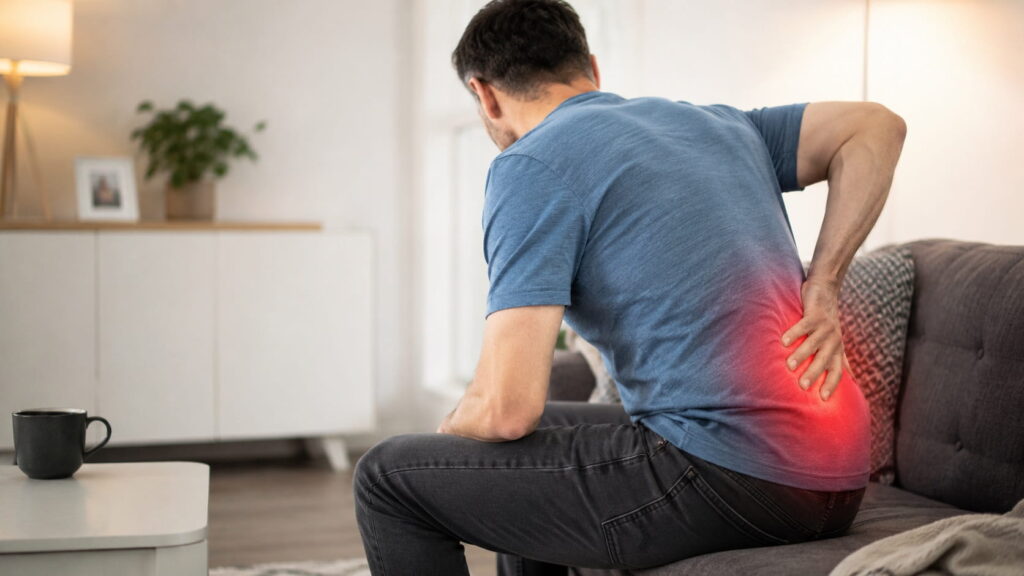
If you’ve ever had sciatica, you already know the drill. One minute you’re fine. The next, a bolt of pain shoots from your lower back down your leg, and suddenly standing up from a chair feels like a small negotiation with your own body.
I’m Dr. McLee Tembo, founder of NFH Clinic, and sciatic nerve pain is one of the most common complaints I see walk through our doors. The good news? Most people don’t need surgery. Most people don’t even need months of treatment. With the right approach, sciatica pain relief is very achievable — often faster than patients expect.
This guide covers everything: what’s actually causing your pain, how to relieve sciatica pain immediately, what to do if you can’t exercise, which medicines actually help, and how to stop sciatica from coming back for good.
Quick Answer: How to Relieve Sciatic Nerve Pain
- Change position first — lying with a pillow under or between your knees often eases pressure fastest
- Use cold for the first 48 hours, then switch to heat
- A gentle knee-to-chest stretch, held for 30 seconds, can calm irritation in the moment
- Stay as active as your pain allows — bed rest slows recovery
- NSAIDs help with mild to moderate flare-ups; see a doctor if pain lasts beyond 2–3 weeks
- Seek emergency care immediately for numbness in the groin, or loss of bladder or bowel control
In this article:
- What Is Sciatica?
- Sciatic Nerve Pain Symptoms to Watch For
- What Causes Sciatic Nerve Pain?
- What Makes Sciatica Worse — and What Actually Helps
- How to Relieve Sciatic Nerve Pain Immediately at Home
- How to Relieve Sciatic Nerve Pain Without Exercise
- Best Medicine for Sciatica Pain
- Best Sciatica Relief Exercises and Stretches
- What to Expect: A Rough Recovery Timeline
- How to Cure Sciatica Permanently
- Medical Treatments for Sciatica
- When to See a Doctor
- Emergency Symptoms — Seek Urgent Care Immediately
- How to Prevent Sciatica From Coming Back
- Myth vs. Fact
- Frequently Asked Questions About Sciatic Nerve Pain
- Final Thoughts from NFH Clinic
What Is Sciatica?
Sciatica isn’t a disease on its own — it’s what happens when your sciatic nerve, the longest and thickest nerve in your body, gets irritated or compressed. This nerve starts in your lower spine, runs through your hip and buttock, and travels all the way down the back of each leg.
When something presses on it — a bulging disc, a tight muscle, or a narrowed spinal canal — you feel it. Not just as back pain, but as a burning, shooting, or electric sensation that can reach your calf or even your foot.
Here’s a quick way to tell the difference: if the pain stays confined to your lower back, it’s probably not sciatica. True sciatic pain travels. That’s the giveaway.
Why does the pain travel down your leg?
The sciatic nerve is really a bundle of nerve roots that exit your lower spine and merge into one thick nerve running down each leg. When one of those roots gets compressed near the spine, the irritation signal travels the entire length of the nerve it belongs to — which is why a problem in your lower back can show up as pain, tingling, or numbness all the way down in your calf or foot. Your brain reads the irritation as coming from wherever that nerve territory runs, not just from the spot where the compression is actually happening.
Sciatic Nerve Pain Symptoms to Watch For
Sciatica almost always shows up on one side of the body. Common signs include:
- A sharp or shooting pain that runs down one leg
- Burning or electric-shock sensations in the buttock or thigh
- Tingling, or “pins and needles,” down the leg
- Numbness in the leg, calf, or foot
- Weakness when trying to lift your foot or stand on your toes
- Pain that flares up when you cough, sneeze, or sit for too long
If any of this sounds familiar, you’re not alone — and you’re in the right place.
How Bad Is It? A Quick Severity Guide
Not every flare-up needs the same response. Use this as a rough guide for what to do next:
| Pain Level | What It Feels Like | What To Do |
|---|---|---|
| Mild | Dull ache, comes and goes | Walking, heat, posture correction |
| Moderate | Noticeable pain, limits some activity | NSAIDs, gentle stretching, activity modification |
| Severe | Pain that stops you doing daily tasks | Book a medical assessment |
| Weakness | Leg or foot feels weak, foot drop | Urgent evaluation needed |
| Bladder/bowel changes | Loss of control, groin numbness | Emergency care — go now |
This isn’t a diagnosis — it’s a starting point to help you judge how urgently you need professional care.
What Causes Sciatic Nerve Pain?
Understanding the cause matters, because it shapes how you treat it. The most frequent triggers I see in clinic are:
1. Herniated or Slipped Disc The cushioning disc between your spinal bones bulges outward and presses on a nearby nerve root. This is the single most common cause of sciatica.
2. Spinal Stenosis A gradual narrowing of the spinal canal, usually linked to age-related wear, that squeezes the nerve roots.
3. Piriformis Syndrome A small muscle deep in your buttock tightens or spasms and irritates the sciatic nerve running beneath — or in some people, through — it.
4. Spondylolisthesis One vertebra slips forward over the one below it, narrowing the space nerves pass through.
5. Injury, Poor Lifting, or Prolonged Sitting Falls, awkward lifting, and long stretches at a desk can all trigger or worsen sciatic irritation.
What Makes Sciatica Worse — and What Actually Helps
Once you know your triggers, you can start avoiding them. In clinic, these are the patterns I see flare pain up again and again:
Tends to make it worse:
- Sitting for long, unbroken stretches
- Sudden twisting movements
- Heavy lifting with a rounded back
- Soft, low couches that curl your spine
- Long car rides without breaks
- Sleeping on your stomach
- Slouched posture at a desk
Tends to make it better:
- Regular walking, even in short bursts
- Getting up and moving every 30–45 minutes
- Good, consistent sleep
- Core and lower-back strengthening
- Gradual weight loss, if carrying extra weight
- Correct lifting mechanics — bend at the knees, not the back
- Maintaining upright, supported posture
How to Relieve Sciatic Nerve Pain Immediately at Home
When sciatica flares, you want relief now — not in six weeks. While no single trick works instantly for everyone, these steps genuinely calm irritated nerve tissue fast and are the closest thing to immediate relief for sciatica pain that doesn’t involve a prescription.
1. Change Your Position First
Often the fastest fix is simply shifting how you’re sitting or lying. Try lying on your back with a pillow under your knees, or on your side with a pillow between your knees. This takes pressure off the nerve root almost instantly for many people.
2. Apply Cold, Then Heat
In the first 48 hours of a flare-up, use a cold pack on the painful area for up to 20 minutes at a time. After the first two days, switch to heat — a heating pad or warm towel relaxes the muscles gripping around the nerve. Alternating between the two often works better than either alone.
3. Try the “30-Second Reset” Stretch
Lie on your back, gently pull one knee toward your opposite shoulder, and hold for about 30 seconds. This single movement — sometimes shared online as a way to relieve sciatica pain in 30 seconds — won’t cure sciatica, but it can noticeably ease pressure on the nerve in the moment. Repeat two or three times on the affected side.
4. Take the Pressure Off Your Spine
Standing up, walking a short distance, or leaning gently backward can decompress the lower spine. If sitting triggered the flare, don’t just switch positions — actually stand and move for a minute or two.
5. Use an Anti-Inflammatory
A short course of an over-the-counter NSAID, taken as directed, can begin easing inflammation around the compressed nerve within a few hours for many people, though response varies from person to person.
None of these replace a proper diagnosis if your pain is severe or persistent — but used together, they’re the best combination for fast, at-home sciatica relief.
A word on bed rest: resting for a day when pain first hits is fine, but staying down much longer works against you. Muscles supporting your spine weaken quickly with inactivity, joints stiffen, and blood flow to the injured area drops — all of which can actually slow healing rather than speed it up. Move as soon as you reasonably can.
How to Relieve Sciatic Nerve Pain Without Exercise
Not everyone can — or should — jump straight into stretching when sciatica is at its worst. If movement feels impossible right now, here’s how to ease sciatic nerve pain without exercise:
- Positional relief: As above, side-lying with a pillow between the knees, or back-lying with knees elevated, reduces nerve tension passively.
- Heat therapy: A heating pad relaxes the surrounding muscles without requiring any movement from you.
- TENS therapy: A transcutaneous electrical nerve stimulation unit sends gentle pulses that can interrupt pain signals, and many patients use one at home under guidance.
- Massage: Having someone else work on the tight muscles around your lower back and glutes can relieve pressure on the nerve without you doing any of the work.
- Medication: NSAIDs, muscle relaxants, or short-term nerve pain medication (discussed below) can bring meaningful relief while your body settles.
- Posture correction while seated: Using lumbar support and keeping your feet flat shifts weight off the compressed nerve root even while you’re sitting still.
Once the sharpest pain has eased, gentle movement becomes your best long-term ally — but there’s no shame in starting passive first.
Best Medicine for Sciatica Pain
Patients often ask me directly: what’s the best medicine for sciatica pain relief? The honest answer is that it depends on severity, but here’s how doctors typically approach it:
- NSAIDs (ibuprofen, naproxen) — first-line for mild to moderate flare-ups
- Muscle relaxants — helpful when muscle spasm is adding to nerve compression
- Short-term nerve pain medication — used for persistent burning or shooting pain that doesn’t respond to standard anti-inflammatories
- Topical anti-inflammatory gels — useful as an add-on, especially for localized tenderness
- Corticosteroids or epidural steroid injections — reserved for more severe or stubborn cases, and only under medical supervision
Paracetamol alone rarely does much for true nerve pain — it’s worth knowing that before you rely on it. Always talk to a healthcare professional before combining medications or using anything beyond short-term.
Best Sciatica Relief Exercises and Stretches
Once you’re past the acute, can’t-move stage, movement becomes one of the most effective sciatica treatments available — more effective, honestly, than most people expect.
Why movement matters: Staying in bed for days weakens the muscles supporting your spine and can actually prolong recovery. Controlled movement keeps blood flowing to the area and prevents stiffness from compounding the problem.
Stretches and exercises worth building into your routine:
- Knee-to-chest stretch — lie on your back, pull one knee toward your chest, hold 30 seconds
- Piriformis stretch — cross the affected ankle over the opposite knee while seated, lean forward gently
- Seated spinal twist — opens space around the compressed nerve root
- Standing hamstring stretch — reduces tension pulling on the lower back
- Cat-cow stretch — mobilizes the spine gently through flexion and extension
- Walking — 15–20 minutes daily at a comfortable pace is one of the simplest, most underrated sciatica treatments
Hold each stretch for 20–30 seconds without bouncing or forcing it. If a stretch sharpens your pain rather than easing it, stop — that’s your body telling you something.
When walking makes things worse: for most people, walking helps. But if you have significant spinal stenosis, a large disc herniation, or your pain is still in the acute, highly inflamed stage, walking can occasionally aggravate symptoms rather than ease them. If a short walk consistently leaves you worse afterward rather than better, that’s a sign to scale back and get assessed rather than push through.
What to Expect: A Rough Recovery Timeline
Everyone heals at a different pace, but here’s a general shape recovery tends to follow:
- First 24 hours: Pain is often at its sharpest. Focus on positioning, cold therapy, and gentle movement.
- Days 2–7: Switch to heat, begin light stretching, and stay as mobile as comfort allows.
- Weeks 2–4: Most people notice a steady, if uneven, improvement. Gentle exercise becomes more tolerable.
- Weeks 4–8: Pain continues easing for most people; this is when strengthening work becomes valuable.
- Beyond 8 weeks: If pain hasn’t meaningfully improved by now, it’s time for a proper medical evaluation rather than continuing to wait it out.
This is a general pattern, not a guarantee — some people recover faster, some slower, and that’s normal.
How to Cure Sciatica Permanently
“Permanently” is a word I use carefully, because sciatica can return if the underlying cause isn’t addressed. But most people can get to a place where it rarely — if ever — flares again, by combining:
- Core and back strengthening — a strong core takes pressure off the spinal discs and nerve roots
- Correcting how you sit, stand, and lift — poor mechanics are often the real reason sciatica keeps returning
- Maintaining a healthy weight — extra weight around the midsection increases load on the lower spine
- Treating the root cause — whether that’s a disc issue, spinal stenosis, or piriformis tightness, targeted treatment (physiotherapy, manual therapy, or in rare cases surgery) resolves the trigger rather than just the symptom
- Staying consistently active — sciatica tends to return in people who go back to long sitting hours and no movement the moment pain fades
Think of it less as a single fix and more as closing the door the pain keeps walking back through.
Medical Treatments for Sciatica
If home care and self-management aren’t cutting it after a few weeks, it’s time to bring in professional treatment. At NFH Clinic, depending on what’s driving your sciatica, we may recommend:
Physiotherapy — targeted strengthening and posture correction to address the mechanical cause, not just the pain.
Manual Therapy — hands-on mobilization techniques that reduce pressure on the nerve root.
Epidural Steroid Injections — for more severe inflammation that isn’t responding to conservative care.
Nerve Pain Medication — for ongoing nerve irritation that needs more targeted management than NSAIDs provide.
Surgery — genuinely a last resort, used only when there’s significant weakness, loss of bladder or bowel control, or pain that simply won’t respond to anything else. In our experience, the large majority of sciatica cases never reach this point.
When to See a Doctor
Most sciatica improves with self-care within 6–12 weeks. But you shouldn’t wait that long if your pain:
- Lasts more than two to three weeks without improving
- Is getting progressively worse
- Disrupts your sleep
- Stops you from walking, working, or doing normal daily tasks
Catching it early genuinely does change the outcome — it lowers the risk of the nerve irritation becoming a longer-term problem.
Emergency Symptoms — Seek Urgent Care Immediately
Rarely, sciatica symptoms signal something more serious: cauda equina syndrome, a medical emergency that needs immediate attention. Go to the emergency room if you experience:
- Numbness around your groin, genitals, or buttocks
- Sudden loss of bladder or bowel control
- Severe, rapidly worsening weakness in both legs
These are not “wait and see” symptoms. Get to urgent care right away.
How to Prevent Sciatica From Coming Back
Prevention is where long-term relief actually lives. A few habits make a real difference:
- Exercise regularly, focusing on core and back strength
- Lift heavy objects with your knees, not your back
- Maintain a healthy body weight
- Avoid sitting for long, unbroken stretches — get up every 30–45 minutes
- Quit smoking, which accelerates spinal disc degeneration
- Keep your posture in check, especially at a desk
Sitting Smart: Small Changes That Add Up
Since most of us sit for hours a day, small adjustments here make an outsized difference:
- Set your chair so your feet sit flat on the floor and your knees stay level with your hips
- Use lumbar support — a rolled towel works if you don’t have a proper cushion
- Position your monitor at eye level so you’re not leaning forward
- Skip the back-pocket wallet while sitting or driving — it tilts your pelvis unevenly
- Avoid crossing your legs for long periods
- On long drives, stop every hour to stand and stretch
Myth vs. Fact
Myth: Complete bed rest cures sciatica. Fact: Gentle, consistent movement supports recovery far better than staying still.
Myth: Everyone with sciatica eventually needs surgery. Fact: The large majority of cases improve with conservative care alone.
Myth: Worse pain means worse nerve damage. Fact: Pain intensity doesn’t reliably reflect how serious the underlying issue is — some significant nerve compression causes only mild discomfort, and vice versa.
Frequently Asked Questions About Sciatic Nerve Pain
What is the fastest way to relieve sciatic nerve pain?
Changing position, applying cold or heat, and a gentle knee-to-chest stretch tend to bring the quickest relief. Avoid prolonged bed rest — it usually slows recovery rather than helping it.
How do I stop sciatica pain immediately?
There’s no true instant cure, but shifting position, decompressing the spine by standing and walking briefly, and using an anti-inflammatory can noticeably ease pain within minutes to an hour.
How do I know if it’s sciatica or just back pain?
Sciatica travels — it radiates from your lower back into your buttock and down one leg. If the pain stays only in your back, it’s less likely to be sciatica.
How long does sciatic nerve pain take to heal?
Most cases resolve within 6 to 12 weeks with proper self-care, movement, and posture correction.
Is walking good for sciatica?
Yes. Gentle walking improves blood flow, reduces stiffness, and generally supports faster recovery than staying sedentary.
Can sciatica go away on its own?
Often, yes — especially with consistent movement and the right early treatment. Many people never need injections or surgery.
What’s the best sleeping position for sciatica?
Side-sleeping with a pillow between your knees, or back-sleeping with a pillow under your knees, both reduce pressure on the nerve.
Is sciatica permanent?
No, not usually. It can recur, but with the right lifestyle changes and treatment, most people manage it long-term without it becoming a chronic issue.
Does sitting make sciatica worse?
Yes — prolonged sitting increases pressure on the sciatic nerve. Take a movement break every 30–45 minutes.
Can physiotherapy cure sciatica?
Physiotherapy is one of the most effective tools available. It strengthens the muscles supporting your spine, corrects posture, and reduces the nerve compression causing your pain.
Why is sciatica worse at night?
Lying still for hours removes the natural movement that keeps pressure off the nerve during the day, and your body’s awareness of pain often increases when other distractions fall away. A supportive sleep position (see above) usually helps.
Can sciatica cause knee pain?
Yes. Because the sciatic nerve runs behind the knee on its way down the leg, irritation higher up can sometimes be felt as pain, tingling, or aching around the knee itself.
Can sciatica affect both legs?
It’s uncommon — sciatica is typically one-sided. Pain in both legs, especially with numbness or weakness, is worth getting checked promptly, as it can occasionally point to a more significant spinal issue.
Is massage good for sciatica?
Often, yes. Massage can loosen the tight muscles around the lower back, hips, and glutes that contribute to nerve compression, particularly when piriformis tightness is part of the picture. It works best alongside movement and posture correction, not as a stand-alone fix.
Does losing weight help sciatica?
Yes, particularly if extra weight is centered around your midsection — it increases the load on your lower spine and the discs that can compress the nerve. Gradual, sustainable weight loss reduces that pressure over time.
Final Thoughts from NFH Clinic
Sciatica can feel frightening when it first hits — the pain is intense, and it’s disruptive to nearly everything you do. But in my years treating patients at NFH Clinic, I can tell you this with confidence: the vast majority of sciatica cases improve without surgery, often faster than people expect, once they get the right combination of movement, posture correction, and targeted care.
Don’t ignore leg pain that lingers. The earlier you address it, the faster — and more completely — you recover.
If your sciatica pain isn’t improving with home care, book a consultation with NFH Clinic and let’s build a recovery plan that actually works for you.
Related Articles: